Why Sample Cleanup Matters in Proteomics
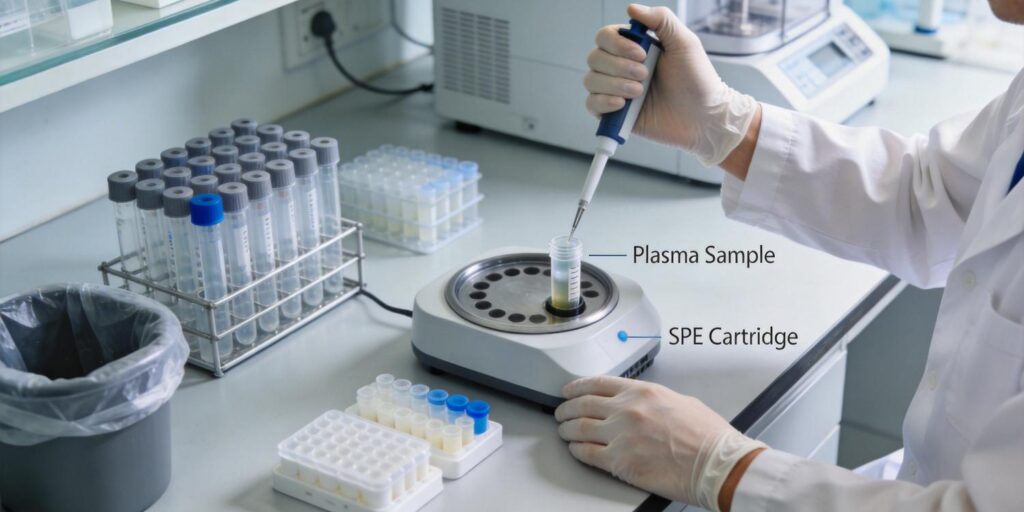
In bottom-up proteomics, the quality of your mass spectrometry data is directly tied to the cleanliness of your peptide samples. After protein digestion, the sample contains not only peptides but also salts, detergents (e.g., SDS or urea), chaotropes, and other contaminants that can severely suppress ionization, cause adduct formation, and foul the LC column. Solid-phase extraction (SPE) is the gold standard for removing these interferences, offering a fast, reproducible, and scalable cleanup method that dramatically improves peptide detection and quantification.
Removing Salts and Detergents Before MS
Common contaminants like sodium chloride, phosphate buffers, and SDS must be eliminated before LC-MS/MS analysis. Salts cause ion suppression and reduce sensitivity, while detergents can co-elute with peptides and create high background noise. SPE cartridges with reversed-phase or mixed-mode chemistries efficiently retain peptides while washing away polar contaminants and hydrophobic detergents. For example, a simple C18 SPE desalting step can remove up to 99% of salts and urea, yielding a clean peptide mixture ideal for downstream analysis.
Choosing the Right SPE Sorbent for Peptide Enrichment
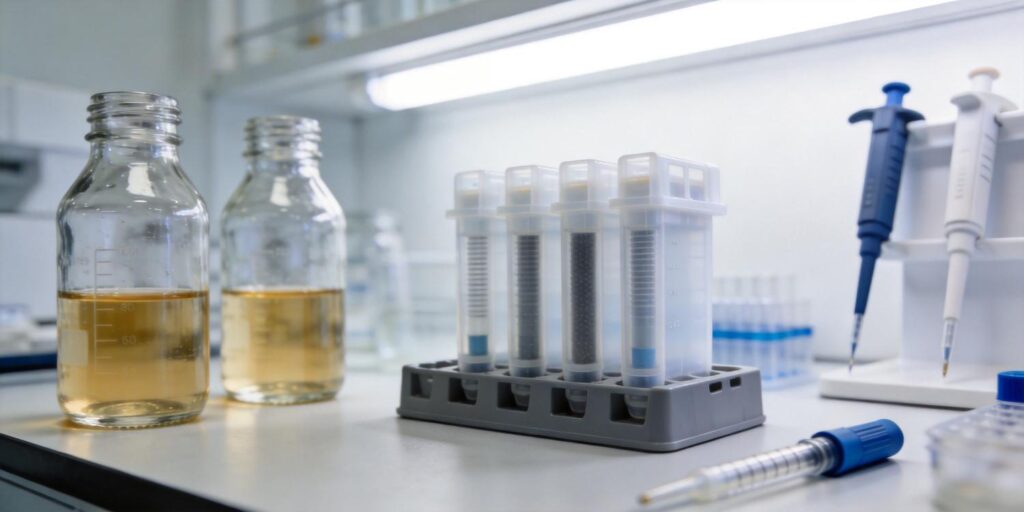
Peptide enrichment typically employs reversed-phase (C18, C8), ion-exchange (SCX, SAX), or mixed-mode sorbents. C18 is the most popular choice for general desalting, as it retains peptides via hydrophobic interactions while allowing salts and polar compounds to flow through. For more selective enrichment—such as phosphopeptides or glycopeptides—mixed-mode sorbents like HLB (hydrophilic-lipophilic balanced) or MAX (mixed-mode anion exchange) provide superior specificity. Our HLB SPE cartridges are particularly effective for complex proteomics samples, offering high recovery across a wide pH range.
Conditioning the SPE Cartridge for Optimal Binding
Proper conditioning is critical for reproducible peptide binding. For reversed-phase sorbents, the cartridge is first wet with an organic solvent (e.g., methanol or acetonitrile) to solvate the hydrophobic chains, then equilibrated with an aqueous solution (typically 0.1% TFA or formic acid) at a pH that promotes protonation of peptide carboxyl groups. This step ensures that active binding sites are available and that the sorbent surface is uniformly hydrated. Skipping or rushing conditioning often leads to poor recovery and batch-to-batch variability.
Loading Digested Protein Samples
After digestion, the peptide mixture is acidified (pH < 3) with TFA or formic acid to enhance retention on reversed-phase sorbents. The sample is loaded at a slow, controlled flow rate—gravity flow or low vacuum—to maximize contact time and binding efficiency. Overloading the cartridge can cause breakthrough, while too fast a flow reduces peptide binding. For high-concentration samples, diluting the digest in 0.1% TFA improves loading efficiency and prevents clogging.
Washing to Remove Contaminants
A washing step with a low percentage of organic solvent (e.g., 5% methanol or acetonitrile in 0.1% TFA) removes residual salts, urea, and non-retained interferences without eluting peptides. For samples with high detergent content, a more aggressive wash with 10–20% organic solvent may be needed, but care must be taken to avoid premature peptide loss. The use of our WAX SPE cartridges can aid in removing anionic detergents while retaining peptides through weak anion exchange interactions.
Elution of Purified Peptides
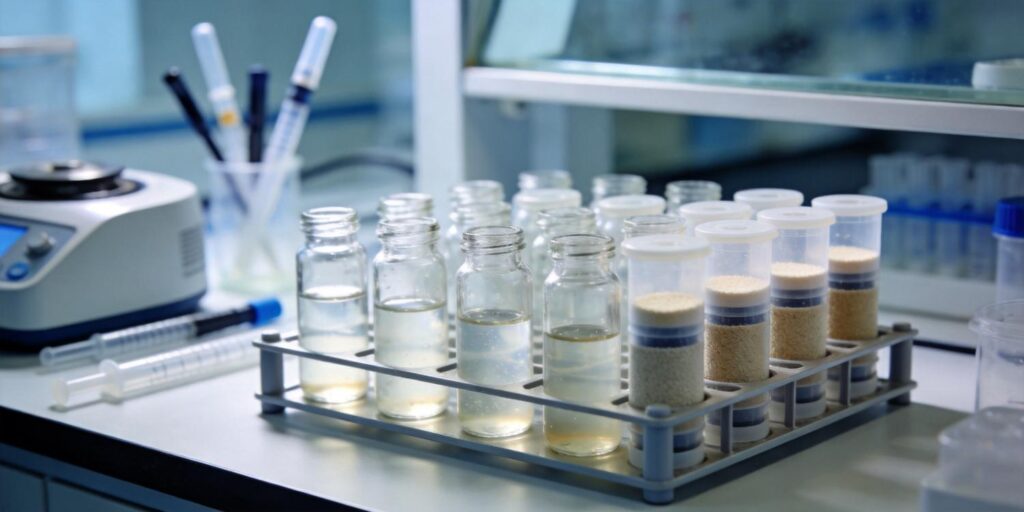
Peptides are eluted with a high-percentage organic solvent (typically 50–80% acetonitrile in 0.1% TFA or formic acid). The elution volume should be kept small (e.g., 200–500 µL for a 1 mL cartridge) to concentrate the sample. After collection, the eluate is dried down in a vacuum concentrator and reconstituted in a suitable buffer for LC-MS/MS. For maximum recovery, a two-step elution (e.g., 40% then 80% ACN) can be employed, especially for hydrophobic or modified peptides.
Integration with LC-MS/MS Proteomics Workflows
Once purified, the peptide sample is ready for high-resolution LC-MS/MS analysis. The SPE-cleaned peptides show improved signal-to-noise ratios, fewer missed cleavages, and more consistent retention times. Integrating SPE as a routine step before LC-MS/MS not only enhances data quality but also extends column life and reduces instrument downtime. For high-throughput applications, our 96-well SPE plates allow parallel processing of multiple samples, accelerating biomarker discovery and large-scale proteomic studies.
By selecting the appropriate SPE sorbent and following a rigorous conditioning–load–wash–elute protocol, researchers can achieve robust, reproducible peptide cleanup that forms the backbone of successful proteomics. As the field moves toward deeper proteome coverage and single-cell analysis, SPE remains an indispensable tool for every proteomics laboratory.