Homogenization of Fish Tissue Samples
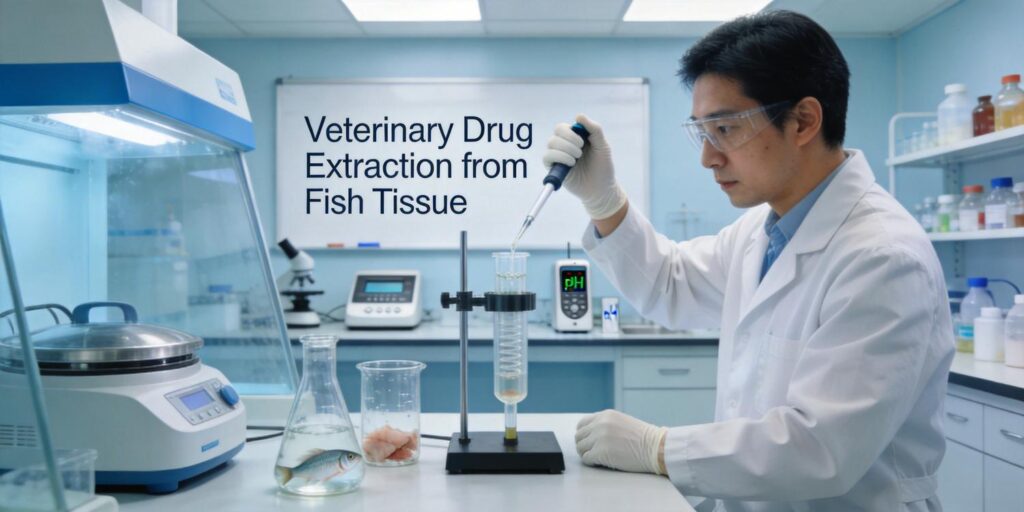
The first critical step in extracting veterinary drug residues from fish tissue involves proper sample homogenization. As noted in the literature, tissue samples like fish muscle require liquefaction or solubilization of analytes from the solid matrix. A typical approach involves homogenizing the fish tissue in a slurrying buffer such as metaphosphoric acid/methanol (3:2 v/v) to deproteinize the sample. This initial homogenization disrupts cellular structures and releases bound analytes into solution, making them accessible for subsequent extraction steps. The homogenization process must be thorough and reproducible to ensure consistent analyte recovery across samples.
Extraction Using Acetonitrile with Acid Modifiers
Following homogenization, the next step involves extraction using acetonitrile with acid modifiers. Acetonitrile is preferred for veterinary drug extraction due to its excellent protein precipitation properties and ability to extract a wide range of analytes with varying polarities. Acid modifiers, typically formic acid or acetic acid at 0.1-1% concentration, help maintain acidic conditions that favor the extraction of basic veterinary drugs while suppressing ionization of acidic compounds. This combination effectively precipitates proteins and lipids while extracting target analytes into the organic phase. The acidified acetonitrile extraction has been shown to provide cleaner extracts compared to traditional solvent extraction methods, particularly for polar or pseudo-zwitterionic drugs.
Centrifugation and Fat Removal Steps
After extraction, centrifugation is essential to separate the organic phase from precipitated proteins and cellular debris. Typically, samples are centrifuged at 4000-6000 × g for 10-15 minutes to obtain a clear supernatant. For fatty fish tissues, additional fat removal steps may be necessary. Some methods employ freezing at -20°C for several hours to solidify lipids, followed by centrifugation to remove the fat layer. Alternatively, hexane or petroleum ether washes can be used to remove non-polar lipids. These fat removal steps are crucial for preventing cartridge clogging and reducing matrix interferences during SPE cleanup.
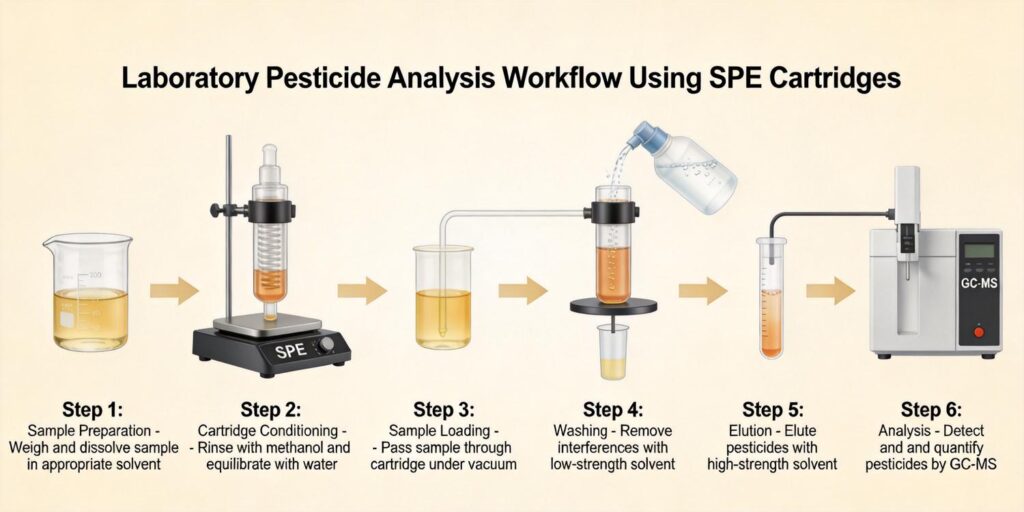
Conditioning HLB Cartridges
HLB (Hydrophilic-Lipophilic Balanced) cartridges require proper conditioning before sample loading. The standard conditioning protocol involves sequential washing with methanol (typically 2-3 mL) followed by water or buffer (2-3 mL). For veterinary drug applications, conditioning with acidified water (pH 2-3) may be beneficial for retaining basic compounds. It’s essential to prevent the cartridge bed from drying out during conditioning – maintaining approximately 1-2 mm of solvent above the sorbent bed ensures optimal performance. Proper conditioning activates the sorbent by solvating the polymer chains and creating the appropriate environment for analyte retention.
Loading Diluted Extract onto SPE Cartridge
The centrifuged extract must be diluted with water or buffer before loading onto the HLB cartridge to reduce the organic solvent content. Typically, a 1:1 to 1:4 dilution with water or acidified water (pH 2-3) is employed to achieve a final organic content of 10-25%. This dilution is critical because high organic content can reduce analyte retention on the HLB sorbent. The loading flow rate should be controlled at 1-2 mL/min to ensure adequate contact time between analytes and sorbent. For fish tissue extracts, it’s advisable to filter the diluted extract through a 0.45 μm syringe filter before loading to prevent particulate matter from clogging the cartridge.
Washing with Water to Remove Proteins and Salts
After sample loading, washing steps remove interfering matrix components while retaining target analytes. For HLB cartridges, washing typically involves 2-3 mL of water or 5-10% methanol in water. Some methods incorporate additional washes with hexane or ethyl acetate to remove non-polar interferences. The wash step effectively removes residual proteins, salts, and polar endogenous compounds that could interfere with subsequent analysis. It’s important to optimize wash conditions to maximize removal of interferences while minimizing analyte loss. For veterinary drug applications, acidified water washes (pH 2-3) can help maintain acidic conditions for basic drug retention.
Elution with Methanol or Acetonitrile
Elution is performed using organic solvents that disrupt analyte-sorbent interactions. Methanol and acetonitrile are commonly used for veterinary drug elution from HLB cartridges, typically in volumes of 2-3 mL. For improved recovery of certain drug classes, acidified or basified organic solvents may be employed. For instance, 2% formic acid in methanol enhances elution of basic drugs, while 2% ammonia in methanol improves recovery of acidic compounds. Allowing the elution solvent to soak in the cartridge for 30-60 seconds before applying vacuum improves recovery. Some methods use multiple small elution volumes rather than a single large volume to maximize recovery.
LC-MS/MS Detection of Veterinary Drug Residues
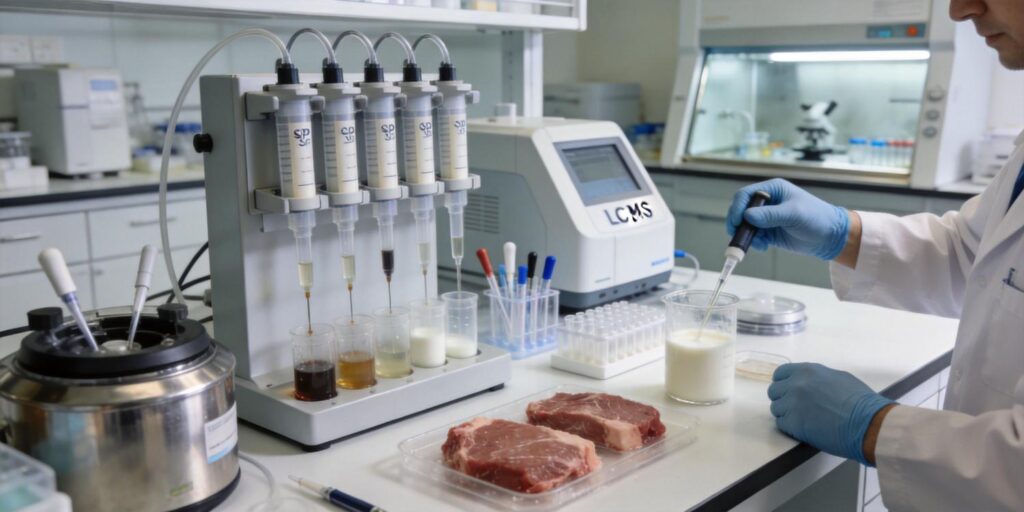
The final eluate is typically evaporated to dryness under nitrogen or vacuum and reconstituted in mobile phase compatible with LC-MS/MS analysis. For veterinary drug screening, LC-MS/MS offers superior sensitivity and selectivity compared to traditional detection methods. Electrospray ionization (ESI) in positive or negative mode is commonly employed, depending on the drug class. Multiple reaction monitoring (MRM) transitions provide specific detection of target analytes with detection limits often reaching low ng/g levels. The method should include appropriate quality controls, matrix-matched calibration standards, and internal standards to ensure accurate quantification. Recent advances in LC-MS/MS technology allow simultaneous screening of multiple veterinary drug classes in a single run, significantly improving laboratory throughput for fish tissue analysis.
Method Optimization Considerations
When developing SPE methods for veterinary drugs in fish tissue, several factors require optimization. The sample size should not exceed 100 mg of wet tissue to avoid overloading the SPE cartridge capacity. Enzymatic digestion using proteases like Subtilisin Carlsberg can improve recovery of protein-bound drugs, though careful optimization is needed to avoid introducing interferences. The pH during extraction and SPE steps significantly affects recovery, particularly for ionizable compounds. Mixed-mode SPE cartridges combining hydrophobic and ion-exchange interactions can provide cleaner extracts for complex matrices like fish tissue.
Quality Control and Validation
Proper method validation is essential for regulatory compliance. Recovery studies should demonstrate consistent extraction efficiency across the target concentration range, typically 70-120% with RSD < 15%. Matrix effects should be evaluated using post-extraction spiking experiments, and matrix-matched calibration is recommended to compensate for ionization suppression or enhancement. The method should demonstrate specificity, linearity, accuracy, precision, and stability according to relevant guidelines such as those from the European Commission or FDA.
Alternative SPE Approaches
While HLB cartridges are widely used for veterinary drug extraction, alternative SPE phases may offer advantages for specific applications. Mixed-mode cartridges (e.g., MCX, MAX, WCX) provide additional selectivity through ion-exchange interactions. For particularly fatty samples, C18 or C8 phases with appropriate washing steps can effectively remove lipids. Matrix Solid Phase Dispersion (MSPD) represents an alternative approach where the sample is blended directly with sorbent material, potentially simplifying the extraction process for solid tissues.
This comprehensive SPE method provides laboratories with a robust approach for extracting veterinary drug residues from fish tissue, combining effective sample preparation with sensitive LC-MS/MS detection to meet regulatory requirements for food safety monitoring.