
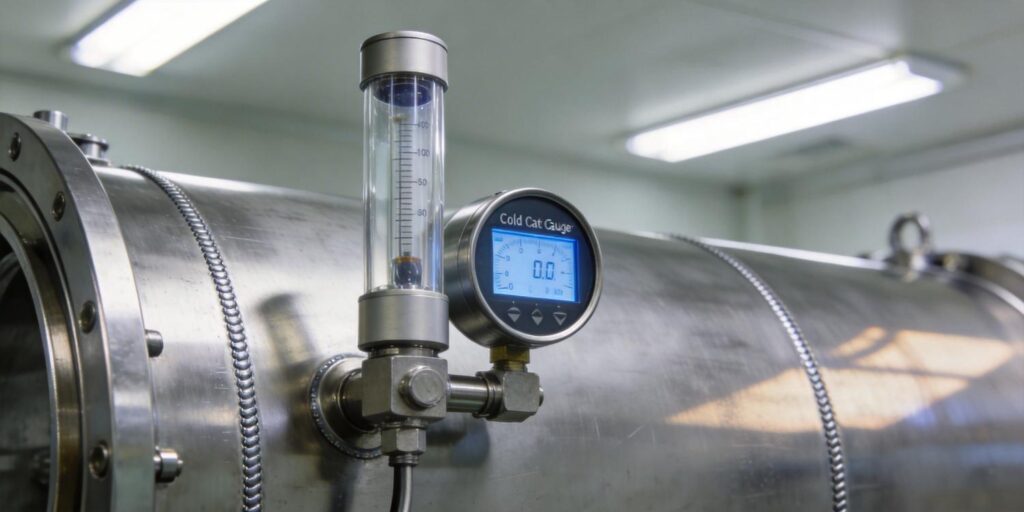
In high-vacuum research, semiconductor processing, and advanced analytical instruments, the ability to resolve true pressure signals at 10−6 mbar (≈7.5 × 10⁻⁷ Torr) and below separates reliable vacuum monitoring from marginal performance. At these ultra-low pressures, the ion current generated by a cold-cathode gauge becomes extremely small, and any background current—whether from electronic noise, leakage, or field emission—can mask the real signal. Poseidon Scientific’s VG-SM225 Cold Cathode Vacuum Gauge, with its positive-magnetron Penning discharge and cleanable stainless-steel electrodes, is specifically engineered to push the practical noise floor as low as possible while remaining cost-effective and maintainable. Paired with the VG-SP205 Pirani Vacuum Transmitter for roughing stages, the system delivers full-range coverage with clear understanding of noise limitations at the high-vacuum end.
Defining Noise Floor in Vacuum Gauges
The noise floor is the lowest pressure level at which the gauge’s output signal can be reliably distinguished from background fluctuations. In quantitative terms, it is the pressure equivalent of the root-mean-square (RMS) noise in the measured ion current or voltage output when the true gas density is near zero. For ionization gauges operating at ultra-low pressures, this floor is not set by the gauge’s sensitivity alone but by the sum of all spurious currents that appear independent of pressure.
In the ideal gauge equation, ion current i+ is proportional to pressure P:
i+ = K · ie · P,
where K is the gauge constant (sensitivity), ie is the ionizing electron current, and P is pressure. At ultra-low pressures the real i+ drops into the picoampere or femtoampere range; any constant or fluctuating background term ir (leakage, field emission, or electrometer noise) becomes dominant, raising the effective noise floor. Literature from the American Vacuum Society consistently identifies this regime as the practical limit for cold-cathode gauges, typically around 10−6–10−7 mbar for well-designed instruments.
For the VG-SM225, the positive-magnetron geometry and controlled discharge current keep the noise floor competitive with far more expensive inverted-magnetron designs while allowing periodic electrode cleaning to restore original performance.
Electronic Limitations at the 10−6 mbar Region
At 10−6 mbar the ion current in a typical cold-cathode gauge falls to roughly 10−11–10−12 A. This tiny signal must be amplified by high-impedance electrometers whose own noise—thermal Johnson noise, flicker noise, and input bias current—translates directly into pressure uncertainty. In addition, cable and insulator leakage paths (even at gigaohm levels) contribute microampere-scale offsets that appear as false pressure readings of 10−7–10−8 mbar.
Field emission from microscopic surface irregularities on the high-voltage electrodes (operating at –2000 V in the VG-SM225) adds another voltage-dependent spurious current that is indistinguishable from true ionization without careful diagnostics. The VG-SM225 mitigates these effects through polished stainless-steel electrodes (restored to metallic luster via 500-mesh sanding) and PEEK insulators that maintain >1012 Ω resistance. Nevertheless, the electronic limitation remains: below ≈5 × 10⁻⁷ mbar the signal-to-noise ratio approaches unity unless averaging or shielding techniques are applied.
The 0–10 V analog output (effective 2–8 V range) and customizable RS-232 digital stream of the VG-SM225 are designed with 12-bit resolution and software filtering to push the practical floor lower than many legacy single-feedthrough cold-cathode gauges. At 10−6 mbar the gauge still provides usable data for process confirmation, but users must recognize that absolute accuracy is limited by these electronic factors rather than the discharge physics itself.
Distinguishing Real Signal from Noise
Real ionization current scales monotonically with pressure and responds instantly to controlled gas admission. Noise or spurious currents show different signatures:
- Consistent startup behavior: At 10−6 mbar the VG-SM225 starts in ≈5 minutes; sudden failure or erratic delay indicates contamination or leakage rather than true low pressure.
- Repeatable pressure response: Introduce a known dose of nitrogen and verify the output rises proportionally; discontinuities or jumps are classic signs of field-emission bursts or insulator leakage.
- Drift characteristics: True base pressure is stable over minutes once equilibrated; random fluctuations >5 % of reading typically stem from electrometer noise or cable pickup.
A practical test: with the chamber at ultimate vacuum, power-cycle the gauge several times and compare the stabilized reading. If variation exceeds the manufacturer’s specified repeatability (±5 % at 10−6 mbar), the excess is noise. The VG-SM225’s software-controlled voltage ramp (–2500 V startup to –2000 V steady) and automatic HV shutoff above 10−3 mbar further reduce false signals by preventing arcing during transitions.
Engineers often cross-check with the VG-SP205 Pirani during pump-down; once the system crosses 10−3 mbar the cold-cathode reading should track continuously without jumps, confirming the transition is real rather than electronic artifact.
Shielding Techniques to Lower the Effective Noise Floor
Effective shielding directly improves the signal-to-noise ratio at ultra-low pressures. Recommended practices for the VG-SM225 include:
- Cable shielding and grounding: Use fully shielded coaxial or twisted-pair cables for the 0–10 V analog and RS-232 lines. Ground the shield at one end only (instrument side) to avoid ground loops.
- Faraday cage enclosure: House the gauge electronics and cable entry in a grounded metal box; this attenuates external RF and electrostatic pickup that would otherwise appear as 10−7 mbar noise.
- Guard electrodes and clean surfaces: The VG-SM225’s stainless-steel electrodes and removable sensor head allow periodic mechanical cleaning to eliminate field-emission sites. Avoid sharp edges and maintain metallic luster—no mirror polish required.
- Isolation from light and magnetic fields: Although cold-cathode gauges are less sensitive to x-ray photocurrent than hot-cathode types, ambient light can still contribute minor photocurrents. Keep the gauge >10 cm from strong magnets or RF sources to preserve the 100-gauss internal field symmetry.
Implementing these techniques routinely lowers the practical noise floor by a factor of 3–5, enabling repeatable measurements at 10−7 mbar where unshielded installations would be unusable.
Stability Validation Method
To confirm that the observed noise floor is electronic rather than gauge degradation, follow this repeatable validation protocol:
- Evacuate the chamber to the lowest achievable pressure using a calibrated turbomolecular pump and reference capacitance manometer.
- Record VG-SM225 output (analog voltage or RS-232 values) at 1-second intervals for 30 minutes after startup stabilization.
- Calculate RMS deviation of the pressure-equivalent reading; values <5 % of nominal 10−6 mbar indicate normal electronic noise.
- Introduce a small, controlled nitrogen dose (raising pressure to 5 × 10⁻⁶ mbar) and verify linear response with <3 % hysteresis.
- Repeat the test after electrode cleaning (if indicated by startup delay or low readings) to quantify improvement.
This method, derived from standard practices in vacuum metrology, allows engineers to separate true gauge performance from external noise sources. Poseidon provides factory calibration data and recommends quarterly validation in critical ultra-high-vacuum applications. The VG-SM225’s cleanable design ensures stability can be restored without full replacement—unlike many sealed imported units.
By combining the VG-SP205 for rough vacuum and the VG-SM225 for high vacuum, laboratories achieve a complete monitoring chain whose noise characteristics are well understood and controllable at every pressure decade.
Ready to Minimize Noise Floor in Your Ultra-Low-Pressure Applications?
Understanding and managing vacuum gauge noise floor at 10−6 mbar and below is essential for reproducible results in analytical instruments, surface science, and semiconductor R&D. The VG-SM225 Cold Cathode Vacuum Gauge, with its robust positive-magnetron design, cleanable electrodes, and integrated electronic safeguards, delivers a practical noise floor that meets the demands of modern high-vacuum systems—without the premium price of legacy imported solutions.
- VG-SM225 Cold Cathode Vacuum Gauge – optimized for ultra-low-pressure monitoring with low noise and easy maintenance
- VG-SP205 Pirani Vacuum Transmitter – complementary roughing sensor for seamless full-range coverage
Contact the Poseidon Scientific applications team today for a customized noise-floor analysis, shielding recommendations, or RS-232 protocol examples tailored to your chamber. Let us help you achieve stable, low-noise vacuum measurements that you can trust at the limits of your system.


