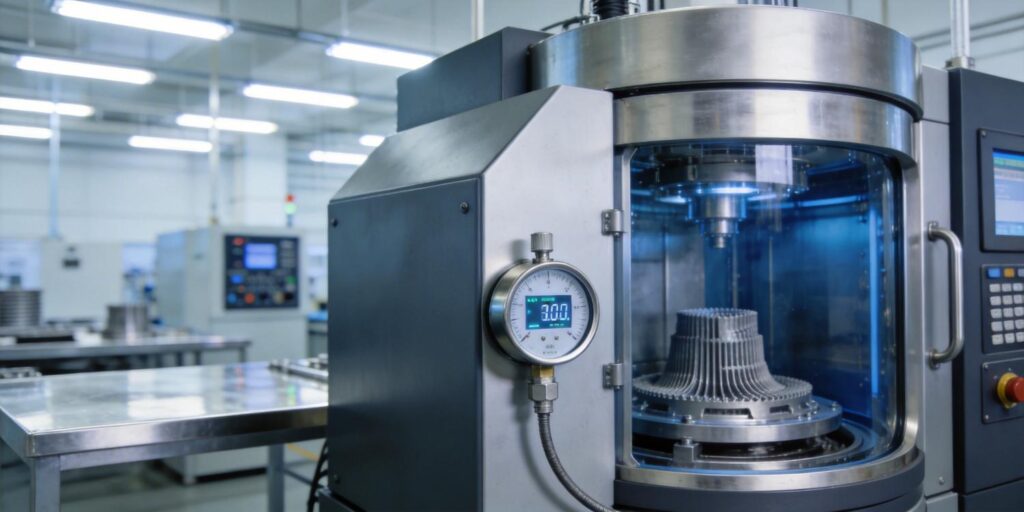
Metal additive manufacturing—particularly electron-beam powder bed fusion (EB-PBF) and emerging vacuum laser powder bed fusion (vacuum LPBF)—relies on precise vacuum control to eliminate oxidation, stabilize the melt pool, and achieve dense, high-integrity parts from reactive alloys such as titanium, aluminum, and nickel superalloys. Chambers must rapidly reach and maintain high vacuum before energy-source ignition, then hold stable pressure during layer-by-layer melting. Even small deviations can trigger spatter, keyhole porosity, or elemental evaporation, compromising mechanical properties and repeatability.
Poseidon Scientific’s VG-SP205 Pirani Vacuum Transmitter and VG-SM225 Cold Cathode Vacuum Gauge are engineered for exactly these demanding cycles. The Pirani covers the rough-to-medium vacuum range (atmosphere to 10⁻³ Torr) with maintenance-free thermal-conductivity sensing, while the Cold Cathode extends reliable monitoring from 10⁻³ Torr to 10⁻⁷ Torr using a compact positive-magnetron Penning discharge. Together they deliver continuous, gap-free coverage, fast response, and cost-effective integration—making them the practical choice for both production EBM machines and research-grade vacuum AM platforms.
Vacuum-Assisted Printing Stages
Every metal AM build follows a repeatable vacuum sequence that demands accurate, real-time monitoring at each step:
- Roughing / initial pump-down: From atmosphere to ~1 Torr. The VG-SP205 Pirani excels here, tracking the rapid pressure drop with its platinum filament and constant-temperature control. Its linear response in the 10 Torr to 10⁻² Torr band ensures precise timing of valve sequencing and pre-heating initiation.
- High-vacuum pump-down and pre-heat: Chamber evacuation to 10⁻⁴–10⁻⁵ Torr (typical EBM target ~0.0001 mbar / ~7.5×10⁻⁵ Torr) while the build plate is heated to 600–1000 °C. The VG-SM225 Cold Cathode takes over seamlessly, confirming the required vacuum level before beam or laser ignition.
- Build phase with controlled backfill: Many EBM systems introduce a low partial pressure of helium (~10⁻³ mbar) to stabilize the electron beam without scattering. Both Poseidon gauges maintain accurate readings across this transition, with the Pirani handling any transient spikes and the Cold Cathode verifying base stability.
- Cool-down and venting: Controlled return to atmosphere. The dual-gauge combination again provides full-range visibility, enabling safe, rapid venting without overshoot.
The compact sensor volumes of both instruments minimize disturbance to the chamber’s pumping speed, while their KF16/KF25 flanges and arbitrary mounting orientation simplify integration into existing or new AM tool designs.
Pressure Stability for Melt Pool Control
Melt-pool dynamics in vacuum AM are governed by vapor recoil pressure, surface tension, and evaporation rates—all highly sensitive to residual gas pressure. In EBM, even minor increases in chamber pressure can scatter the electron beam, reduce energy density, or promote unwanted plasma formation. In vacuum LPBF, lower process pressures (down to 10 mbar or below) reduce laser-plasma interaction and spatter while improving laser penetration depth.
The VG-SP205’s fast thermal response tracks pressure transients during layer melting and powder spreading with sub-second resolution in its linear band. The VG-SM225’s Penning discharge provides stable, drift-resistant readings at the ultra-low base pressures where melt-pool evaporation is most critical. Built-in temperature compensation (15–50 °C operating range) and software-controlled high-voltage ramping ensure the Cold Cathode remains accurate despite the thermal cycling typical of AM builds.
Engineers use the combined 0–10 V analog outputs to implement closed-loop pressure control: if readings deviate beyond ±5 %, the system can adjust helium bleed rate or pause the build—directly improving part density and surface finish while reducing defects such as lack-of-fusion or keyhole porosity.
Key Stability Metrics in Vacuum Metal AM
- Base pressure before ignition: ≤10⁻⁴ Torr (EBM) or 1–200 mbar range (vacuum LPBF)
- Pressure reproducibility across layers: ±3 %
- Response time to transients: <2 s
- Minimal gauge-induced pumping speed loss
High Vacuum Requirement Before Laser (or Beam) Ignition
Safety and quality protocols mandate that the energy source—whether electron beam or laser—remains disabled until the chamber reaches a predefined high-vacuum threshold. At higher pressures, electron or laser energy scatters off residual gas molecules, producing unreliable melt pools, excessive spatter, or even equipment damage.
Typical EBM specifications require ~10⁻⁴ mbar (≈7.5×10⁻⁵ Torr) before ignition; vacuum LPBF studies show optimal performance below 200 mbar with clear benefits below 10 mbar. The VG-SM225 Cold Cathode, with its 10⁻³ to 10⁻⁷ Torr range and automatic high-voltage interlock (shutoff above 10⁻³ Torr), is perfectly suited to gate the ignition signal. Its positive-magnetron geometry and cleanable “之”字形 electrodes maintain consistent sensitivity even after repeated thermal cycles, while the compact 0.3 cm³ internal volume ensures negligible impact on pump-down time.
The VG-SP205 Pirani complements this by monitoring the preceding roughing stage, confirming that the turbomolecular pumps can safely engage without oil-backstreaming risk. This staged monitoring eliminates false starts and protects expensive electron guns or laser optics.
Integration with Safety Interlocks
Modern AM systems incorporate vacuum status directly into the machine safety PLC. Both Poseidon gauges deliver industry-standard 0–10 V analog signals (effective 2–8 V range) plus fully customizable RS-232 digital protocols—available from just 5–10 unit orders. Engineers simply map the outputs to interlock logic:
- Beam/laser enable only when VG-SM225 confirms pressure ≤10⁻⁴ Torr
- Automatic high-voltage shutoff on the Cold Cathode if pressure rises above 10⁻³ Torr
- Alarm and pause sequence if Pirani detects unexpected pressure rise during build
The RJ45 interface (field-changeable to DB9/DB15) and low internal leak rate (<10⁻¹¹ Pa·m³/s) make integration straightforward. Because the gauges are non-magnetic (or low-field) and compact, they install safely away from sensitive beam columns or laser optics while still sampling true chamber conditions via short conductance tubing.
Monitoring Redundancy
High-value AM builds cannot tolerate single-point failure. The dual-range Poseidon solution inherently provides redundancy:
- During roughing and venting, the VG-SP205 serves as primary with the Cold Cathode in standby.
- At high vacuum, the VG-SM225 is primary while the Pirani cross-checks for gross leaks or valve issues.
- Both gauges can be installed on separate KF ports for true independent verification—standard practice in semiconductor-grade vacuum tools and now increasingly adopted in production AM systems.
The VG-SM225’s removable sensor head allows quick electrode cleaning (500-mesh sandpaper, <15 min) without breaking the chamber seal, while the Pirani is completely maintenance-free. Combined with factory calibration traceability and 3–5 year service life in clean environments, this architecture delivers the uptime and data integrity that certification bodies and aerospace/medical customers demand.
Ready to Strengthen Your Metal AM Vacuum Monitoring?
Whether you are building production EBM systems, developing next-generation vacuum LPBF platforms, or retrofitting existing additive machines, the VG-SP205 Pirani Vacuum Transmitter and VG-SM225 Cold Cathode Vacuum Gauge deliver the full-range coverage, fast response, safety interlock compatibility, and long-term reliability required for consistent, defect-lean parts—at a fraction of the cost of legacy imported solutions.
- VG-SP205 Pirani Vacuum Transmitter – ideal for roughing, transients, and medium-vacuum stages
- VG-SM225 Cold Cathode Vacuum Gauge – precision high-vacuum monitoring with cleanable electrodes and built-in interlocks
Contact the Poseidon Scientific applications team today for a customized integration package, sample interlock logic diagrams, or a side-by-side performance comparison with your current gauges. Let us help you achieve stable melt pools, faster pump-downs, and higher machine uptime in your vacuum metal additive manufacturing process.