The Critical Need for Simultaneous Detection of Acidic, Neutral, and Basic Drugs
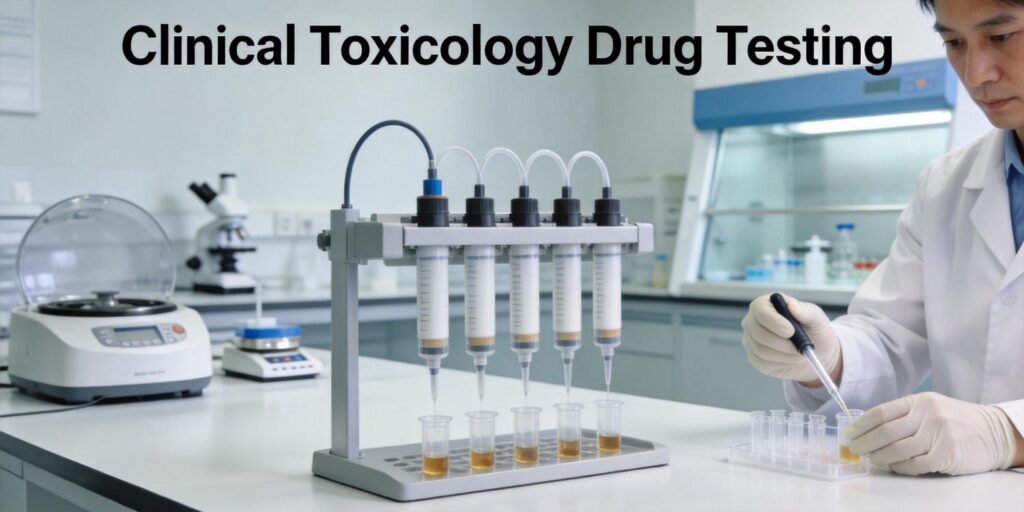
In clinical toxicology laboratories, the ability to simultaneously detect and quantify drugs spanning different chemical classes is paramount for comprehensive patient care. Modern drug screening must address the reality that patients may be exposed to multiple substances with varying physicochemical properties—acidic drugs like NSAIDs and barbiturates, neutral compounds such as cannabinoids and certain benzodiazepines, and basic drugs including amphetamines, opioids, and tricyclic antidepressants.
Traditional single-mode extraction methods often fail to provide adequate recovery across this broad spectrum. As research from the Groningen Institute for Drug Studies demonstrates, “a single SPE extraction mechanism would not suffice” for comprehensive toxicological analysis. This limitation has driven the development of mixed-mode SPE strategies that can handle the diverse chemical landscape encountered in clinical toxicology.
Advantages of Mixed-Mode Sorbents: MCX and MAX Cartridges
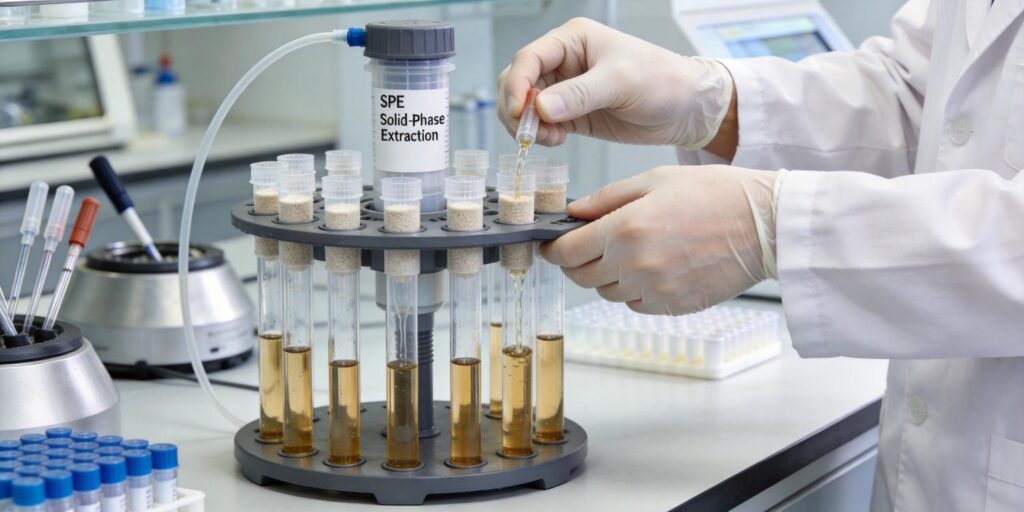
Mixed-mode solid-phase extraction cartridges represent a significant advancement in sample preparation technology. These sorbents combine multiple retention mechanisms within a single phase, typically pairing reversed-phase hydrophobic interactions with ion-exchange capabilities. The most common configurations include:
MCX (Mixed-mode Cation eXchange) Cartridges
MCX cartridges feature a polymer-based sorbent with sulfonic acid groups providing cation exchange functionality (1 meq/g capacity) alongside hydrophobic C8 or similar alkyl chains. This dual mechanism allows for:
- Selective retention of basic drugs through cation exchange at appropriate pH
- Hydrophobic retention of neutral and acidic compounds
- Stability across the entire pH range (0-14) for robust method development
- Absence of interfering silanol groups that complicate retention patterns
MAX (Mixed-mode Anion eXchange) Cartridges
MAX cartridges employ quaternary amine groups (0.25 meq/g capacity) for anion exchange combined with hydrophobic functionality. These are particularly effective for:
- Selective extraction of acidic drugs and metabolites
- Simultaneous retention of neutral compounds
- Clean extracts with minimal matrix interference
Research by Chen et al. (1992) demonstrated that mixed-mode cartridges could achieve recoveries of 90-100% for 25 different drugs from plasma, with relative standard deviations under 10%. This performance makes them ideal for the “undirected approach” required in systematic toxicological analysis.
Sample Pretreatment with Protein Precipitation
Before SPE processing, biological samples typically require protein precipitation to release bound analytes and remove interfering proteins. For blood and plasma samples, common approaches include:
- Acetonitrile or methanol precipitation (typically 2:1 or 3:1 solvent:sample ratio)
- Acid precipitation using perchloric or trichloroacetic acid
- Combination approaches for complex matrices
For urine samples, enzymatic hydrolysis may be necessary to liberate conjugated metabolites, particularly for opioids and benzodiazepines. The resulting supernatant is then pH-adjusted to optimize retention on the mixed-mode sorbent.
Sequential SPE Workflow Using Mixed-Mode Cartridges
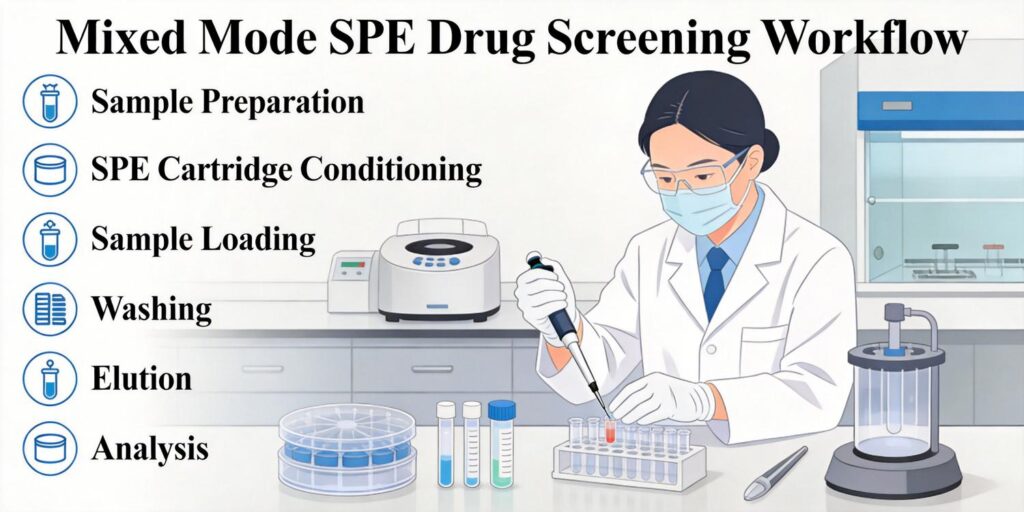
The power of mixed-mode SPE lies in its sequential workflow that fractionates drugs by chemical class. A typical procedure, as described in forensic applications, follows these steps:
- Cartridge Conditioning: Methanol followed by aqueous buffer to activate both hydrophobic and ion-exchange sites
- Sample Application: pH-adjusted sample loaded at controlled flow rates (typically 1-2 mL/min)
- Wash Steps: Sequential washes to remove interfering compounds while retaining analytes
- pH Adjustment: Modification of cartridge environment to optimize elution selectivity
- Fractional Elution: Stepwise elution of neutral, acidic, and basic fractions
This approach, validated by multiple research groups, provides clean extracts amenable to various analytical techniques while maintaining high recovery across drug classes.
Wash Steps for Removing Phospholipids and Endogenous Compounds
Effective wash protocols are critical for removing matrix interferences while retaining target analytes. Mixed-mode cartridges allow for sophisticated wash strategies:
Polar Washes
Water or dilute aqueous buffers remove polar endogenous compounds, salts, and water-soluble matrix components without disrupting hydrophobic or ion-exchange interactions.
Organic Washes
Low-percentage organic solvents (5-20% methanol or acetonitrile in water) elute moderately polar interferences while retaining most drugs of interest.
pH-Modified Washes
Buffers at specific pH values can selectively weaken certain interactions, allowing removal of specific interference classes while maintaining target compound retention.
Research by Chen et al. (1993) demonstrated that introducing an extra wash step with 20% acetonitrile in water significantly improved extract cleanliness for urine samples analyzed by GC/NPD, reducing background interference in chromatograms.
Stepwise Elution Strategy Separating Neutral, Acidic, and Basic Fractions
The fractionation capability of mixed-mode SPE is its most powerful feature for multi-class drug screening. A typical elution scheme involves:
Fraction A: Neutral and Acidic Drugs
Elution with organic solvents (typically ethyl acetate or methylene chloride with small percentages of alcohol) at neutral or slightly acidic pH recovers:
- Neutral drugs (cannabinoids, neutral benzodiazepines)
- Acidic drugs (NSAIDs, barbiturates, acidic metabolites)
Studies show recoveries of 95-99% for barbiturates and neutral drugs in this fraction.
Fraction B: Basic Drugs
Subsequent elution with ammoniated organic solvents (2% ammonium hydroxide in ethyl acetate or similar) releases:
- Basic drugs (amphetamines, opioids, tricyclic antidepressants)
- Strong bases requiring ion-exchange disruption
Research indicates recoveries of 97-104% for basic drugs like methamphetamine and imipramine using this approach.
This fractionation prevents co-elution of compounds with similar chromatographic behavior but different chemical classes, simplifying downstream analysis and interpretation.
LC-MS/MS Screening Methods for Multi-Class Drug Analysis
Liquid chromatography coupled with tandem mass spectrometry provides the ideal platform for analyzing SPE fractions from mixed-mode extractions. Key considerations include:
Chromatographic Separation
Reversed-phase columns (C18 or equivalent) with gradient elution using water/acetonitrile or water/methanol with formic acid or ammonium formate buffers provide excellent separation of diverse drug classes.
Mass Spectrometric Detection
Multiple reaction monitoring (MRM) allows simultaneous detection of hundreds of compounds with high sensitivity and specificity. Modern instruments can monitor 200+ transitions in a single run, ideal for comprehensive screening.
Data Analysis
Automated processing software compares retention times and ion ratios against established libraries, flagging potential positives for confirmation.
The clean extracts produced by mixed-mode SPE significantly reduce matrix effects in LC-MS/MS, improving accuracy and reproducibility compared to direct injection of crude extracts.
Validation of Multi-Class Drug Recovery and Method Performance
Comprehensive validation is essential for clinical implementation of mixed-mode SPE methods. Key validation parameters include:
Recovery Studies
Studies across multiple drug classes demonstrate consistent recoveries. For example, research shows:
- Barbiturates: 95-99% recovery
- Benzodiazepines: 65-98% recovery (depending on specific compound)
- Amphetamines: 74-98% recovery
- Opioids: 93-99% recovery
Precision and Accuracy
Inter-day and intra-day precision typically show RSD values under 10% for most compounds at therapeutic and toxic concentrations.
Matrix Effects
Studies comparing multiple lots of cartridges (Chen et al., 1993) demonstrate excellent lot-to-lot reproducibility, with recoveries varying less than 5% between different production batches.
Carryover and Reusability
Research indicates that mixed-mode cartridges can be reused multiple times without significant performance degradation when properly cleaned between uses.
Automation Compatibility
The sequential nature of mixed-mode SPE makes it highly amenable to automation. Systems like ASPEC (Automated Sample Preparation with Extraction Cartridges) can perform the entire extraction process, improving throughput and reproducibility while reducing manual labor.
Conclusion: The Future of Multi-Class Drug Screening
Mixed-mode SPE strategies represent the current gold standard for comprehensive drug screening in clinical toxicology. By combining the selectivity of ion-exchange with the broad retention of reversed-phase mechanisms, these methods provide unparalleled capability for simultaneous extraction of acidic, neutral, and basic drugs from complex biological matrices.
As analytical challenges continue to evolve with new drug classes and increasingly complex patient presentations, the flexibility and robustness of mixed-mode SPE ensure it will remain a cornerstone technology in clinical laboratories. Continued development of sorbent chemistries, automation platforms, and integrated analytical workflows will further enhance the utility of these methods for patient care and forensic applications.
For laboratories implementing or optimizing multi-class drug screening, mixed-mode SPE cartridges like MCX and MAX offer proven performance and reliability. When combined with appropriate sample pretreatment and modern LC-MS/MS detection, they provide the comprehensive analytical capability required for today’s clinical toxicology challenges.