Research laboratories in universities, national labs, and R&D centers routinely handle a wide spectrum of vacuum applications—from sample preparation at rough vacuum to surface science experiments requiring high or ultra-high vacuum. Selecting the right vacuum monitoring solution can be challenging when budgets are tight, space is limited, and experiments change frequently. Poseidon Scientific’s VG-SP205 Pirani Vacuum Transmitter and VG-SM225 Cold Cathode Vacuum Gauge were developed with exactly these constraints in mind. Their compact size, low cost, and customizable communication protocols make them ideal building blocks for flexible, reliable vacuum monitoring systems that grow with your lab’s needs.
Mixed Vacuum Level Requirements
Most research labs operate across two distinct vacuum regimes that no single gauge can cover economically or accurately. Rough vacuum (atmosphere down to 10−3 Torr) is common in glove boxes, load locks, and initial pump-down stages. High vacuum (10−3 to 10−7 Torr) is required for scanning electron microscopes, mass spectrometers, thin-film deposition chambers, and surface-analysis tools.
The VG-SP205 Pirani Vacuum Transmitter excels in the higher-pressure range using the thermal-conductivity principle. Its platinum filament maintains constant temperature while measuring the power needed to counteract gas cooling—providing fast, repeatable readings from atmosphere to 10−3 Torr. The linear response zone (10 Torr to 10−2 Torr) delivers the precision needed for process monitoring, while temperature compensation circuitry keeps accuracy stable across the typical 15–50 °C lab environment.
For the high-vacuum regime, the VG-SM225 Cold Cathode Vacuum Gauge uses a positive-magnetron Penning discharge. It reliably measures from 10−3 Torr down to 10−7 Torr with a compact sensor volume and cleanable stainless-steel electrodes. Together, the two gauges provide seamless, gap-free coverage from atmosphere to 10−7 Torr—exactly the mixed-range capability that research labs require without the expense of ultra-high-vacuum Bayard-Alpert gauges or the fragility of hot filaments.
Typical Lab Vacuum Regimes
- Rough vacuum (load locks, glove boxes): VG-SP205 only
- Medium vacuum (sputter chambers, mass specs): VG-SP205 + VG-SM225
- High vacuum confirmation (SEM, XPS prep): VG-SM225 primary
Modular Gauge Configuration
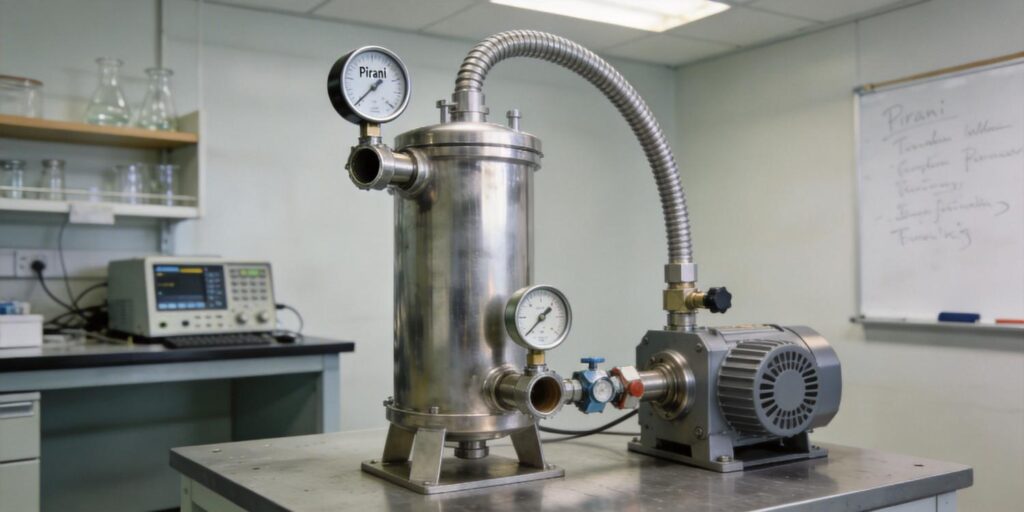
One of the greatest advantages of Poseidon’s gauges is their modular design. Both instruments share the same KF16 or KF25 flange footprint and RJ45 electrical interface, allowing engineers to mix and match them on a single vacuum manifold or chamber. The VG-SP205 mounts directly on the process line for fast response during pump-down; the VG-SM225 can be placed on a conductance-limited side port to protect it from contamination while still sampling true chamber pressure.
Installation is straightforward—any orientation works, and the compact bodies (significantly smaller than most imported equivalents) fit easily into crowded lab setups. The VG-SM225’s removable sensor head further simplifies maintenance without breaking the main vacuum seal. For labs running multiple chambers, a single controller can monitor both gauges via customizable RS-232 output, eliminating the need for multiple power supplies or complex PLC programming.
Common Modular Setups
| Configuration | Application | Benefits |
|---|---|---|
| Single VG-SP205 | Glove box or roughing line | Maintenance-free, low cost |
| VG-SP205 + VG-SM225 | Multi-purpose deposition chamber | Full-range coverage, easy integration |
| Dual VG-SM225 | High-vacuum analytical tools | Redundancy and cross-check capability |
Flexibility for Multiple Experiments
Research labs rarely run the same experiment for years; new grants, students, and collaborations bring new vacuum requirements monthly. Poseidon’s gauges were engineered for exactly this variability. The communication protocol is fully customizable—even for orders as small as 5–10 units—so the gauges speak the language of your existing LabVIEW, Python, or Arduino-based data acquisition system without additional converters.
The small physical size and low magnetic field of the VG-SM225 (≈100 gauss) minimize interference with sensitive instruments such as electron microscopes or magnetic sample holders. The VG-SP205’s completely passive operation adds zero electromagnetic noise. When an experiment ends, swapping gauges or reconfiguring ports takes minutes rather than hours, and factory calibration ensures immediate usability. This plug-and-play flexibility has made Poseidon instruments the choice for university core facilities supporting dozens of research groups simultaneously.
Data Logging Importance
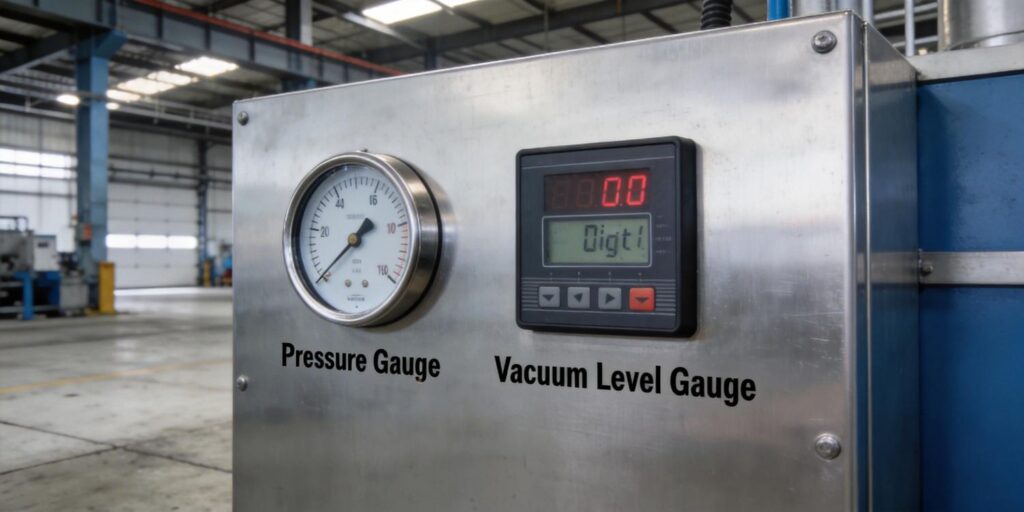
Modern research demands traceable, reproducible vacuum data. Every publication and grant report increasingly includes pressure-time plots to prove experimental conditions. The VG-SP205 and VG-SM225 both output a stable 0–10 V analog signal (effective 2–8 V range) that connects directly to any low-cost DAQ card or PLC. The customizable RS-232 digital output delivers pressure values, status codes, and error flags in a simple ASCII frame—perfect for automated logging at 1-second intervals or faster.
With both gauges running continuously, labs capture complete pump-down curves, leak-check data, and long-term base-pressure stability without manual intervention. Temperature compensation in each instrument ensures logged data remains accurate despite daily lab temperature swings. Many users integrate the outputs into open-source tools such as Python with pyserial, creating automated dashboards that flag anomalies before they affect experiments. This level of data logging—previously available only on instruments costing twice as much—has become a standard expectation in competitive research environments.
Budget vs Performance Decision
Research budgets are always constrained. Imported gauges from INFICON, MKS, or similar brands typically run $8,000–$10,000 each, quickly consuming grant money that could otherwise fund samples or student support. Poseidon’s self-developed instruments are manufactured at 3,000–3,500 yuan per unit, delivering comparable or better performance in the exact ranges research labs actually use.
The VG-SP205 and VG-SM225 sacrifice nothing critical for research: they achieve ±5 % accuracy where it matters, offer 3–5 year lifetimes in clean environments, and include features such as automatic high-voltage shutoff and cleanable electrodes that imported units often lack at this price point. For labs that previously compromised with single-range gauges or manual Pirani tubes, the dual-gauge Poseidon solution provides full-range monitoring at roughly half the cost of one premium cold-cathode unit. Procurement teams appreciate the ability to start with one gauge and expand modularly as funding allows—true scalability without vendor lock-in.
Field data from university labs show that total cost of ownership—including installation, maintenance, and occasional cleaning—remains lower than legacy systems even after five years of service. When performance meets research needs and budget stays intact, the choice becomes straightforward.
Ready to Build Your Lab’s Vacuum Monitoring System?
Designing vacuum monitoring for a research laboratory no longer requires expensive, over-specified instruments or complex integration headaches. The VG-SP205 Pirani Vacuum Transmitter and VG-SM225 Cold Cathode Vacuum Gauge deliver the mixed-range coverage, modular flexibility, data-logging capability, and budget-friendly performance that today’s labs demand.
- VG-SP205 Pirani Vacuum Transmitter – perfect for rough-to-medium vacuum monitoring
- VG-SM225 Cold Cathode Vacuum Gauge – compact high-vacuum solution with easy maintenance
Contact the Poseidon Scientific applications team today for a free configuration consultation, sample RS-232 protocol files, or a side-by-side cost comparison tailored to your lab’s specific experiments. Let us help you create a vacuum monitoring system that scales with your research—without breaking the budget.