1. Antibiotic Usage in Aquaculture and Environmental Concerns
The aquaculture industry has experienced exponential growth over the past decades, becoming a crucial source of protein for global populations. However, this expansion has been accompanied by significant antibiotic usage to prevent disease outbreaks and promote growth in densely populated aquatic environments. Tetracyclines (oxytetracycline, chlortetracycline, tetracycline) and sulfonamides (sulfamethazine, sulfadimethoxine) are among the most commonly administered antibiotics in aquaculture operations worldwide.
Environmental concerns surrounding antibiotic residues in aquaculture are multifaceted. When antibiotics are administered to fish, substantial portions can be excreted unchanged or as metabolites into surrounding water systems. These residues can accumulate in sediments, affect non-target organisms, and potentially contribute to the development of antibiotic-resistant bacterial strains. The presence of antibiotic residues in aquaculture products also raises food safety concerns, as consumption of contaminated fish can lead to human exposure and potential allergic reactions or disruption of gut microbiota.
Regulatory agencies worldwide have established maximum residue limits (MRLs) for antibiotics in aquaculture products. For instance, the European Union sets MRLs for oxytetracycline at 100 μg/kg in fish muscle and 200 μg/kg in liver. The United States FDA has established tolerances for various antibiotics in edible tissues of fish. These regulations necessitate robust analytical methods capable of detecting antibiotic residues at trace levels, typically in the low parts-per-billion (ppb) range.
2. Sample Collection from Fish Tissue or Pond Water
Proper sample collection is the foundation of reliable antibiotic residue analysis in aquaculture. The choice between fish tissue and pond water samples depends on monitoring objectives, with each matrix presenting unique challenges and advantages.
Fish Tissue Collection
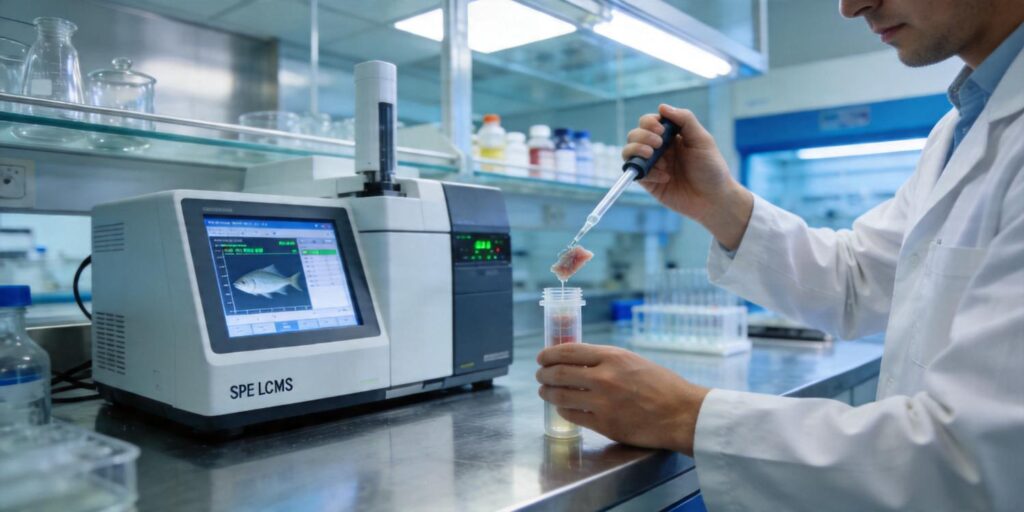
For fish tissue analysis, representative sampling is critical. Muscle tissue is typically the target matrix for regulatory compliance, as it represents the edible portion. However, liver and kidney tissues often contain higher concentrations of antibiotics due to metabolic processes and can provide valuable information about recent exposure. Research by Long et al. (1990g) demonstrated successful extraction of oxytetracycline from catfish (Ictalurus punctatus) muscle tissue using matrix solid phase dispersion (MSPD), highlighting the importance of proper tissue homogenization.
Sample collection protocols should include:
- Collection of at least 100g of muscle tissue from the dorsal region
- Immediate freezing at -20°C or lower to prevent degradation
- Documentation of fish species, weight, and collection location
- Use of clean, contaminant-free collection tools
Pond Water Collection
Water samples provide insight into environmental contamination and potential exposure pathways. Collection should consider:
- Grab samples from multiple locations within the pond
- Composite samples collected over time to account for temporal variations
- Immediate filtration through 0.45μm membranes to remove particulates
- Preservation with appropriate agents (e.g., sodium thiosulfate for chlorinated compounds)
- Storage at 4°C in amber glass containers to prevent photodegradation
3. SPE Sorbent Selection for Tetracyclines and Sulfonamides
The selection of appropriate solid phase extraction sorbents is crucial for successful antibiotic residue analysis. Tetracyclines and sulfonamides possess distinct chemical properties that dictate optimal sorbent chemistry.
Tetracycline-Specific Considerations
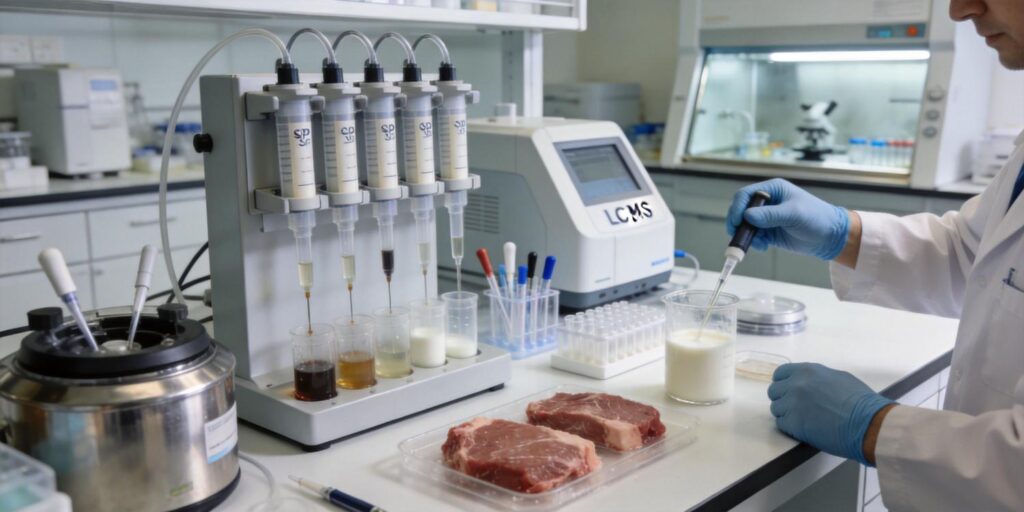
Tetracyclines are amphoteric compounds containing multiple functional groups that can exist in different ionization states depending on pH. They typically require mixed-mode sorbents that combine hydrophobic interactions with cation exchange capabilities. Poseidon Scientific’s MCX SPE cartridges, containing mixed-mode cation exchange sorbents, are particularly effective for tetracycline extraction due to their ability to retain these compounds through both hydrophobic and ionic interactions.
Sulfonamide-Specific Considerations
Sulfonamides are weak acids with pKa values typically between 5-7. They benefit from mixed-mode anion exchange sorbents or reversed-phase sorbents with appropriate pH adjustment. Poseidon Scientific’s WAX SPE cartridges (weak anion exchange) provide excellent recovery for sulfonamides by exploiting their anionic character at appropriate pH conditions.
Multiresidue Approaches
For laboratories monitoring multiple antibiotic classes simultaneously, mixed-mode sorbents offer the most comprehensive solution. Research by Horie et al. (1991) demonstrated successful simultaneous determination of synthetic antibacterials in fish using appropriate SPE cleanup procedures. The choice between specific and broad-spectrum sorbents depends on analytical requirements, with specific sorbents generally offering cleaner extracts and higher recoveries for target compounds.
4. Conditioning and Loading Procedures
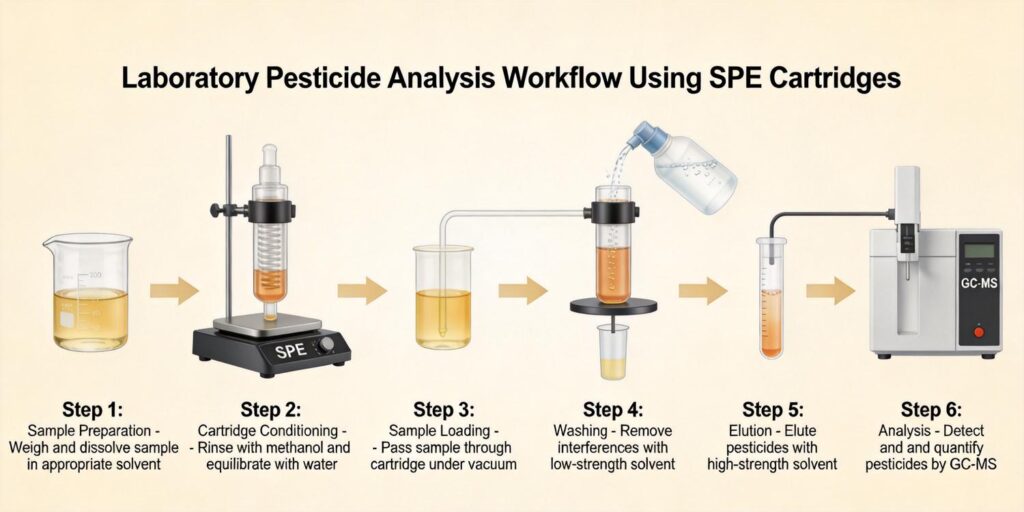
Proper SPE conditioning and loading are essential for achieving consistent recoveries and minimizing matrix effects. The following protocol has been optimized for aquaculture antibiotic analysis:
Conditioning Sequence
- Solvent Activation: Pass 3-5 mL of methanol through the cartridge to wet the sorbent bed completely
- Equilibration: Follow with 3-5 mL of deionized water or appropriate buffer solution
- pH Adjustment: For mixed-mode cartridges, condition with buffer matching the sample pH
It’s crucial to prevent the sorbent bed from drying between conditioning and sample loading, as this can create channels and reduce extraction efficiency.
Sample Loading Optimization
For fish tissue extracts, samples should be prepared in aqueous solutions with pH adjusted to optimize retention. Tetracyclines typically load best at pH 4-5, while sulfonamides benefit from pH 6-7. Flow rates should be controlled at 1-2 mL/min to ensure adequate interaction time between analytes and sorbent.
For water samples, large volumes (100-1000 mL) may be required to achieve adequate sensitivity. Automated systems or 96-well SPE plates can significantly improve throughput for high-volume applications.
5. Washing Strategies Removing Proteins and Lipids
Effective washing steps are critical for removing matrix interferences while retaining target antibiotics. Fish tissue extracts contain significant amounts of proteins, lipids, and other endogenous compounds that can interfere with subsequent analysis.
Protein Removal
Proteins can be effectively removed using aqueous washes containing mild organic solvents. A typical protocol includes:
- 5% methanol in water for reversed-phase sorbents
- Buffer solutions at appropriate ionic strength for mixed-mode sorbents
- Addition of small amounts of acids or bases to disrupt protein-sorbent interactions
Lipid Removal
Lipids represent a significant challenge in fish tissue analysis. Effective strategies include:
- Hexane or other non-polar solvent washes for reversed-phase sorbents
- Combined solvent systems (e.g., hexane:ethyl acetate mixtures)
- Temperature-controlled washing to optimize lipid solubility
Research by Horie et al. (1991) utilized metaphosphoric acid/methanol slurrying buffer for fish tissue deproteinization prior to SPE, demonstrating the importance of proper sample pretreatment.
Matrix-Specific Optimization
The optimal washing protocol varies depending on fish species, tissue type, and antibiotic class. Fatty fish species (e.g., salmon) require more aggressive lipid removal strategies than lean species (e.g., tilapia). Liver and kidney tissues typically contain higher lipid and protein content than muscle tissue, necessitating modified washing protocols.
6. Elution Solvents Compatible with LC-MS/MS
Elution solvent selection must balance complete analyte recovery with compatibility with downstream analytical techniques, particularly LC-MS/MS.
Tetracycline Elution
Tetracyclines require relatively strong elution conditions due to their multiple interaction mechanisms with mixed-mode sorbents. Effective elution solvents include:
- Methanol containing 2-5% formic acid
- Acetonitrile:methanol mixtures with ammonium hydroxide
- Methanol:water mixtures with EDTA to chelate metal ions
Research by Long et al. (1990c) demonstrated successful elution of tetracyclines from MSPD columns using appropriate solvent systems, with recoveries exceeding 85% for oxytetracycline, tetracycline, and chlortetracycline in milk matrices.
Sulfonamide Elution
Sulfonamides typically elute effectively with:
- Methanol or acetonitrile with 2-5% acetic acid
- Ammonium hydroxide in methanol for anion exchange sorbents
- Mixed organic solvents with pH adjustment
LC-MS/MS Compatibility Considerations
Elution solvents must be compatible with LC-MS/MS systems:
- Minimize non-volatile salts that can cause ion suppression
- Avoid phosphate buffers that can precipitate in LC systems
- Consider evaporation and reconstitution in mobile phase-compatible solvents
- Optimize solvent strength to prevent peak broadening in LC
7. Quantification Methods and Detection Limits
Modern antibiotic residue analysis in aquaculture relies heavily on liquid chromatography coupled with tandem mass spectrometry (LC-MS/MS) for sensitive and selective quantification.
LC-MS/MS Method Development
Successful LC-MS/MS methods for aquaculture antibiotics should include:
- Multiple reaction monitoring (MRM) transitions for each compound
- Appropriate internal standards (preferably isotopically labeled analogs)
- Chromatographic separation to minimize matrix effects
- Optimized ionization conditions (typically electrospray ionization in positive mode)
Detection Limits and Linearity
Current regulatory requirements demand detection capabilities at or below established MRLs. Typical method performance characteristics include:
- Limit of quantification (LOQ): 1-10 μg/kg for most antibiotics
- Linear range: 1-200 μg/kg covering regulatory limits
- Recovery: 70-120% with RSD < 15%
- Matrix-matched calibration to account for suppression/enhancement effects
Research by Walker and Barker (1994b) demonstrated successful determination of sulfadimethoxine and its metabolite in channel catfish muscle and plasma with detection limits suitable for regulatory compliance.
Alternative Detection Methods
While LC-MS/MS represents the gold standard, other techniques include:
- High-performance liquid chromatography with ultraviolet detection (HPLC-UV)
- Enzyme-linked immunosorbent assays (ELISA) for screening purposes
- Capillary electrophoresis with appropriate detection systems
8. Quality Control Measures in Aquaculture Monitoring
Robust quality control measures are essential for generating defensible data in aquaculture antibiotic monitoring programs.
Laboratory Quality Assurance
Comprehensive QA programs should include:
- Method validation following international guidelines (e.g., EU 2021/808)
- Regular participation in proficiency testing programs
- Implementation of standard operating procedures (SOPs)
- Documentation of all analytical steps and instrument maintenance
Sample-Specific Controls
Each analytical batch should include:
- Method blanks to monitor contamination
- Matrix-matched calibration standards
- Quality control samples at low, medium, and high concentrations
- Internal standard monitoring for extraction efficiency
- Duplicate analyses to assess precision
Data Quality Indicators
Acceptance criteria for analytical batches typically include:
- Calibration curve correlation coefficient > 0.99
- QC sample recoveries within 70-120% of nominal values
- Retention time stability within ± 0.1 minute
- Ion ratio consistency within ± 20-30% of reference values
Continuous Improvement
Ongoing method optimization should address:
- Emerging antibiotic compounds and metabolites
- New aquaculture species and production systems
- Advances in SPE technology and sorbent chemistry
- Integration of automated systems for improved throughput
The integration of proper SPE workflows with robust analytical methods and comprehensive quality control measures ensures reliable monitoring of antibiotic residues in aquaculture, supporting both food safety and environmental protection objectives. As aquaculture continues to expand globally, these analytical approaches will play an increasingly important role in sustainable production practices.