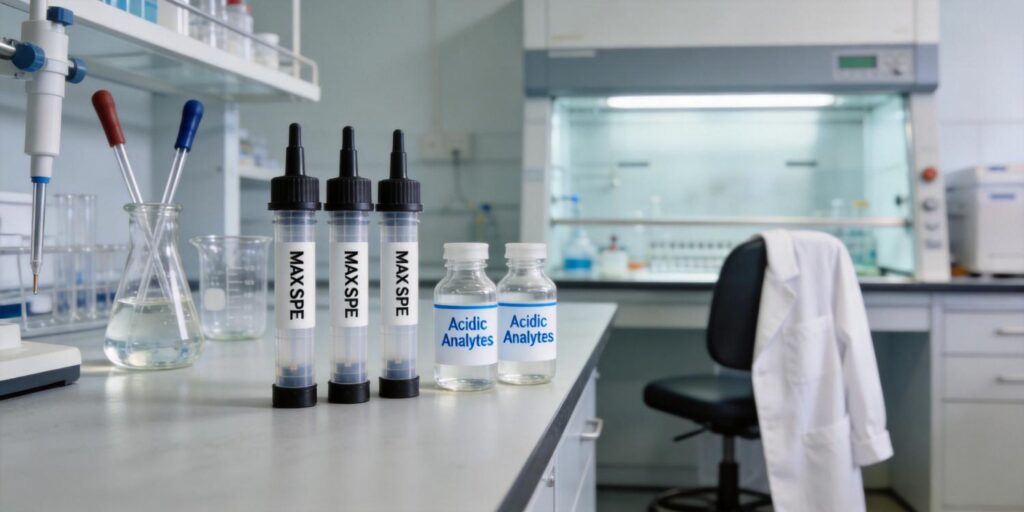
Chemical Characteristics of Acidic Herbicides
Acidic herbicides such as 2,4-D (2,4-dichlorophenoxyacetic acid) and dicamba (3,6-dichloro-2-methoxybenzoic acid) represent a critical class of agricultural chemicals requiring specialized extraction methodologies. These compounds share common structural features including carboxylic acid functional groups that impart acidic properties with pKa values typically ranging from 2.6-2.8 for 2,4-D and approximately 2.2 for dicamba. Their chemical behavior in aqueous environments is governed by these ionization characteristics, which directly influence their solubility, mobility, and extraction efficiency.
Research by Rao and Davidson (1981) established that 2,4-D has a log Pow value of approximately 2.6-2.8, while simazine (a related compound) has a log Pow of 1.94. These relatively low partition coefficients indicate moderate hydrophobicity, making these compounds challenging to extract using conventional reversed-phase mechanisms alone. The presence of chlorine substituents in both 2,4-D and dicamba enhances their environmental persistence while also influencing their interaction with solid-phase extraction sorbents.
Structural Implications for SPE
The carboxylic acid groups in these herbicides create opportunities for multiple retention mechanisms. While traditional reversed-phase extraction can provide some retention through hydrophobic interactions with the aromatic rings and chlorine substituents, optimal recovery requires leveraging the ionic characteristics of these analytes. As noted in forensic applications, “acidic compounds are negatively charged above their pKa“—a fundamental principle that guides method development for these challenging analytes.
pH Adjustment for Analyte Ionization
The cornerstone of successful MAX SPE extraction for acidic herbicides lies in precise pH control. For acidic compounds with pKa values in the 2-8 range, alkaline conditions (typically pH 8-10) ensure complete ionization of the carboxylic acid groups. This transformation from neutral molecules to negatively charged anions enables strong retention through anion-exchange mechanisms while simultaneously enhancing water solubility.
According to established ion-exchange principles, “to get approximately 100% ionization you must be 2 full pH units above the appropriate pKa of the compound for acids.” For 2,4-D with a pKa of approximately 2.8, adjusting water samples to pH 8-10 ensures >99% ionization. This pH manipulation serves dual purposes: it maximizes ionic interaction with the MAX sorbent’s anion-exchange sites while minimizing non-specific binding through hydrophobic mechanisms that might otherwise lead to poor recovery.
Practical Considerations for Water Samples
Environmental water samples present unique challenges for pH adjustment. The presence of dissolved organic matter (DOM) and humic substances can buffer samples and interfere with precise pH control. Research by Senseman et al. (1995) demonstrated that “effects of humic acid on reduced recovery of pesticides, greater at pH 6 than at pH 8, were postulated to be due to increased neutral character of the DOC as pH is lowered.” Therefore, thorough mixing and verification of final pH after adjustment are critical steps in method reliability.
MAX Cartridge Conditioning Protocol
Proper conditioning of MAX (Mixed-mode Anion eXchange) cartridges establishes the foundation for reproducible extraction. The Oasis MAX sorbent, as described in Waters documentation, “has a tightly controlled ion-exchange capacity of 0.25 meq/g, ensuring reproducible SPE protocols for extraction of acidic compounds.” This consistency is particularly valuable for environmental monitoring where regulatory compliance demands method robustness.
The conditioning sequence typically involves:
- Methanol (5-10 mL): Activates the polymeric backbone and removes any residual contaminants from manufacturing
- Deionized water (5-10 mL): Re-equilibrates the sorbent to aqueous conditions and prepares the ion-exchange sites
- Alkaline buffer (optional): Some methods include a final conditioning with pH-adjusted water matching the sample pH
Critical to this process is maintaining a small volume of conditioning solvent above the sorbent bed to prevent drying, which can compromise retention efficiency. As noted in SPE optimization guidelines, “Leave ~1-2 mm of preconditioning solvent above sorbent bed to prevent bed from drying.”
Controlled Flow Rate Sample Loading
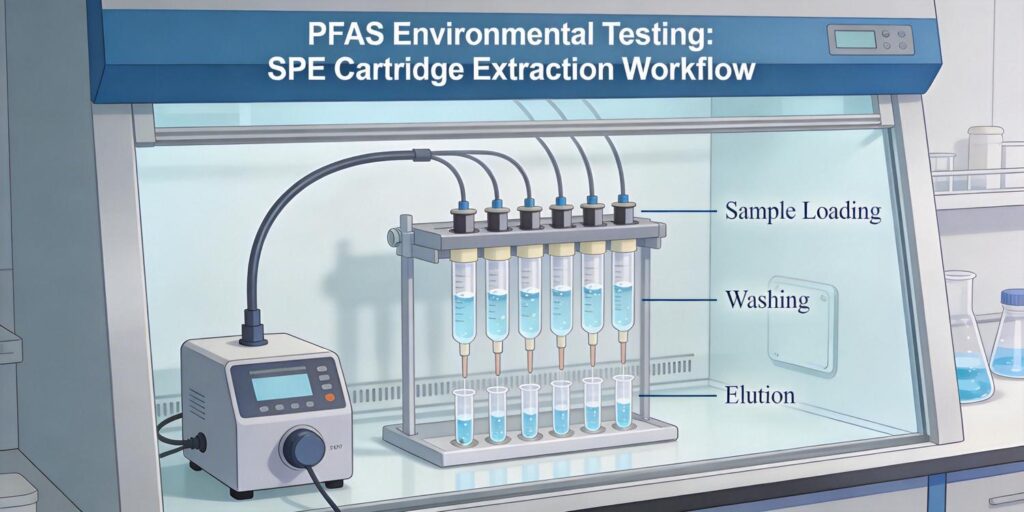
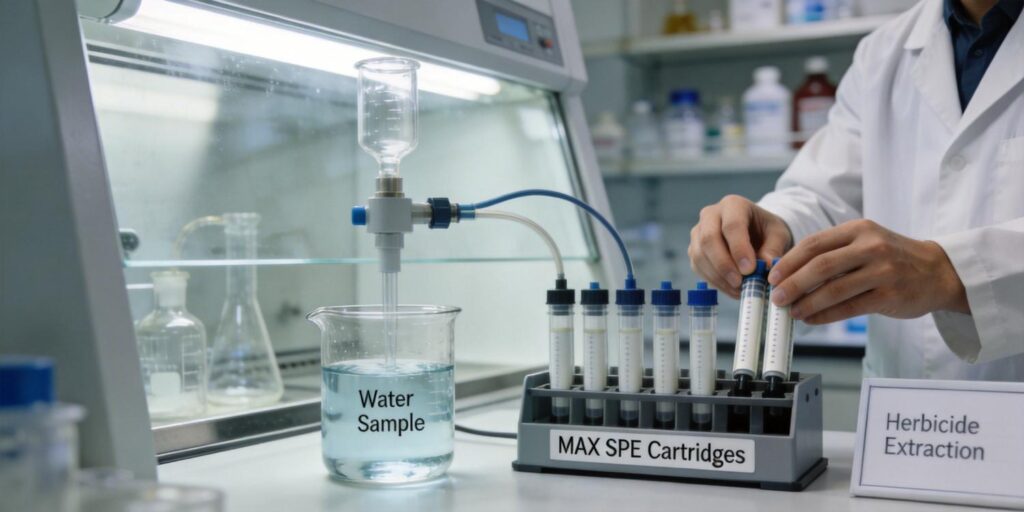
Sample loading represents the most critical phase for quantitative recovery of acidic herbicides. The adjusted water sample (typically 100-1000 mL for environmental applications) should be passed through the conditioned MAX cartridge at a controlled flow rate of 1-10 mL/min, depending on cartridge size and sample volume.
Research consistently demonstrates that “slower flow gives better results” for SPE applications. For MAX cartridges specifically, maintaining flow rates below 10 mL/min ensures:
- Sufficient contact time for ion-exchange interactions
- Complete mass transfer of analytes from aqueous phase to sorbent
- Minimization of channeling effects within the sorbent bed
Environmental applications often employ larger sample volumes (up to 1 liter) to achieve necessary detection limits for regulatory compliance. In these cases, the use of vacuum manifolds with adjustable flow control or positive pressure systems provides the precision needed for consistent recovery.
Aqueous Solvent Wash for Matrix Cleanup
Following sample loading, a carefully optimized wash step removes neutral and weakly acidic interferences while retaining target acidic herbicides. For MAX cartridges, typical wash protocols employ 5-10 mL of aqueous solutions containing 5-20% methanol or acetonitrile, often with mild alkaline conditions (pH 8-10) to maintain analyte ionization.
The wash serves multiple purposes:
- Removal of neutral contaminants: Hydrophobic compounds without ionizable groups are eluted while ionized acids remain retained
- Desalting: Inorganic salts and other water-soluble matrix components are washed through
- Reduction of matrix effects: Co-extracted humic substances and other natural organic matter are partially removed
As noted in forensic SPE applications, “ionic bonds are strong enough to allow the analyte to remain bound while interferences are washed away with high percentages (up to 100%) of polar or nonpolar organic solvents.” For acidic herbicides on MAX sorbents, maintaining the pH above the analytes’ pKa during washing ensures continued ionic retention.
Acidified Methanol Elution Strategy
Elution of retained acidic herbicides requires disruption of both ionic and hydrophobic interactions. Acidified methanol (typically 2-5% formic acid or acetic acid in methanol) serves as an effective elution solvent by:
- Protonating the analytes: Lowering the pH below the pKa converts ionized acids back to neutral molecules
- Disrupting ion-exchange: The acidic environment competes with analytes for anion-exchange sites
- Providing eluotropic strength: Methanol effectively disrupts hydrophobic interactions
Standard protocols recommend 3-10 mL of acidified methanol, with collection beginning after 0.5-1 mL of solvent has passed through the cartridge to ensure complete elution. Allowing the elution solvent to soak in the cartridge for 0.5-1 minute before applying vacuum or pressure significantly improves recovery, as noted in SPE optimization guidelines: “Allow cartridge/plate to soak with eluent for 0.5 – 1 min. (↑ recovery).”
Elution Volume Optimization
For maximum recovery, multiple small aliquots of elution solvent often prove more effective than a single large volume. This approach ensures complete displacement of analytes from all retention sites while minimizing final extract volume for subsequent concentration steps.
LC-MS Detection and Calibration Strategy
Following SPE extraction and appropriate concentration (typically to 0.5-1.0 mL), acidic herbicides are ideally suited for LC-MS/MS analysis. The compatibility of MAX extracts with mass spectrometric detection stems from the clean extracts produced by the mixed-mode mechanism, which significantly reduces matrix effects compared to simpler extraction approaches.
Chromatographic Conditions
Modern UPLC systems paired with BEH C18 columns (e.g., 2.1 × 100 mm, 1.7 μm) provide excellent separation of acidic herbicides. Typical mobile phases consist of:
- Mobile Phase A: Water with 0.1% formic acid
- Mobile Phase B: Methanol or acetonitrile with 0.1% formic acid
Gradient elution from 90% A to 100% B over 7-10 minutes effectively separates 2,4-D, dicamba, and related acidic herbicides from potential interferences.
Mass Spectrometric Detection
Electrospray ionization in negative mode (ESI-) provides optimal sensitivity for acidic herbicides due to their propensity to form stable deprotonated molecules [M-H]–. Multiple Reaction Monitoring (MRM) transitions offer the specificity required for regulatory applications:
- 2,4-D: m/z 219 → 161 (quantifier) and 219 → 125 (qualifier)
- Dicamba: m/z 219 → 175 (quantifier) and 219 → 127 (qualifier)
Instrument parameters typically include capillary voltage of 1-3 kV, desolvation gas flow of 800-1000 L/hr at 400-500°C, and source temperature of 120-150°C.
Calibration and Quality Assurance
A robust calibration strategy employs isotopically labeled internal standards (e.g., 2,4-D-d3, dicamba-d3) to correct for matrix effects and recovery variations. Calibration curves spanning 0.1-100 μg/L typically demonstrate excellent linearity (R2 > 0.995) for environmental water applications.
Quality control measures should include:
- Method blanks: To monitor laboratory contamination
- Laboratory control samples: Fortified at known concentrations to verify recovery
- Matrix spikes: To assess matrix effects in different water types
- Continuing calibration verification: Periodic checks of calibration standards
Method Performance and Applications
The MAX SPE method for acidic herbicides delivers consistent recoveries of 85-110% with relative standard deviations typically below 10% for replicate analyses. This performance meets or exceeds requirements for environmental monitoring programs including EPA methods for pesticide analysis in water.
Applications extend beyond basic environmental monitoring to include:
- Drinking water compliance testing
- Agricultural runoff monitoring
- Groundwater contamination studies
- Wastewater treatment evaluation
The method’s robustness against matrix variations, particularly dissolved organic matter, makes it particularly valuable for analyzing surface waters with high humic content. As research by Sutherland (1994) demonstrated, “no detrimental effect due to the presence of DOM on recovery of 2,4-D or simazine was noted” when using appropriate SPE methodologies.
Conclusion
The MAX SPE method represents a sophisticated approach to extracting acidic herbicides from water samples, leveraging mixed-mode retention mechanisms to achieve superior selectivity and recovery compared to traditional methods. By understanding the chemical characteristics of target analytes, precisely controlling pH throughout the extraction process, and optimizing each SPE step, analysts can achieve detection limits in the low ng/L range required for modern environmental monitoring.
For laboratories considering method implementation or optimization, the Poseidon Scientific MAX SPE cartridges offer the consistent performance and low extractable levels necessary for reliable trace analysis. When paired with appropriate LC-MS/MS instrumentation and rigorous quality control procedures, this methodology provides a robust solution for monitoring acidic herbicide contamination in diverse water matrices.