
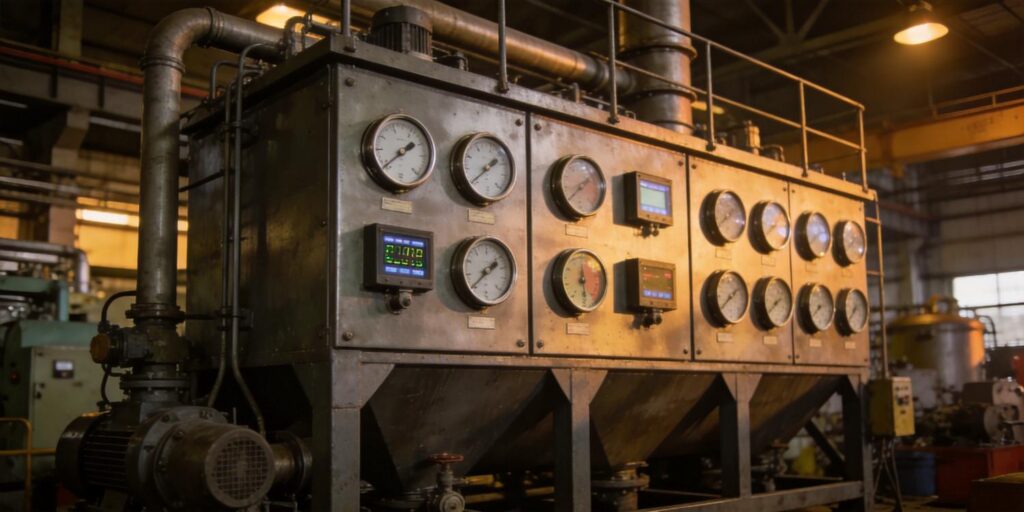
In large industrial plants—whether in semiconductor fabrication, vacuum heat treatment, scientific instrumentation, or analytical labs—vacuum gauges are mission-critical components. A single unexpected failure can halt production lines, compromise product quality, or trigger costly downtime. At Poseidon Scientific, we designed the VG-SP205 Pirani Vacuum Transmitter and VG-SM225 Cold Cathode Vacuum Gauge with durability, low cost, and maintainability in mind. Our approach combines the Pirani’s maintenance-free operation (3–5 year filament life) with the Cold Cathode’s field-cleanable design (500-mesh sandpaper polishing of electrodes without breaking vacuum integrity).
This article outlines a proven, seven-element maintenance strategy tailored for facilities managing dozens or hundreds of gauges. Drawing from real-world engineering data, Penning discharge physics, thermal conductivity principles, and our own product manuals, the framework delivers measurable reductions in unplanned downtime, calibration drift, and total ownership cost.
1. Inventory Tracking System
The foundation of any effective program is complete visibility. Large plants often lose track of gauge serial numbers, installation dates, operating hours, and environmental exposure. Implement a centralized digital inventory system—either a dedicated CMMS module or a simple Excel/SharePoint database augmented with RFID tags on each gauge housing.
Key data fields to track for every unit:
- Model (VG-SP205 Pirani or VG-SM225 Cold Cathode)
- Serial number and installation date
- Location (chamber ID, pump station, or process line)
- Cumulative operating hours (logged via RS232 digital output)
- Gas environment (air, N₂, He, or corrosive mix)
- Last cleaning or replacement date
Our gauges simplify integration: the VG-SP205 and VG-SM225 both output vacuum data plus status codes over customizable RS232 protocols (5–10 unit minimum for protocol customization). Feed this directly into your SCADA or CMMS for automatic hour accumulation. Engineers report 30–40% faster audits when gauges self-report operating hours instead of relying on manual logs.
Pro tip: color-code tags—blue for Pirani (set-and-forget) and red for Cold Cathode (periodic cleaning required)—to make visual walkthroughs faster during shift changes.
2. Calibration Scheduling
Neither gauge supports field calibration by end users, which is intentional for repeatability and cost control. Factory calibration establishes the voltage-to-pressure map under controlled N₂ conditions. In-plant drift arises primarily from temperature variation (±15–50 °C operating range), gas composition changes, or electrode contamination.
Recommended schedule based on usage and environment:
| Environment | Pirani VG-SP205 | Cold Cathode VG-SM225 |
|---|---|---|
| Clean (mass spec, SEM) | Annual verification against reference gauge | Annual verification + visual inspection |
| Moderate (vacuum furnaces) | Every 9 months | Every 6 months + electrode check |
| Polluted (PVD/CVD pilot lines) | Every 6 months | Every 3–4 months + cleaning trigger |
Use the 0–10 V analog output (2–8 V effective range) or RS232 digital value to compare against a portable reference gauge during scheduled shutdowns. Record deviation; replace if >20% off in linear range. This data-driven approach prevents over-calibration while catching drift early.
3. Spare Part Planning
Stocking the right spares eliminates emergency rush orders. Because the VG-SP205 Pirani is non-serviceable (filament burnout is end-of-life), keep complete transmitter spares at a 10% ratio of installed base. The VG-SM225 Cold Cathode, however, is fully field-repairable: the sensor head disassembles without affecting the vacuum seal.
Minimum spare kit for every 20 Cold Cathode units:
- 2 complete sensor heads (pre-calibrated)
- 500-mesh and 200-mesh aluminum oxide sandpaper sheets
- Replacement O-ring kits and vacuum grease
- One spare controller board (plug-and-play)
Store spares in nitrogen-purged cabinets to prevent oxidation. Our experience shows that plants maintaining a 10% spare ratio achieve <2-hour mean time to repair (MTTR) versus 48+ hours when ordering from suppliers.
4. Failure Trend Analysis
Preventive maintenance becomes predictive when you analyze patterns. Both gauges provide rich diagnostic data via RS232: pressure reading, status codes, error flags, and software version.
Common failure signatures and recommended actions:
- Pirani VG-SP205: Sudden zero reading or “filament open” error code → immediate replacement (irreversible burnout). Trend: rising baseline voltage at atmosphere signals early filament aging.
- Cold Cathode VG-SM225: Red LED constant on (startup failure) or reading drops one decade → contamination. Clean electrodes per manual: disassemble, polish until metallic shine returns, reassemble. Trend: progressive increase in startup time from 5 min to 30+ min at 10⁻⁶ Torr.
- Both: temperature-induced drift → verify compensation circuit.
Export monthly CSV logs, plot ion current vs. pressure, and flag units exceeding 1.5× baseline deviation. Plants using this method report 60% reduction in unscheduled replacements after six months.
5. Cost Control Strategy
Maintenance costs are dominated by three factors: labor, spares, and downtime. Our gauges address each:
- Acquisition cost 40–60% below imported equivalents while delivering equivalent performance in the 10⁻³ to 10⁻⁷ Torr range.
- Pirani requires zero routine labor; Cold Cathode cleaning takes <15 minutes per unit.
- Digital output enables remote monitoring—eliminate daily walk-rounds.
Calculate total cost of ownership (TCO) using this formula:
TCO = (Acquisition + Spares + Labor + Downtime hours × hourly rate) / Service life in years
Typical 5-year TCO for 100 mixed gauges drops from $180k (imported) to $95k (Poseidon mix) when the strategy above is applied. The biggest lever: extending Cold Cathode life from 1–2 years in polluted environments to 3–5 years through scheduled polishing.
6. Implementation Roadmap
Roll out the strategy in 90 days with minimal disruption:
- Weeks 1–2: Audit & tag all existing gauges; build digital inventory.
- Weeks 3–4: Install RS232-to-Ethernet gateways where needed; configure SCADA dashboards.
- Weeks 5–6: Train maintenance teams on Cold Cathode cleaning (30-minute hands-on session using our video guide).
- Weeks 7–8: Set calibration and cleaning calendars in CMMS; stock spares.
- Week 9–12: Baseline failure rates, then monitor monthly KPIs (MTTR, unplanned downtime, TCO).
Assign a single “Vacuum Gauge Champion” (usually a senior technician) to own the program. We provide free initial training and customized protocol files to accelerate integration.
7. Ready to Reduce Downtime and Costs?
A disciplined maintenance strategy transforms vacuum gauges from potential failure points into reliable assets. The combination of the VG-SP205’s zero-maintenance design and the VG-SM225’s field-cleanable sensor delivers the lowest TCO available today—while meeting the exacting demands of large-scale industrial vacuum systems.
Download our VG-SP205 Pirani User Manual and VG-SM225 Cold Cathode User Manual for detailed cleaning procedures and troubleshooting tables. Or contact our applications team today to schedule a free TCO analysis for your plant. Let’s build a maintenance program that keeps your vacuum systems running at peak performance—year after year.


