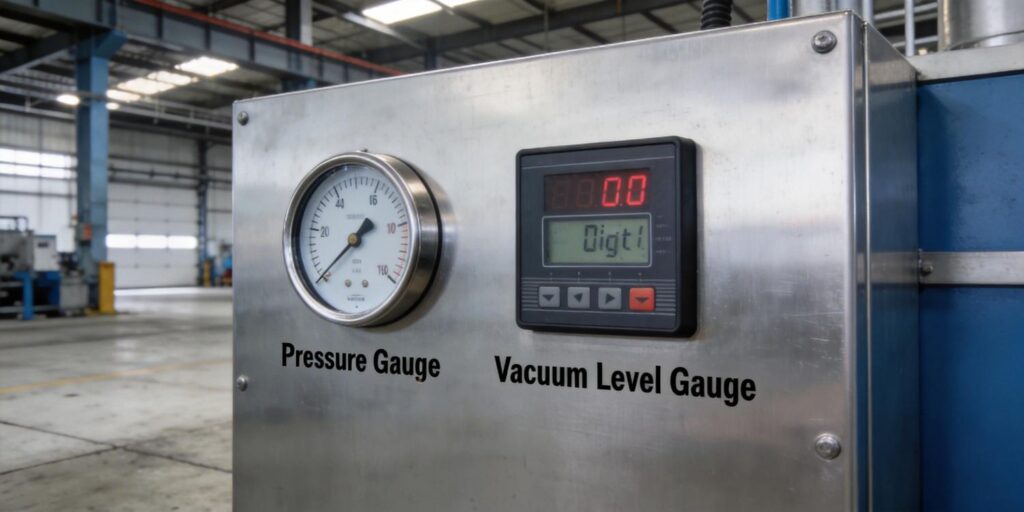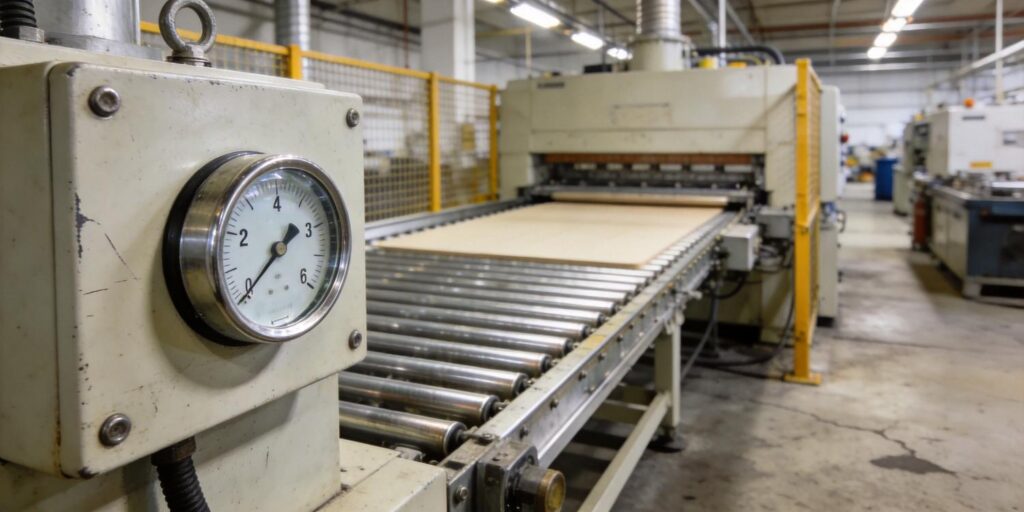
Vacuum forming remains one of the most cost-effective methods for producing large, lightweight thermoplastic parts used in automotive interiors, medical device packaging, and consumer appliance housings. Consistent part quality depends on repeatable vacuum levels, rapid pump-down, and reliable pressure feedback throughout every cycle. Poseidon Scientific’s VG-SP205 Pirani Vacuum Transmitter and VG-SM225 Cold Cathode Vacuum Gauge deliver the exact monitoring performance required by modern vacuum forming machines—without the high cost or maintenance burden of imported alternatives. The VG-SP205 handles the rough-to-medium vacuum range (atmosphere to 10⁻³ Torr) that dominates forming processes, while the VG-SM225 provides optional deeper vacuum confirmation when machines incorporate pre-evacuation or hybrid forming steps.
Vacuum Forming Pressure Requirements
Standard vacuum forming operates in the rough-to-medium vacuum regime. Typical target pressures range from 100 mbar (≈75 Torr) down to 10 mbar (≈7.5 Torr) for most sheet thicknesses and mold geometries. Deeper levels below 1 mbar are rarely needed except in high-precision applications such as optical lenses or medical trays, where residual air pockets must be eliminated completely.
The VG-SP205 Pirani Vacuum Transmitter is purpose-built for this window. Its platinum filament maintains constant temperature while measuring the power required to counteract gas cooling—directly proportional to molecular density from atmosphere to 10⁻³ Torr. The linear response region (10 Torr to 10⁻² Torr) delivers the accuracy and repeatability (±5 % in the operating band) that forming engineers need to achieve uniform material draw and avoid webbing or thinning defects. Unlike capacitance manometers or mechanical gauges, the Pirani provides fast, continuous output without moving parts or high replacement costs.
For machines that incorporate a pre-vacuum stage or switch to deeper evacuation (for example, in skin-pack or plug-assist forming), the VG-SM225 Cold Cathode Vacuum Gauge seamlessly extends coverage to 10⁻⁷ Torr. Its positive-magnetron Penning discharge and compact sensor volume ensure the chamber reaches the required base pressure before heating or forming begins. Together, the two gauges eliminate measurement gaps, giving operators full visibility from atmosphere through the entire forming cycle.
Typical Pressure Targets in Vacuum Forming
- Initial draw: 200–100 mbar (fast roughing)
- Forming vacuum: 50–10 mbar (material conformation)
- Hold pressure: <10 mbar for precision parts
- Optional deep vacuum (hybrid machines): 10⁻³–10⁻⁴ mbar
Rapid Evacuation Detection
Vacuum forming cycles are time-critical. Pump-down from atmosphere to forming pressure must occur in 5–15 seconds to maintain production rates of 10–30 parts per minute. Any delay in detecting the target vacuum wastes energy and reduces throughput.
The VG-SP205’s thermal-conductivity principle responds almost instantly to pressure changes. Its short platinum filament (20–30 mm) and constant-temperature control circuit track rising or falling edges with sub-second resolution in the critical 100–10 mbar band. Engineers use the 0–10 V analog output (effective 2–8 V range) to trigger the forming sequence the moment the set point is reached—eliminating guesswork and ensuring every cycle starts at exactly the same vacuum level.
The VG-SM225 complements this during deeper evacuations. Its software-controlled high-voltage ramp (–2500 V startup, then –2000 V steady) and automatic shutoff above 10⁻³ Torr prevent unnecessary power draw while confirming the chamber is ready. In high-speed rotary or inline machines, the combined gauge pair enables closed-loop control that shortens cycle times by up to 20 % compared with slower mechanical or single-range sensors.
Both instruments feature RJ45 interfaces (field-changeable to DB9/DB15) and fully customizable RS-232 protocols—even for orders as small as 5–10 units. This flexibility lets machine builders integrate the gauges directly into existing PLCs without additional converters, delivering real-time pressure data for both operator HMI and SCADA logging.
Sensor Robustness in Plastic Processing
Vacuum forming environments expose sensors to heat, plastic vapors, and occasional particulates. Heated sheets can outgas plasticizers or release fine dust during trimming. Traditional hot-filament gauges suffer burnout or contamination; imported cold-cathode units often require frequent, expensive replacement.
The VG-SP205 eliminates filament burnout risk through its maintenance-free platinum filament. Platinum’s high chemical stability and large temperature coefficient of resistance provide excellent resistance to organic vapors common in PVC, PET, and polystyrene forming. The gauge operates reliably from 15 °C to 50 °C—covering the full range of forming machine ambient and platen temperatures—with built-in compensation that keeps readings stable despite daily thermal swings.
The VG-SM225 adds further durability. Its stainless-steel electrodes and removable sensor head allow quick cleaning with 500-mesh sandpaper to remove any deposited films without breaking the vacuum seal. The positive-magnetron geometry and 100-gauss neodymium magnet keep internal volume small (comparable to industry-leading compact designs), minimizing contamination accumulation. Both gauges achieve leak rates below 10⁻¹¹ Pa·m³/s and arbitrary mounting orientation, simplifying installation on crowded forming platens or tool platens.
Field data from packaging and automotive suppliers show service life of 3–5 years in typical plastic-forming service—far exceeding the 12–18 months often seen with legacy gauges exposed to similar environments.
Integration with Forming Cycle
Modern vacuum forming machines run fully automated cycles controlled by PLC or CNC. Vacuum status must integrate directly into the sequence: heat → evacuate → form → cool → vent.
The 0–10 V analog output from both Poseidon gauges connects straight to any industrial PLC analog input card. Engineers map the signal to simple set points—for example, “form enable” at 20 mbar and “cycle complete” at 5 mbar hold. The customizable digital RS-232 output adds status codes, error flags, and software version for advanced diagnostics and predictive maintenance alerts.
For machines with multiple forming stations, a single controller can monitor both the VG-SP205 (process vacuum) and VG-SM225 (base vacuum confirmation) via one RJ45 port. This dual-gauge architecture provides redundancy: the Pirani serves as primary during fast roughing, while the Cold Cathode verifies ultimate vacuum before high-precision forming steps. Integration is further simplified by the gauges’ compact size—significantly smaller than most imported equivalents—and low power consumption, allowing easy retrofits on existing machines without cabinet modifications.
Safety interlocks are equally straightforward. The VG-SM225’s automatic high-voltage shutoff above 10⁻³ Torr prevents arcing during vent sequences, while the Pirani’s continuous monitoring flags leaks or pump failures before they affect part quality.
Typical Integration Points
- Pump-down complete trigger (VG-SP205)
- Forming vacuum confirmation (both gauges)
- Leak detection during hold (VG-SM225)
- Vent sequence interlock (analog output)
Maintenance Planning
Production uptime is everything in vacuum forming. The VG-SP205 requires zero routine maintenance—its platinum filament and sealed design make it truly “install and forget.” The VG-SM225, when used, follows a simple schedule:
- Monthly: visual check of analog output stability and startup time
- Quarterly: compare reading against a reference gauge at 10 mbar
- Annually or as-needed: disassemble sensor head (5 minutes), sand electrodes to metallic luster with 500-mesh paper, reinstall
This cleaning restores original performance without recalibration or vacuum break. Because the sensor head is removable while the flange remains sealed, maintenance can be performed during scheduled tool changes with minimal downtime. The low internal volume and cleanable design keep total cost of ownership 40–60 % below imported cold-cathode gauges that often require full replacement after contamination.
Both gauges ship factory-calibrated against standard vacuum references. For critical applications, users can request traceability documentation or periodic recalibration services from Poseidon Scientific.
Ready to Upgrade Your Vacuum Forming Vacuum Control?
Whether you build new high-speed rotary forming lines, retrofit existing single-station machines, or supply OEM equipment to packaging and automotive customers, the VG-SP205 Pirani Vacuum Transmitter and VG-SM225 Cold Cathode Vacuum Gauge deliver the rapid response, robustness, and integration flexibility that modern vacuum forming demands—at a price point that protects margins.
- VG-SP205 Pirani Vacuum Transmitter – maintenance-free solution for all standard forming pressures and rapid evacuation
- VG-SM225 Cold Cathode Vacuum Gauge – compact high-vacuum confirmation with easy electrode cleaning
Contact the Poseidon Scientific applications team today for a free machine-specific integration guide, sample PLC ladder logic, or a side-by-side cost and performance comparison with your current gauges. Let us help you shorten cycle times, improve part consistency, and reduce maintenance costs in every vacuum forming application.