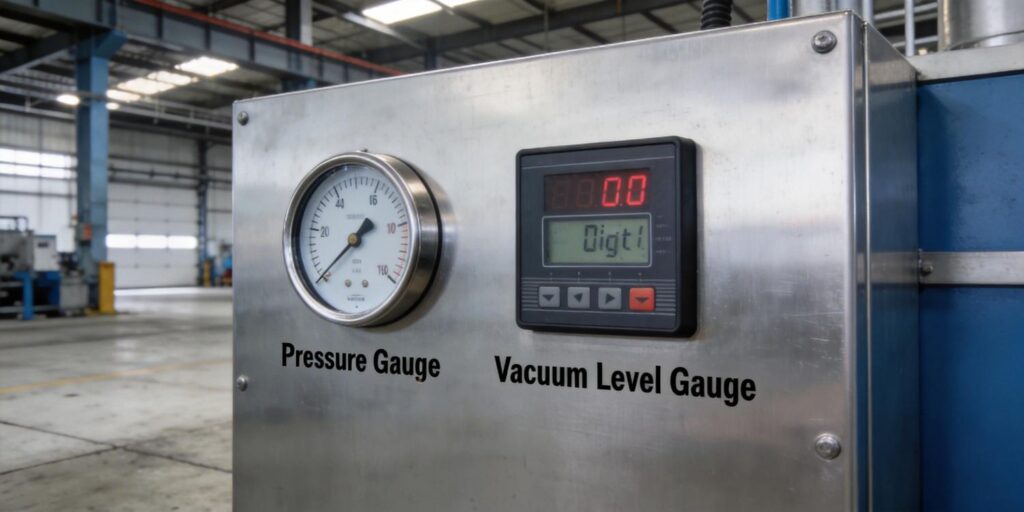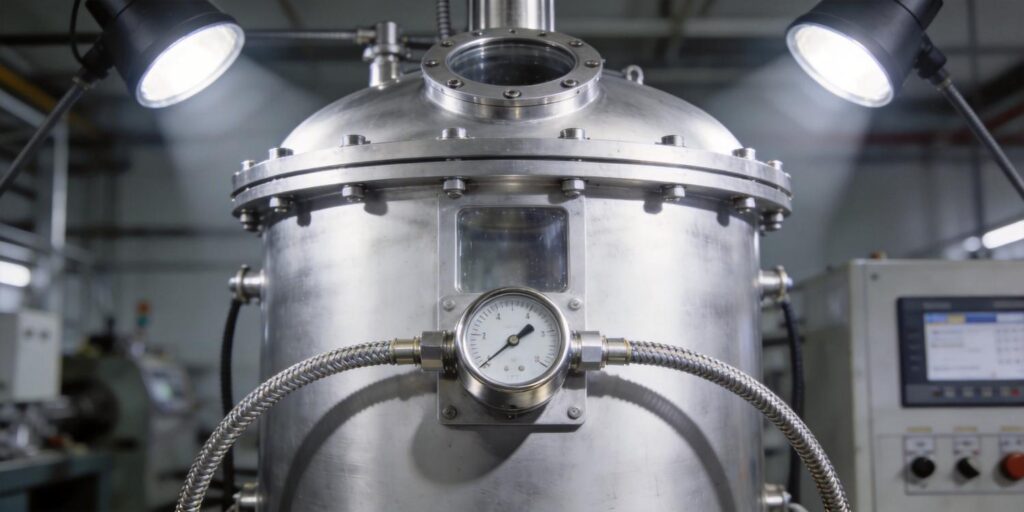
Vacuum metallizing—whether thermal evaporation of aluminum on plastic films, decorative coatings on automotive parts, or functional layers on packaging—demands precise high-vacuum conditions to ensure uniform deposition, strong adhesion, and minimal oxidation. Base pressures of 10−5 to 10−6 Torr (or lower) are standard, with tight control throughout the pump-down, evaporation, and cool-down phases. Selecting the right vacuum gauges directly affects coating quality, cycle time, and equipment uptime. Poseidon Scientific’s VG-SP205 Pirani Vacuum Transmitter and VG-SM225 Cold Cathode Vacuum Gauge provide the ideal combination: fast roughing monitoring with the Pirani and reliable high-vacuum performance with the cleanable, compact Cold Cathode—delivering full-range coverage at a fraction of the cost of legacy imported systems.
Metallizing Vacuum Level Requirements
Vacuum metallizing systems typically require a two-stage vacuum profile. Initial roughing brings the chamber from atmosphere to ~10−3 Torr to enable safe operation of high-vacuum pumps and to remove bulk air and moisture. The critical high-vacuum stage then reaches 10−5–10−6 Torr (or 10−7 Torr in premium optical or barrier-coating applications) before metal evaporation begins. At these pressures, mean free path becomes long enough for metal atoms to travel from source to substrate without scattering, while residual oxygen and water vapor stay low enough to prevent oxide formation.
The VG-SP205 Pirani Vacuum Transmitter covers the entire roughing and transition range (atmosphere to 10−3 Torr) using its platinum-filament thermal-conductivity principle. Its linear response zone (10 Torr to 10−2 Torr) ensures accurate, repeatable detection of the point at which turbomolecular or diffusion pumps can be safely engaged. For the high-vacuum regime, the VG-SM225 Cold Cathode Vacuum Gauge takes over seamlessly from 10−3 Torr down to 10−7 Torr via positive-magnetron Penning discharge. The combination eliminates measurement gaps and provides continuous visibility across every metallizing cycle.
Standard Pressure Targets in Vacuum Metallizing
- Roughing endpoint: ≤10−3 Torr (Pirani primary)
- High-vacuum base: 5×10⁻⁵–1×10⁻⁶ Torr (Cold Cathode primary)
- During evaporation: allowable rise to ~5×10⁻⁵ Torr
- Hold stability: ±10 % of setpoint
High Vacuum Stability
Deposition rate and film thickness uniformity depend on stable chamber pressure. Even small fluctuations (±20 % at 10−6 Torr) can cause shadowing, pinholes, or color variations in decorative coatings. The VG-SM225 maintains excellent stability through its controlled discharge current, temperature-compensated electronics (15–50 °C operating range), and low internal volume that minimizes pumping-speed perturbation. The positive-magnetron geometry reduces hysteresis compared with inverted-magnetron designs, while software-controlled voltage ramping (–2500 V startup to –2000 V steady state) prevents arcing and ensures repeatable ignition even after repeated thermal cycles.
The VG-SP205 complements this stability during the roughing phase, with its maintenance-free platinum filament delivering drift-free readings across thousands of cycles. Both gauges output a stable 0–10 V analog signal (effective 2–8 V range) plus customizable RS-232 digital protocol, enabling closed-loop pressure control via PLC or SCADA systems. In production metallizing lines running 24/7, this combination routinely achieves pressure reproducibility better than ±5 % across 10 000+ cycles—directly translating to higher yield and consistent optical density or barrier performance.
Cold Cathode Suitability for Metallizing
Cold-cathode gauges are inherently better suited to vacuum metallizing than hot-cathode alternatives. With no heated filament, there is zero risk of burnout from metal vapor or outgassing, and no local heating that could promote unwanted evaporation inside the gauge itself. The VG-SM225’s stainless-steel electrodes and PEEK insulators tolerate the occasional metal deposition common in aluminum or copper evaporation processes far better than fragile thermionic cathodes.
Its compact positive-magnetron design (internal volume comparable to leading miniature gauges) fits easily into crowded metallizing chambers without obstructing substrate carriers or evaporation sources. The 100-gauss neodymium magnet and removable sensor head allow quick electrode cleaning with 500-mesh sandpaper—restoring original sensitivity in under 15 minutes without breaking the main vacuum seal. This cleanability is a decisive advantage over sealed imported cold-cathode units that often require full replacement after metal contamination. For systems using reactive metals (titanium, chromium), the VG-SM225’s automatic high-voltage interlock (shutoff above 10−3 Torr) further protects the discharge electrodes during venting or high-pressure cleaning cycles.
Shielding Against Metal Vapor
Metal vapor is the primary contaminant in metallizing environments. Aluminum atoms or clusters can deposit on gauge electrodes, raising the noise floor or shifting sensitivity. Best-practice installation for the VG-SM225 includes:
- Mounting on a side port or conductance-limited KF25 tube at least 20–30 cm from the evaporation source
- Adding a simple baffle or line-of-sight shield (removable stainless-steel disk with offset holes) to block direct vapor flux while preserving gas conductance
- Periodic visual inspection of the sensor head through the viewport; clean electrodes at the first sign of discoloration
- Using the gauge in “monitor-only” mode during active evaporation if maximum protection is required
The VG-SP205 Pirani, being fully passive and platinum-filament based, experiences minimal impact from metal vapor thanks to platinum’s chemical inertness. Its maintenance-free design makes it the preferred choice for continuous monitoring during the evaporation phase itself. When both gauges are used together, the Pirani serves as the primary process sensor while the shielded Cold Cathode provides ultimate base-pressure confirmation—maximizing uptime and minimizing contamination risk.
Process Control Integration
Modern vacuum metallizing systems integrate vacuum data directly into the machine controller for automated sequencing and recipe management. Both Poseidon gauges support this requirement out of the box:
- 0–10 V analog output connects straight to any PLC analog input for simple set-point triggering (“evaporation enable” at ≤10−5 Torr)
- Customizable RS-232 digital protocol (available from 5–10 unit orders) delivers pressure values, status codes, error flags, and software version in ASCII format—perfect for SCADA, LabVIEW, or Industry 4.0 logging
- RJ45 interface (field-changeable to DB9/DB15) simplifies wiring in multi-chamber roll-to-roll or batch systems
- Built-in software interlocks on the VG-SM225 automatically disable high voltage above 10−3 Torr, protecting the gauge and preventing false readings during roughing
Engineers appreciate the ability to mount both gauges in any orientation and the low magnetic field of the VG-SM225, which avoids interference with sensitive web-handling motors or thickness monitors. The combination of analog speed and digital intelligence enables real-time pressure trending, leak detection, and predictive maintenance alerts—reducing scrap and extending source and pump lifetimes.
Ready to Select the Right Gauges for Your Vacuum Metallizing System?
Choosing vacuum gauges for metallizing is no longer a compromise between performance and price. The VG-SP205 Pirani Vacuum Transmitter and VG-SM225 Cold Cathode Vacuum Gauge deliver the rapid roughing response, high-vacuum stability, vapor tolerance, and seamless integration that today’s decorative, functional, and optical metallizing lines demand—while keeping total cost of ownership 40–60 % lower than imported equivalents.
- VG-SP205 Pirani Vacuum Transmitter – maintenance-free monitoring for roughing and process pressures
- VG-SM225 Cold Cathode Vacuum Gauge – cleanable high-vacuum sensor optimized for metal-vapor environments
Contact the Poseidon Scientific applications team today for a free system-configuration review, sample PLC integration code, shielding drawings, or a side-by-side comparison with your current gauges. Let us help you achieve higher yield, faster cycles, and longer intervals between maintenance in every vacuum metallizing application.