Introduction to Organic Acid Analysis in Fermentation
Fermentation broths are complex matrices containing a wide variety of metabolites, including organic acids such as lactic acid, acetic acid, and succinic acid. These compounds are critical indicators of microbial metabolic activity and are often monitored for process optimization in biotechnology. Accurate quantification of organic acids requires efficient sample preparation to remove interfering components like proteins, sugars, and salts. Solid-phase extraction (SPE) using weak anion-exchange (WAX) sorbents offers a selective and reproducible method for isolating organic acids from fermentation samples prior to HPLC or LC-MS analysis.
Why Choose WAX for Organic Acids?
WAX sorbents feature a weak anion-exchange functional group, typically a secondary or tertiary amine, that retains analytes through electrostatic interactions. At a pH above the pKa of the sorbent (typically around pH 6–8), the sorbent is positively charged and retains anions. Organic acids, which are negatively charged at pH values above their pKa values (e.g., lactic acid pKa ~3.86, acetic acid pKa ~4.76, succinic acid pKa1 ~4.21, pKa2 ~5.64), can be selectively bound under neutral to slightly basic conditions. This mechanism allows for efficient retention while neutral and cationic species pass through during the wash step.
Sample Pretreatment
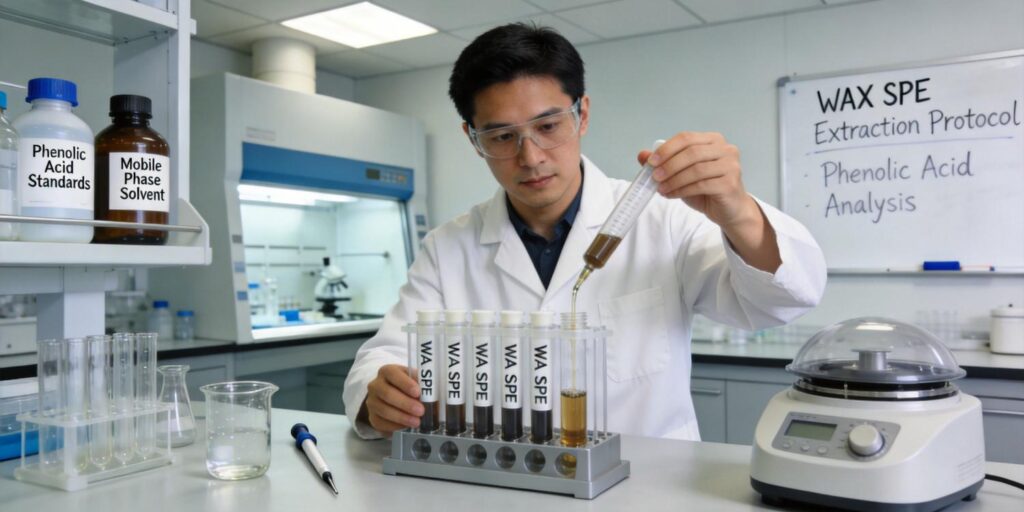
Fermentation broth samples often contain high levels of proteins, cells, and particulate matter. Before SPE, it is recommended to centrifuge the broth at 10,000 × g for 10 minutes to remove cells and large debris. The supernatant should then be filtered through a 0.22 μm membrane filter to ensure particle-free loading. If protein content is high, a protein precipitation step with acetonitrile or methanol (1:1 v/v) followed by centrifugation can be employed. The clarified sample pH should be adjusted to 6–7 using a dilute base such as ammonium hydroxide to ensure the organic acids are in their anionic form for optimal retention on WAX.
Cartridge Conditioning and Equilibration
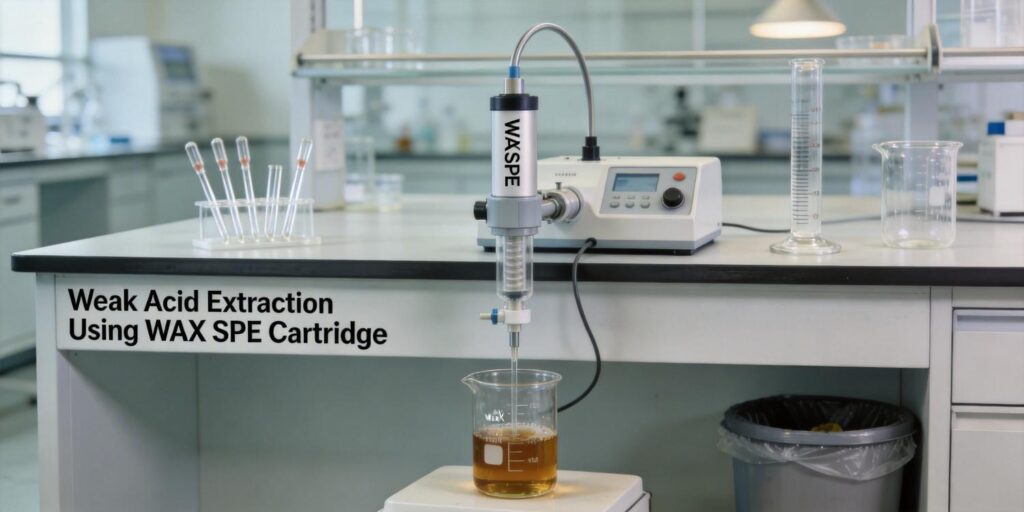
For optimal performance, the WAX SPE cartridge should be conditioned with methanol (1 cartridge volume) followed by water (1 volume) to wet the sorbent. Equilibrate with a buffer at pH 6–7, such as 20 mM ammonium acetate, to ensure the sorbent is in the correct ionization state. Avoid using phosphate buffers as they may interfere with subsequent LC-MS analysis.
Sample Loading and Wash
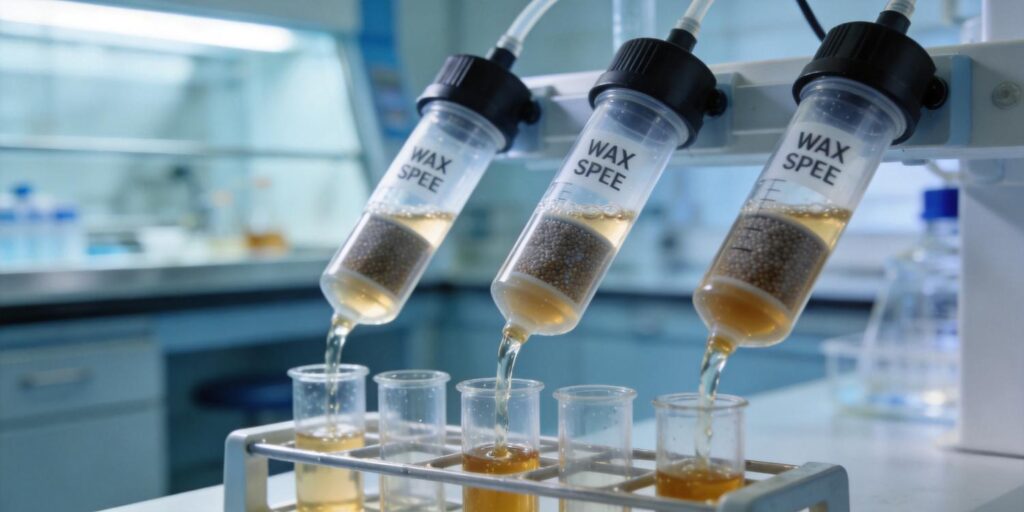
Load the pretreated sample (typically 1–5 mL depending on cartridge capacity) at a flow rate of 1–2 mL/min. The organic acids will be retained via anion exchange. To remove proteins and sugars, wash the cartridge with 2–3 mL of 20 mM ammonium acetate buffer at pH 6 containing 5% methanol. This step effectively elutes neutral sugars and minimally retains protein fragments, while the organic acids remain bound due to the weak anion-exchange interaction. For more complex samples, an additional wash with 20% methanol in buffer can be used to enhance removal of hydrophobic interferences.
Elution of Organic Acids
Elution is achieved by disrupting the ionic interaction using an acidic solvent mixture. A typical elution solvent is 2% formic acid in acetonitrile/water (80:20, v/v) or 5% ammonia in methanol for LC-MS compatibility. Collect the eluate (1–2 mL) and evaporate under a nitrogen stream if concentration is needed. For direct injection, the eluate can be diluted with water or mobile phase to match the initial HPLC conditions.
Quantitative Analysis by HPLC or LC-MS
The purified organic acid extract can be analyzed by HPLC using a reversed-phase C18 column with a mobile phase of 0.1% phosphoric acid in water (pH ~2.2) at 210 nm detection. For LC-MS, a volatile acid such as 0.1% formic acid in water/acetonitrile gradient is recommended. Typical recoveries for lactic, acetic, and succinic acids using WAX SPE range from 85–105% with good precision (RSD <5%).
Application in Biotechnology Process Monitoring
Regular monitoring of organic acid concentrations in fermentation broths is essential for controlling metabolic pathways and maximizing yield. For example, in lactic acid fermentation by Lactobacillus species, lactic acid levels indicate sugar consumption and product formation. In succinic acid production by engineered E. coli, accurate tracking of succinate accumulation and byproduct formation (acetate) is critical. The WAX SPE method provides a robust, high-throughput solution for sample preparation in these processes, enabling real-time insights into fermentation dynamics.
Conclusion
Weak anion-exchange SPE is a powerful tool for organic acid analysis in fermentation broths. Its selectivity, reproducibility, and compatibility with downstream analytical methods make it a preferred choice for bioprocess monitoring. For laboratories seeking reliable SPE products, Poseidon Scientific offers high-quality WAX SPE cartridges and 96-well SPE plates designed for demanding applications.