Understanding Alkaloid Chemistry and Protonation Behavior
Alkaloids are nitrogen-containing organic compounds widely distributed in plants, fungi, and some animals. They exhibit diverse pharmacological activities and are often the target analytes in herbal product analysis. The key to selective isolation of alkaloids using solid-phase extraction lies in their protonation behavior. Alkaloids have one or more basic nitrogen atoms that can accept a proton in acidic conditions, forming positively charged (cationic) species. The pKa values of alkaloid nitrogen groups typically range from 6 to 10, meaning they are protonated at pH values below their pKa. In strongly acidic conditions, alkaloids exist as cations, while neutral or basic conditions lead to deprotonation and neutral forms. This pH-dependent charge state is exploited in strong cation-exchange SPE to achieve selective retention and elution.
Strong Cation-Exchange Sorbent Structure
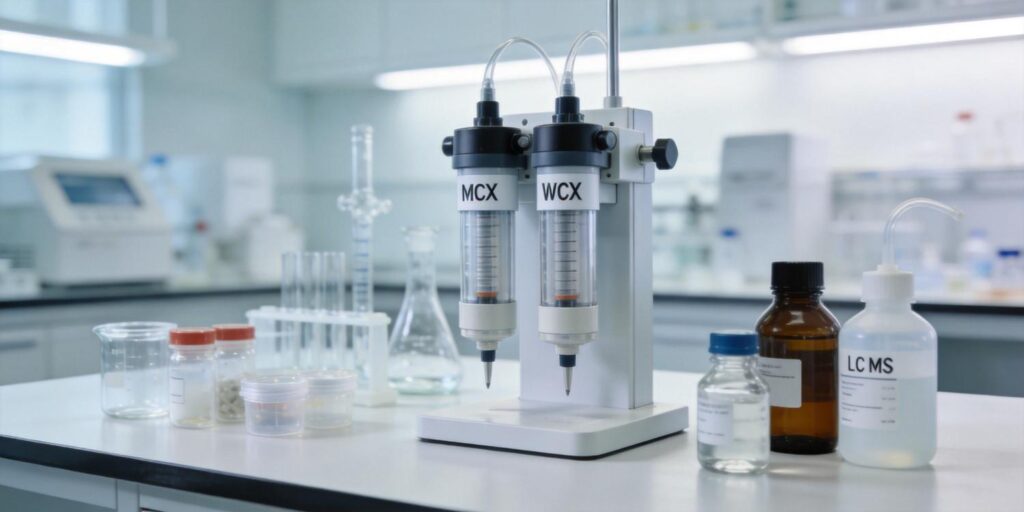
The MCX SPE cartridge (Mixed-mode Strong Cation eXchange) from Poseidon Scientific features a sorbent that combines a reversed-phase (hydrophobic) C18-like backbone with a strong cation-exchange functional group, typically sulfonic acid (-SO₃⁻). The sulfonic acid group is fully ionized across a wide pH range (pH 2–8), providing a permanent negative charge that can strongly bind cationic analytes via electrostatic interactions. This dual-mode mechanism allows the sorbent to retain both hydrophobic and ionic compounds, making MCX ideal for complex plant extracts containing alkaloids, pigments, and lipids.
Sample Preparation for Plant Extracts
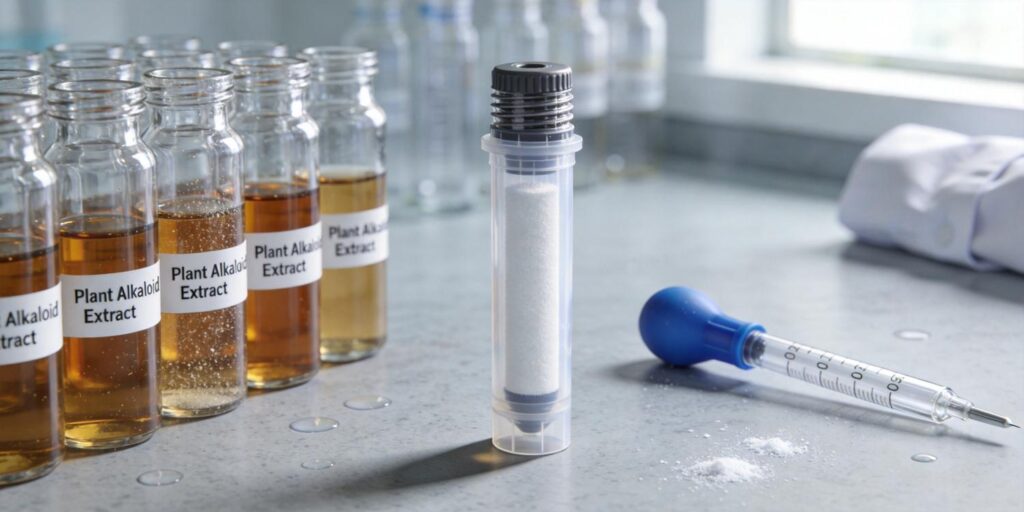
Plant materials such as roots, leaves, or bark are typically dried, ground, and extracted with a suitable solvent (e.g., methanol, ethanol, or acidified water). The crude extract contains a wide range of compounds including alkaloids, flavonoids, pigments (chlorophyll, carotenoids), lipids, and organic acids. Prior to SPE, the extract is usually acidified to pH 2–3 using an acid like hydrochloric acid or formic acid. Acidification ensures that basic alkaloids become protonated and positively charged, while acidic and neutral compounds remain neutral or negatively charged. The sample should be filtered through a 0.45 µm membrane to remove particulates that could clog the SPE cartridge.
pH Conditions to Ensure Analyte Binding
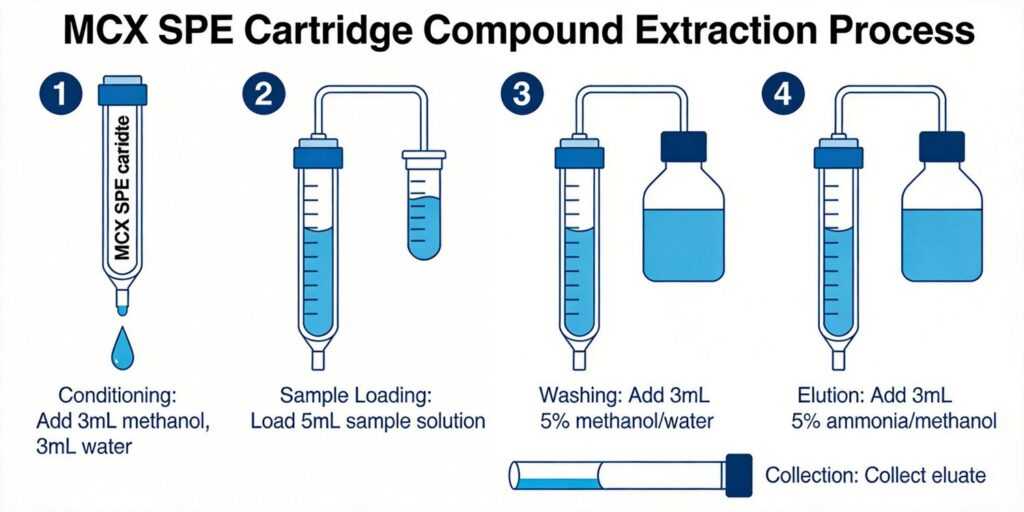
For effective binding of alkaloids to the MCX sorbent, the sample pH must be adjusted to 2–3. At this pH, alkaloids are fully protonated and bind strongly to the sulfonic acid groups via cation exchange. Meanwhile, neutral hydrophobic compounds (e.g., chlorophyll, triglycerides) are retained by reversed-phase interactions, but they can be selectively removed in later washing steps. The MCX sorbent is conditioned with methanol followed by water, then equilibrated with an acidic buffer (e.g., 0.1% formic acid in water) at pH 2–3 to activate the cation-exchange sites.
Washing Steps Removing Pigments and Lipids
After sample loading, the cartridge is washed to remove interferences. A first wash with 0.1% formic acid in water (pH 2–3) removes salts and polar neutral compounds. A second wash with methanol or acetonitrile (e.g., 100% methanol) efficiently elutes neutral hydrophobic compounds such as chlorophyll, carotenoids, and lipids that were retained by reversed-phase interactions, while the protonated alkaloids remain bound to the cation-exchange sites. This selective washing step is critical for obtaining a clean extract suitable for LC-MS analysis.
Elution with Ammonia-Containing Solvents
To release the bound alkaloids, the cation-exchange interaction must be disrupted. This is achieved by eluting with a basic solvent mixture, typically methanol containing 5% ammonia (NH₃) or ammonium hydroxide. The high pH (around 10–11) deprotonates the alkaloids, converting them back to neutral forms, and also neutralizes the sulfonic acid groups, breaking the electrostatic binding. The elution is usually performed with 2–5 mL of methanol/ammonia (95:5, v/v), collecting the eluate. The eluate is then evaporated to dryness under nitrogen and reconstituted in a suitable solvent for LC-MS analysis.
Example Workflow for Herbal Product Analysis
Consider the analysis of alkaloids in a commercial herbal supplement containing Berberis aristata (berberine). Step 1: Weigh 0.5 g of powdered supplement, add 10 mL of methanol:water (80:20) with 0.1% HCl, sonicate for 30 min, centrifuge, and filter. Step 2: Adjust pH to 2.5 with formic acid. Step 3: Condition an MCX cartridge (60 mg/3 mL) with 3 mL methanol, then 3 mL water, then 3 mL 0.1% formic acid. Step 4: Load the acidified sample (up to 5 mL) at 1 mL/min. Step 5: Wash with 3 mL 0.1% formic acid, then 3 mL methanol. Step 6: Elute with 3 mL methanol/ammonia (95:5). Step 7: Evaporate to dryness, reconstitute in 200 µL methanol, and inject into LC-MS. This workflow yields high recovery of berberine (>90%) with minimal matrix effects.
LC-MS Identification of Isolated Alkaloids
The eluted alkaloids are analyzed by liquid chromatography-mass spectrometry (LC-MS) using a C18 column (e.g., 2.1×100 mm, 1.7 µm) with a mobile phase of water (0.1% formic acid) and acetonitrile (0.1% formic acid) in gradient elution. Positive electrospray ionization (ESI+) is typically used due to the basic nature of alkaloids. Detection is performed in full-scan mode (m/z 100–1000) and targeted MS/MS for confirmation. For example, berberine shows [M]⁺ at m/z 336 and a characteristic fragment at m/z 320. The clean extract from MCX SPE ensures robust quantification and identification with minimal ion suppression.
For a comprehensive range of SPE products, explore Poseidon Scientific’s 96-well SPE plates and other specialized formats such as MAX, WAX, and WCX cartridges for diverse analytical needs.