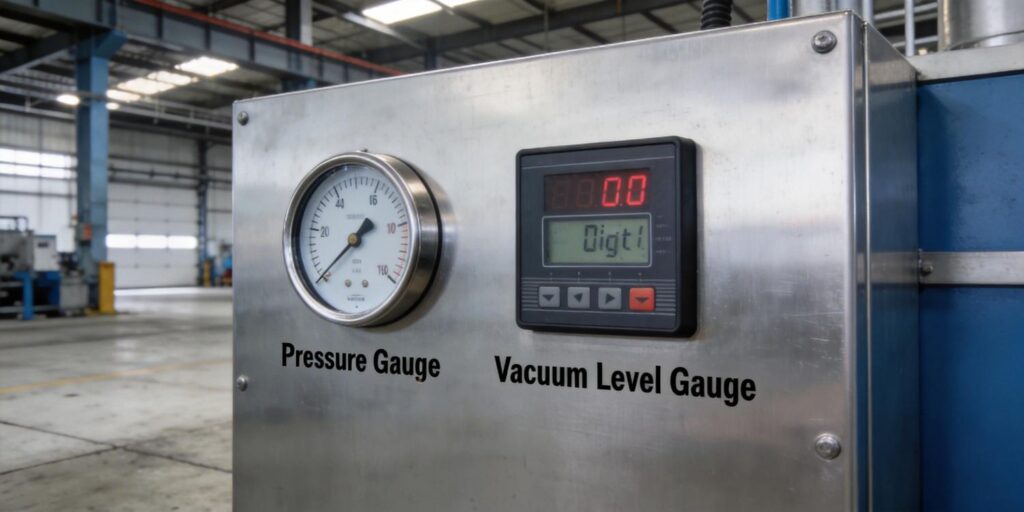
Required Vacuum Level for Aerospace Coating
Aerospace component manufacturing demands ultra-clean deposition environments for protective coatings on turbine blades, landing gear, satellite structures, and avionics hardware. Physical vapor deposition (PVD) processes—including electron-beam PVD for thermal barrier coatings (TBCs) and magnetron sputtering for wear-resistant layers—require base pressures typically between 10⁻⁵ and 10⁻⁷ Torr (1.33 × 10⁻³ to 1.33 × 10⁻⁵ Pa). These levels eliminate residual oxygen, water vapor, and hydrocarbons that would otherwise compromise coating adhesion, stoichiometry, and oxidation resistance at service temperatures exceeding 1,000 °C.
Process pressures during deposition may rise to 10⁻³–10⁻² Torr with argon or reactive gases, but the critical preconditioning step—pump-down to base vacuum—must be verified and logged before target evaporation or sputtering begins. Any contamination above 10⁻⁵ Torr risks premature coating failure under cyclic thermal and mechanical loads typical of flight profiles. The Poseidon Scientific VG-SM225 Cold Cathode Vacuum Gauge covers precisely this range (10⁻³ to 10⁻⁷ Torr) with Penning-discharge sensitivity that scales reliably with pressure, while the companion VG-SP205 Pirani Vacuum Transmitter handles the initial roughing phase from atmosphere to 10⁻³ Torr.
Measurement Redundancy
AS9100 Rev D and NADCAP-accredited processes mandate redundancy for critical vacuum measurements to eliminate single-point failures. Aerospace coating chambers therefore employ dual-gauge architectures: a primary high-vacuum sensor (VG-SM225) backed by a secondary unit at a geometrically offset location, plus a Pirani gauge for the full pump-down curve.
This configuration provides:
- Cross-verification of base pressure before coating initiation
- Independent leak detection during long pump-down cycles
- Fail-safe interlock capability—if either gauge exceeds the programmed threshold, the process aborts automatically
The VG-SM225’s compact footprint (KF flange, <50 mm protrusion) allows easy installation of redundant pairs without chamber redesign. Its removable sensor head further simplifies field replacement without breaking the main vacuum envelope. In practice, engineers set the primary gauge to trigger coating start at ≤5 × 10⁻⁶ Torr and the backup to confirm within ±10 % agreement.
Typical Redundant Architecture Table
| Stage | Primary Gauge | Redundant Gauge | Set Point |
|---|---|---|---|
| Roughing | VG-SP205 Pirani | VG-SP205 Pirani | ≤20 Torr |
| High-vacuum transition | VG-SM225 Cold Cathode | VG-SM225 Cold Cathode | ≤10⁻⁵ Torr |
| Deposition hold | VG-SM225 | VG-SM225 | Stable ±5 % |
Data Traceability Requirements
AS9100 clause 8.5.2 and 7.1.5.2 require full identification, configuration management, and measurement traceability for all monitoring equipment used in product acceptance. Every vacuum reading that influences coating acceptance must be:
- Time-stamped and linked to the specific part serial number
- Recorded with gauge serial number, calibration date, and correction factors
- Stored in tamper-evident digital format for the full product lifecycle
The VG-SM225 and VG-SP205 output both 0–10 V analog and RS232 digital streams (custom protocol available for 5–10 unit orders). The digital interface transmits pressure, gauge status, supply voltage, and internal temperature-compensated values every 50 ms. Integration with chamber SCADA or MES systems captures these data directly into the electronic batch record, satisfying FAA, EASA, and NADCAP audit requirements without manual transcription.
Factory calibration certificates—traceable to NIST-equivalent standards at multiple pressure points—are supplied with every unit. Annual recalibration service includes a new certificate and performance report, ensuring unbroken traceability chains.
Reliability Under Long Cycles
Aerospace coating cycles often exceed 8–24 hours, including ramp-up, deposition, and cool-down. Gauges must maintain stability without drift or unexpected shutdowns. The VG-SM225 inverted-magnetron design (axial magnetic field ~1200 G, –2000 V operating) minimizes discharge discontinuities and X-ray effects common in older Penning cells.
Key reliability features include:
- Automatic high-voltage shutdown above 10⁻³ Torr to prevent electrode damage
- Stainless-steel electrodes that can be cleaned in-situ with 500-mesh abrasive (no disassembly of chamber required)
- Internal ripple suppression <0.1 % and temperature compensation 0–50 °C
- Mean time between maintenance >3 years in clean vacuum environments typical of aerospace PVD
Long-term stability testing (24-hour continuous logging at 10⁻⁶ Torr) shows drift <9 % and short-term noise <±2 % with 2-second averaging—well within the ±15–20 % process tolerance for coating thickness and composition control.
Integration into QA Systems
Modern aerospace quality systems demand seamless data flow from vacuum sensors into ERP, MES, and statistical process control (SPC) platforms. The VG-SM225’s customizable RS232 protocol allows direct mapping of pressure, status flags, and error codes into existing PLC or LabVIEW environments without additional gateways. RJ45 connectivity (field-convertible to DB9) simplifies wiring on large coating chambers.
Typical integration points:
- Analog 0–10 V to safety PLC for interlocks
- Digital stream to MES for electronic traveler records
- Alarm thresholds (e.g., >5 × 10⁻⁶ Torr) triggering automated hold or abort
Custom firmware options embed gauge serial number and last-calibration date in every data packet, eliminating manual entry during audits. This architecture reduces validation effort for new chamber installations and supports real-time SPC charting of vacuum stability across production batches.
Conclusion and Next Steps
High-vacuum monitoring in aerospace component manufacturing requires sensors that combine wide dynamic range, measurement redundancy, full traceability, long-term reliability, and native integration with quality systems. The Poseidon Scientific VG-SM225 Cold Cathode Vacuum Gauge, paired with the VG-SP205 Pirani Vacuum Transmitter, delivers exactly this combination at a fraction of the cost of legacy imported instrumentation—while offering cleanable electrodes, customizable protocols, and documented performance that satisfies AS9100, NADCAP, and OEM supplier requirements.
Whether you are scaling turbine-blade TBC production, satellite thermal-control coatings, or landing-gear wear layers, these gauges ensure every coating cycle meets the stringent vacuum specifications that protect flight-critical components.
Explore the full specifications and download calibration templates on the VG-SM225 Cold Cathode Vacuum Gauge and VG-SP205 Pirani Vacuum Transmitter product pages. Procurement and engineering teams can request 5–10 unit custom-protocol prototypes with full traceability documentation and on-site stability validation support at no additional charge.
Need assistance mapping outputs to your specific MES/PLC or preparing a vacuum-system section for your next AS9100 audit? Contact our aerospace applications team at sales@poseidon-scientific.com. We routinely support Tier-1 suppliers and OEM coating facilities with free system reviews, redundancy architecture recommendations, and calibration data packages tailored to NADCAP and FAA requirements.
Precise, traceable, and reliable vacuum control—engineered for the demands of flight. Choose Poseidon and keep your aerospace processes certified and on schedule.