Distillation Vacuum Stage Requirements
Vacuum distillation systems separate heat-sensitive compounds, high-boiling petroleum fractions, pharmaceuticals, and essential oils by lowering operating pressure. Reducing pressure lowers boiling points dramatically—water boils at 100 °C at atmosphere but at only 46 °C at 50 Torr—preventing thermal decomposition while improving separation efficiency. Most industrial and laboratory vacuum distillation processes operate in the rough-to-medium vacuum regime: 1–100 Torr (1.33–133 mbar) for conventional vacuum distillation and down to 0.1–1 Torr for short-path or wiped-film molecular distillation.
Typical stages include:
- Initial pump-down from atmosphere to target pressure (often 10–50 Torr)
- Steady-state distillation hold where pressure must remain within ±1–2 Torr
- Final venting or back-fill for product recovery
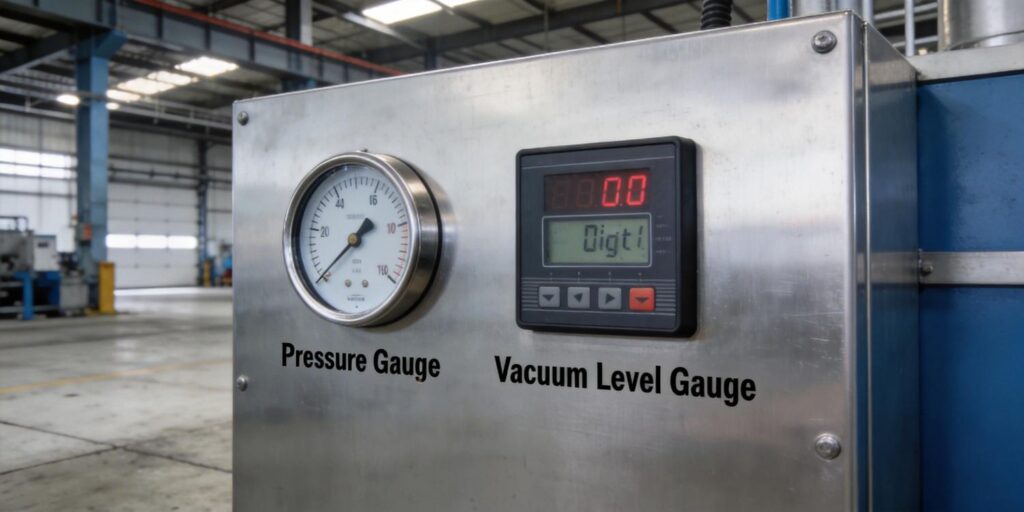
The Poseidon Scientific VG-SP205 Pirani Vacuum Transmitter covers the entire required range (atmospheric to 10⁻³ Torr) with linear response in the critical 10–0.01 Torr band. Its platinum-filament thermal conductivity principle delivers the speed and accuracy needed to track rapid pressure changes during pump-down. For ultra-low-pressure molecular distillation reaching 10⁻³ Torr or below, the VG-SM225 Cold Cathode Vacuum Gauge provides seamless extension with Penning-discharge sensitivity down to 10⁻⁷ Torr.
Accurate vacuum measurement directly controls reflux ratio, throughput, and product purity. Without reliable pressure data, operators risk off-spec fractions, excessive energy use, or equipment damage from over-pressurization.
Stability for Boiling Point Control
Boiling point in vacuum distillation is a direct function of absolute pressure. A 1 Torr fluctuation at 20 Torr can shift the boiling point of many organics by 2–5 °C—enough to move a component into the wrong cut or cause bumping and carry-over. Gauge stability therefore becomes a process-control variable as important as temperature.
The VG-SP205 maintains ±15 % accuracy (and ±5 % repeatability) in the linear operating region through active temperature compensation and digital signal processing. Its constant-temperature filament circuit responds in <100 ms to pressure changes, allowing PID controllers to hold set points within ±0.5 Torr even during variable vapor loads. Platinum filament construction eliminates the oxidation drift common in tungsten sensors, delivering consistent readings across 3–5 years of continuous service.
Digital RS232 output (custom protocol available for 5–10 units) transmits temperature-compensated pressure every 50 ms, enabling real-time calculation of boiling-point curves inside the PLC or DCS. The 0–10 V analog output (effective 2–8 V) integrates directly with legacy controllers for simple set-point alarming. These features keep distillation columns stable, reduce recycle streams, and improve yield by 3–8 % in typical refinery or fine-chemical applications.
Gauge Placement Relative to Condenser
Correct sensor location ensures the measured pressure accurately represents conditions at the distillation flask and vapor line. The optimal position is on the vapor manifold immediately upstream of the condenser or on a short KF25 stub connected to the column head. This placement captures true system pressure without the lag introduced by long tubing runs or the pressure drop across condenser internals.
Mounting directly on the condenser shell is acceptable for small laboratory units but less ideal in large columns because condensate pooling can create local pressure gradients. Never install the gauge downstream of the vacuum pump; pump suction readings will always be 5–20 Torr lower than actual column pressure due to line losses.
The VG-SP205’s compact KF16/KF25 flange and <50 mm protrusion simplify direct chamber mounting. Its low dead volume prevents virtual leaks that could falsify readings during rapid cycling. For dual-gauge redundancy—common in continuous distillation trains—install one VG-SP205 at the column head and a second near the receiver for independent verification of pressure uniformity.
Recommended Placement Summary
| Location | Advantage | Consideration |
|---|---|---|
| Column head manifold (preferred) | Represents true vapor pressure | Minimal tubing lag |
| Condenser inlet stub | Easy access, short connection | Avoid if heavy condensate forms |
| Receiver vessel | Verifies product-side vacuum | Useful for multi-stage systems |
| Pump suction line | Not recommended | Reads 5–20 Torr too low |
Avoiding Vapor Contamination
Distillation vapors—water, alcohols, hydrocarbons, or acids—can deposit films on sensing elements, shifting calibration curves. Traditional tungsten-filament Pirani gauges corrode rapidly in these environments; the VG-SP205 eliminates this risk with a platinum filament chosen for its chemical inertness and large temperature-resistance coefficient.
Platinum withstands oxidative and organic vapors far better than tungsten or rhenium-tungsten alternatives, extending filament life to 3–5 years without cleaning. The stainless-steel body and electropolished KF flange resist cleaning agents (IPA, peroxide, mild acids) used during shutdowns. Because the gauge is completely maintenance-free, operators avoid the downtime and contamination risks associated with electrode disassembly in cold-cathode designs.
Additional protection comes from simple engineering: install a short baffled extension or 10 µm sintered filter on the flange to trap droplets while preserving <100 ms response time. The VG-SP205’s sealed construction achieves leak rates below 10⁻¹¹ Pa·m³/s, preventing process vapor from reaching internal electronics. For extremely aggressive distillates (e.g., halogenated solvents), the gauge can be mounted behind a cold trap cooled to −20 °C without affecting measurement accuracy.
Process Optimization Example
Consider a mid-sized fine-chemical plant distilling a heat-sensitive pharmaceutical intermediate at 25 Torr target pressure. Before installing the VG-SP205, operators used an older analog gauge with ±10 Torr uncertainty, resulting in frequent over- or under-pressurization. Boiling-point drift caused 12 % product loss to decomposition and required 18 % excess reflux.
After retrofitting two VG-SP205 units (one at column head, one at receiver) with RS232 integration to the existing DCS:
- Pump-down time dropped from 12 min to 6 min
- Pressure stability improved to ±0.8 Torr, keeping boiling point within ±1.5 °C
- Reflux ratio was reduced 22 %, increasing throughput by 15 %
- Yield rose from 84 % to 91 % with zero decomposition by-products
The digital output fed directly into the control algorithm, automatically adjusting pump speed via VFD to maintain the exact set point. Annual calibration swap kept total cost of ownership under $400 per year per gauge. ROI was achieved in <4 months through higher capacity and reduced energy use.
This example scales across petroleum vacuum towers, essential-oil extractors, and solvent-recovery systems—anywhere precise vacuum directly translates into dollars per kilogram of product.
Conclusion and Next Steps
Optimizing vacuum measurement in distillation systems requires a gauge that combines wide-range coverage, fast response, long-term stability, contamination resistance, and seamless integration. The Poseidon Scientific VG-SP205 Pirani Vacuum Transmitter meets every criterion for the 1–100 Torr regime typical of vacuum distillation, while the VG-SM225 Cold Cathode extends capability for molecular-distillation lines needing deeper vacuum. Both instruments deliver the small footprint, low cost, and customizable RS232 protocols that modern process engineers and procurement teams demand.
Engineers gain tighter boiling-point control, higher yields, and reduced energy consumption. Procurement teams benefit from domestic manufacturing (3000–3500 RMB self-manufactured equivalent), quick delivery, and a maintenance-free design that eliminates costly downtime.
Ready to upgrade your distillation vacuum monitoring? Visit the VG-SP205 Pirani Vacuum Transmitter product page for full specifications, wiring diagrams, and sample RS232 protocol code. For deeper-vacuum applications, explore the VG-SM225 Cold Cathode Vacuum Gauge.
Procurement and engineering teams can request 5–10 unit custom-protocol prototypes with full calibration data packages and on-site response-time validation at no extra charge. Contact our applications engineering team at sales@poseidon-scientific.com for a free system review, flange-selection assistance, or integration support tailored to your DCS/PLC platform.
Precise vacuum measurement is the foundation of efficient, high-purity distillation. Choose Poseidon and turn every Torr into measurable process improvement.