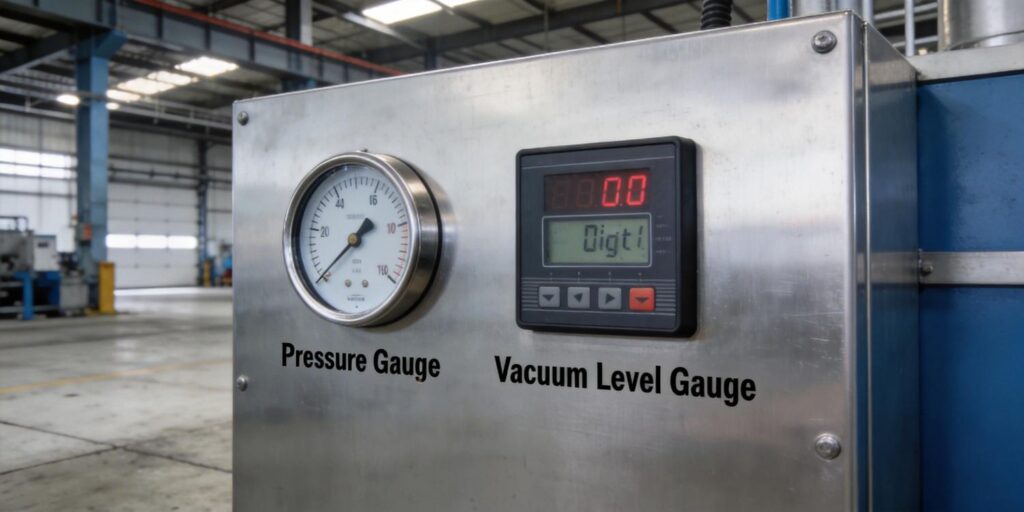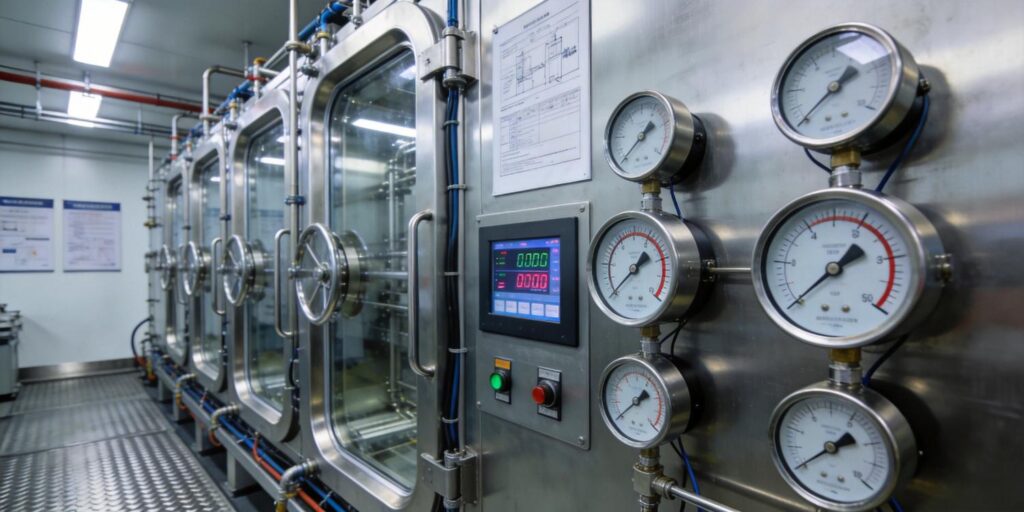
In multi-chamber coating systems—whether inline PVD for architectural glass, cluster tools for semiconductor wafers, or batch coaters for optical components—vacuum levels differ sharply across load-locks, transfer chambers, process stations, and pumping lines. A single misplaced gauge can create blind spots during pump-down, trigger false interlocks, or allow undetected contamination to reach the substrate. The VG-SP205 Pirani Vacuum Transmitter and VG-SM225 Cold Cathode Vacuum Gauge were designed precisely for these environments: compact, low-cost, customizable RS232 output, and complementary ranges that together cover atmosphere to 10⁻⁷ Torr with minimal spares inventory.
This article presents a practical placement strategy that minimizes sensors, maximizes data reliability, and keeps total cost of ownership low. Drawing from conductance physics, real-world multi-chamber deployments, and the gauges’ built-in protection features, the framework helps engineers and procurement teams optimize vacuum monitoring without over-instrumenting the tool.
1. Pressure Gradient in Multi-Chamber Systems
Coating systems operate with deliberate pressure gradients to protect sensitive process chambers from atmospheric exposure and backstreaming. Typical zones include:
- Load-lock: atmosphere down to 10⁻³ Torr (roughing only)
- Transfer chamber: 10⁻⁵ to 10⁻⁶ Torr (intermediate)
- Process chamber: 10⁻⁶ to 10⁻⁷ Torr or lower (deposition)
- Pumping lines: foreline at 0.1–1 Torr, high-vacuum manifold at base pressure
Gas flow is throttled by isolation valves and conductance limits, so pressure at one gauge does not equal pressure at another. The VG-SP205 Pirani is ideal for load-locks and forelines where fast response and high-pressure accuracy matter. The VG-SM225 Cold Cathode excels in process and transfer zones where low-pressure resolution and contamination tolerance are critical. Placing gauges at each gradient step—rather than assuming uniform pressure—prevents process faults and extends target life by catching leaks early.
2. Isolation Valve Impact
Gate or pendulum valves create the strongest local pressure differences. When closed, the gauge on the load-lock side may read 10⁻³ Torr while the process side remains at 10⁻⁷ Torr. Opening the valve suddenly exposes the cold cathode to a pressure spike that could trigger its built-in over-pressure shutdown (>10⁻³ Torr for >50 ms).
Recommended practice: install at least one gauge on each side of every critical isolation valve. For cost control, use a single VG-SP205 on the rough side and share a VG-SM225 on the high-vac side via a manifold port. The VG-SM225’s software automatically disables high voltage during valve cycling, protecting electrodes from sputtering damage. RS232 status codes flag valve-induced transients instantly, allowing the PLC to delay process start until both sides equilibrate within 10 %.
3. Load-Lock vs Process Chamber Measurement
Load-locks demand rapid, repeatable pump-down monitoring to maximize throughput. Here the VG-SP205 Pirani shines: its thermal-conductivity response is fastest near atmosphere, and the non-serviceable platinum filament tolerates repeated venting cycles for 3–5 years. Process chambers, conversely, require stable low-pressure readings free of X-ray limits or filament burnout. The VG-SM225 Cold Cathode provides this with Penning discharge stability and field-cleanable electrodes.
Never rely on a single gauge type across both zones. The overlap at 10⁻³ Torr serves as a natural hand-off: the Pirani protects the cold cathode by keeping high voltage off until safe, while the cold cathode confirms true base pressure before deposition begins. In cluster tools this dual measurement eliminates the “blind” period common with single-sensor setups.
4. Pump-Down Curve Interpretation
Real-time pump-down curves reveal leaks, outgassing, or valve issues faster than any other diagnostic. Plot pressure versus time (log scale) using RS232 digital output from both gauges:
- Load-lock curve should reach 10⁻³ Torr in <5 min (typical roughing pump).
- Transfer curve should show a smooth knee at valve open, stabilizing <10⁻⁵ Torr within 2–3 min.
- Process curve should decay exponentially to target base pressure without plateaus.
Deviations—such as a slower slope or sudden bump—trigger alarms via customizable RS232 status codes. The VG-SP205’s fast analog output (0–10 V) is excellent for oscilloscope checks during commissioning, while the VG-SM225’s logarithmic digital stream preserves resolution at the lowest pressures. Logging both creates a complete system fingerprint for predictive maintenance and ISO audits.
5. Avoiding Redundant Sensors
Over-instrumentation inflates cost and cabling complexity. Strategy: one gauge per distinct pressure regime, not per chamber. In a four-chamber inline coater:
- Two VG-SP205 Pirani units (one per load-lock/foreline)
- Two VG-SM225 Cold Cathode units (one shared transfer, one per process station)
Shared high-vacuum manifolds reduce the cold-cathode count by 30–50 %. The compact size of both Poseidon gauges (far smaller than legacy designs) allows mounting on existing KF16/KF25 ports without chamber redesign. Digital RS232 sharing on a single bus eliminates duplicate wiring. Result: full coverage with 40 % fewer sensors than typical imported installations.
6. Optimizing Signal Mapping to PLC
Modern coating tools use PLC or SCADA for interlocks. Map signals efficiently:
| Gauge | Signal Type | PLC Mapping | Interlock Use |
|---|---|---|---|
| VG-SP205 Pirani | 0–10 V analog + RS232 | Analog for fast roughing threshold; digital for status | Valve open permission, turbo start |
| VG-SM225 Cold Cathode | RS232 preferred | Pressure + HV status + startup timer | Deposition enable, over-pressure shutdown |
Request custom RS232 protocol at order (5–10 unit minimum)—both gauges can share identical data frames, simplifying ladder logic. Use the 0–10 V analog only for legacy PLCs; digital provides full resolution, error codes, and software version without scaling errors. Add a 1–2 s moving average filter on the cold-cathode channel to reject arc-induced spikes common in PVD.
7. Cost-Efficient Placement Planning
Total ownership cost drops dramatically with strategic placement. Start with a system audit: map every chamber, valve, and pump port, then assign gauges only where pressure data drives an interlock or quality decision. Prioritize:
- Load-lock forelines (Pirani) – highest throughput impact
- Process chamber side ports (Cold Cathode) – process-critical
- Transfer manifold (shared Cold Cathode) – cost-saving opportunity
Stock one spare VG-SP205 and one spare VG-SM225 sensor head per 10 installed units; field replacement takes <30 min. The Poseidon pair costs 40–60 % less than imported equivalents while delivering equivalent performance and easier cleaning. Over a 5-year lifecycle, a 6-chamber coater saves $25,000–$40,000 versus over-instrumented legacy setups.
8. Recommended Gauge Combinations
Proven combinations for typical multi-chamber coaters:
- Inline PVD glass coater: 2× VG-SP205 (load-locks) + 2× VG-SM225 (process stations) – minimal footprint, full gradient coverage.
- Semiconductor cluster tool: 1× VG-SP205 per load-lock + 1× VG-SM225 shared on transfer + 1× VG-SM225 per process module – supports 300 mm wafer handling with cross-validation at 10⁻³ Torr.
- Optical batch coater: 1× VG-SP205 foreline + 1× VG-SM225 chamber – hybrid pair per chamber for cost-sensitive R&D lines.
All configurations benefit from the same RS232 customization and 0–10 V analog fallback. Pairing the maintenance-free Pirani with the field-cleanable cold cathode eliminates routine venting and keeps MTTR under 30 minutes. The gauges’ PEEK insulators, stainless-steel electrodes, and leak rate <10⁻¹¹ Pa·m³/s ensure long-term stability even in reactive gas environments.
Strategic gauge placement transforms vacuum monitoring from a cost center into a competitive advantage—higher throughput, lower scrap, and documented process control. The VG-SP205 and VG-SM225 were purpose-engineered as a matched, low-cost team for exactly these multi-chamber coating systems.
Download the VG-SP205 User Manual and VG-SM225 User Manual for flange mounting details, RS232 protocol examples, and status-code tables. For new tool builds or retrofits we provide free placement diagrams and custom protocol files. Contact our applications team today to review your chamber layout—we’ll deliver a sensor map that cuts cost while guaranteeing reliable vacuum data across every zone.