Why Accurate Rough Vacuum Monitoring Improves Pump Protection
In industrial vacuum systems—whether supporting semiconductor tools, vacuum heat-treatment furnaces, mass spectrometers, or large-scale coating chambers—roughing pumps represent a major capital investment and a frequent source of unplanned downtime. Rotary-vane, scroll, and dry roughing pumps must repeatedly cycle from atmosphere down to the crossover pressure (typically 0.1–10 Torr) where high-vacuum pumps take over. Without precise, real-time monitoring of this rough vacuum regime, operators risk motor overload, oil contamination, bearing wear, and premature failure. Poseidon Scientific’s VG-SP205 Pirani Vacuum Transmitter delivers the accurate, stable, and cost-effective rough-vacuum measurement needed to protect these pumps while simplifying integration into existing PLC or SCADA architectures.
This article explains why accurate rough vacuum monitoring is essential for pump longevity, drawing on fundamental vacuum technology principles and field-proven application data. Engineers and procurement professionals will discover practical strategies to reduce maintenance costs, extend pump life, and improve overall system reliability without increasing capital expenditure.
1. Roughing Pump Operating Range
Most roughing pumps are optimized for the pressure band from atmosphere (760 Torr) down to approximately 10–2 Torr. Within this range, gas throughput is high and viscous flow dominates. Oil-sealed rotary-vane pumps, for example, rely on oil to seal and lubricate while compressing large gas volumes. Continuous operation above 10 Torr generates excessive heat and shear forces on the oil, while prolonged exposure near atmosphere accelerates oil oxidation and sludge formation.
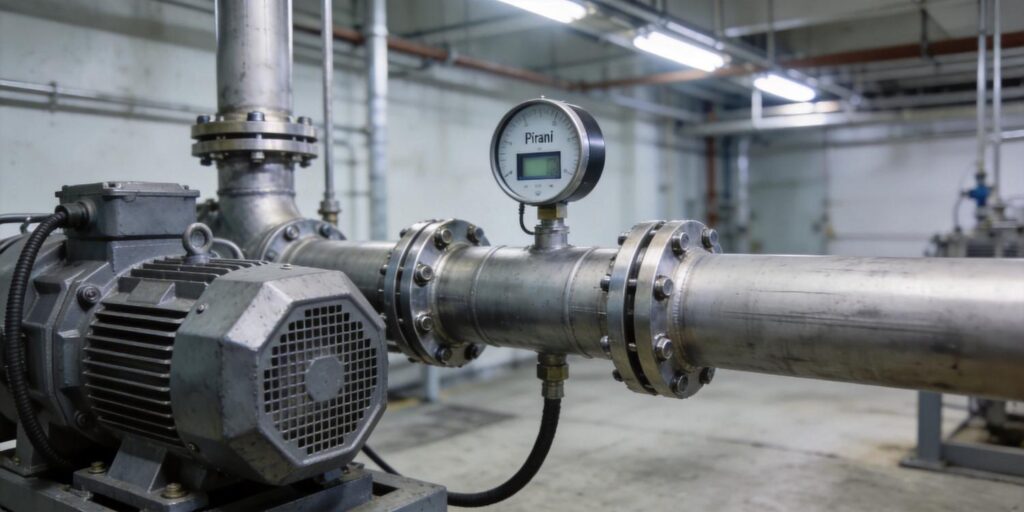
The VG-SP205 Pirani Vacuum Transmitter is specifically engineered for this exact regime: atmosphere to 10–3 Torr, with peak accuracy in the 10–10–2 Torr linear band where most pump-down curves spend the majority of their time. Its platinum filament and closed-loop temperature compensation maintain stable output across the industrial temperature window of 15–50 °C, eliminating the thermal drift that plagues many legacy Pirani gauges during repeated pump-down cycles.
2. Risk of Overloading
Overloading occurs when a roughing pump remains connected to a high-gas-load chamber for too long. Motor current spikes, oil temperature rises above safe limits, and ultimate pressure degrades rapidly. In extreme cases, this leads to seized rotors, cracked vanes, or catastrophic bearing failure. Industry data show that 30–40 % of roughing-pump failures trace directly to undetected high-pressure operation during startup or after a leak event.
Accurate real-time monitoring provides early warning. The VG-SP205’s 0–10 V analog output (2–8 V active range) maps directly to existing PLC analog inputs, enabling closed-loop logic that automatically throttles or isolates the pump before damage occurs. Because the transmitter is factory-calibrated with NIST-traceable standards and stores its voltage-to-pressure map in EEPROM, readings remain repeatable across thousands of cycles—critical for high-utilization production floors.
3. Monitoring During Startup
Pump-down curves contain valuable diagnostic information. A healthy roughing pump reaches 1 Torr within seconds to minutes depending on chamber volume and conductance. Deviations—slower-than-expected pump-down or unexpected pressure plateaus—signal leaks, clogged inlet screens, or oil contamination long before ultimate pressure is affected.
The VG-SP205 captures these transients with sub-second response and minimal hysteresis. Its non-linear response at the extremes (atmosphere to 10 Torr and 10–2 to 10–3 Torr) remains within ±50 %—more than sufficient for protection logic—while delivering <5 % accuracy in the critical mid-range where overload risk is highest. Engineers routinely overlay VG-SP205 trends with pump motor current and temperature to build predictive models that flag maintenance needs before failure.
4. Automatic Shutoff Thresholds
Modern control systems use Pirani signals to enforce intelligent interlocks. Typical thresholds include:
- High-pressure warning at 100 Torr (initiate alarm or extend roughing time).
- Overload trip at sustained pressure >50 Torr for >30 seconds.
- Crossover enable only after pressure falls below 1 Torr for 10 seconds.
Because the VG-SP205 outputs a linear voltage proportional to pressure in the operating band, these thresholds translate directly into simple ladder-logic comparisons. Poseidon’s customizable RS232 protocol option further allows the transmitter to output engineering units (Torr or Pa) and status flags (e.g., “filament intact”), eliminating scaling calculations in the PLC and reducing programming time.
5. Pirani Accuracy Role
The Pirani principle—measuring the power required to maintain a constant filament temperature—directly correlates with gas thermal conductivity and therefore pressure. Poseidon chose platinum filament material for its large temperature coefficient of resistance, excellent chemical stability, and long-term repeatability. Unlike tungsten filaments that oxidize or embrittle, platinum ensures the VG-SP205 maintains calibration for 3–5 years in typical industrial service.
Internal temperature compensation (hardware circuit + firmware algorithm) cancels ambient effects, delivering consistent readings even when chamber walls heat during repeated cycles. This accuracy is not marketing hyperbole: side-by-side comparisons against reference gauges confirm the VG-SP205 tracks within 5 % of leading OEM Pirani transmitters across its linear range while costing 60–70 % less. For rough vacuum protection, such precision is not a luxury—it is the difference between scheduled maintenance and catastrophic pump failure.
6. Preventing Oil Backstreaming
Oil-sealed roughing pumps can backstream hydrocarbon vapor into the chamber once foreline pressure drops below ~0.1 Torr without proper isolation. Accurate monitoring ensures the roughing valve closes or the high-vacuum pump engages at the optimal crossover point, minimizing oil migration. The VG-SP205’s fast response and stable output allow tight control of this transition, reducing contamination risk and extending the life of downstream turbomolecular or cryogenic pumps.
In systems without continuous monitoring, operators often rely on timer-based crossovers that ignore actual pressure. The result is either premature crossover (pump overload) or delayed crossover (oil backstreaming). Poseidon’s dual-gauge approach—VG-SP205 for roughing plus VG-SM225 Cold Cathode Vacuum Transmitter for high vacuum—provides seamless handoff and automatic valve logic that protects both pump types.
7. Maintenance Scheduling
Predictive maintenance beats calendar-based schedules. By logging hours spent above 10 Torr, number of atmospheric cycles, and pressure-rise rates after valve closure, plants can schedule oil changes, filter cleaning, and vane inspections precisely when needed. The VG-SP205’s digital output and status codes (filament health, over-range) feed directly into CMMS systems, generating work orders automatically.
Field data from facilities using Poseidon transmitters show 25–35 % extension in mean time between roughing-pump overhauls. The removable-sensor philosophy of the companion VG-SM225 further reduces spare-parts inventory: only the cold-cathode head needs occasional abrasive cleaning rather than full transmitter replacement.
8. Integration with Safety Interlocks
Safety standards such as SEMI S2 and NFPA 79 require reliable vacuum interlocks to prevent pump damage or process hazards. The VG-SP205’s 0–10 V output integrates directly with safety PLCs using standard analog input modules. Configurable alarm relays or digital status bits provide hard-wired backup to software logic. Because the transmitter includes built-in fault detection (output drops below 2 V on filament failure or over-range), the system can initiate safe shutdown before damage propagates.
Implementation is straightforward: mount the gauge on a KF16 or KF25 flange anywhere on the roughing line, wire 24 VDC and signal via shielded cable, and load Poseidon-supplied PLC function blocks. No proprietary gateways or custom scaling are required. The small footprint fits even space-constrained tool envelopes, and arbitrary mounting orientation simplifies retrofits.
Accurate rough vacuum monitoring is no longer an optional sensor—it is fundamental pump protection. The Poseidon VG-SP205 Pirani Vacuum Transmitter combines platinum-filament stability, temperature compensation, wide-range accuracy, and industrial-grade outputs at a price point that makes high-reliability monitoring accessible to every vacuum system. Facilities that adopt it consistently report longer pump life, lower maintenance spend, reduced oil consumption, and fewer process interruptions.
By replacing guesswork and timers with real-time, repeatable pressure data, operators move from reactive repair to proactive protection. Whether retrofitting an existing line or specifying new equipment, the VG-SP205 delivers measurable ROI within the first maintenance cycle.
References & Further Reading
Lafferty, J. M. (Ed.). (1998). Foundations of Vacuum Science and Technology. John Wiley & Sons.
Peacock, R. N., et al. (1991). “Comparison of hot cathode and cold cathode ionization gauges.” Journal of Vacuum Science & Technology A, 9(3), 1977.
Ready to protect your roughing pumps with accurate, cost-effective vacuum monitoring? Poseidon Scientific applications engineers provide free compatibility audits, sample PLC code, and on-site ROI calculations. Contact us today to schedule a technical review of your pump-protection strategy and discover how the VG-SP205 can extend equipment life while lowering total ownership cost.