Role of LC-MS in Clinical Toxicology Testing
Liquid chromatography-mass spectrometry (LC-MS) has revolutionized clinical toxicology testing by providing unparalleled specificity, sensitivity, and throughput for drug screening and confirmation. Unlike traditional immunoassays that may suffer from cross-reactivity issues, LC-MS offers definitive identification and quantification of toxicological analytes through mass-to-charge ratio (m/z) measurements. The technique’s ability to simultaneously detect multiple drug classes and metabolites makes it indispensable for comprehensive drug screening programs in clinical laboratories.
Modern LC-MS systems, particularly triple quadrupole instruments operating in multiple reaction monitoring (MRM) mode, can achieve detection limits in the low ng/mL range, enabling the identification of drugs at therapeutic and toxic concentrations. This sensitivity is crucial for detecting drugs of abuse, therapeutic drug monitoring, and forensic investigations where trace amounts of substances must be accurately measured.
Matrix Complexity in Biological Toxicology Samples
Biological samples in clinical toxicology present formidable challenges due to their inherent complexity. As noted in forensic literature, “Biological samples are notoriously dirty; injecting them with minimum cleanup onto very sensitive and expensive instruments makes very little sense.” Urine, plasma, whole blood, and tissue samples contain numerous interfering components including proteins, lipids, salts, endogenous metabolites, and cellular debris that can compromise LC-MS analysis.
Urine samples, commonly used in drug testing, contain high concentrations of urea, creatinine, and various organic acids that can cause ion suppression in the MS source. Plasma and serum samples present protein binding challenges, while whole blood contains hemoglobin and cellular components that can foul LC columns and MS ion sources. These matrix effects can lead to inaccurate quantification, reduced sensitivity, and increased instrument downtime for source cleaning and maintenance.
Selecting SPE Sorbents for Toxicology Analytes
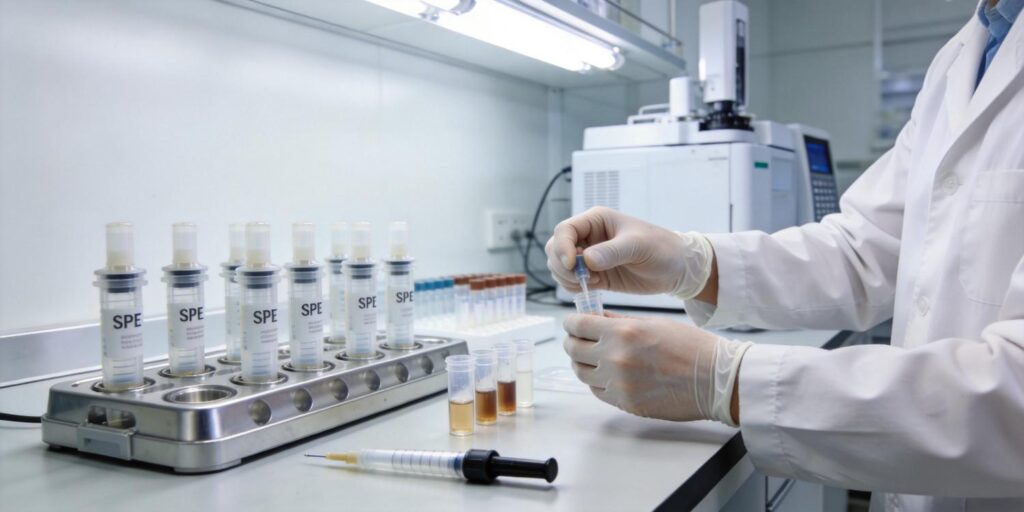
The selection of appropriate solid-phase extraction (SPE) sorbents is critical for successful toxicology sample preparation. Mixed-mode sorbents combining hydrophobic and ion-exchange interactions have proven particularly effective for broad-spectrum drug screening. As research demonstrates, “The strategy of a mixed-mode cartridge providing hydrophobic and cation exchange interactions, combined with a pH-dependent sample application and extraction, can give high recoveries of analytes from plasma, urine, whole blood, and tissues.”
For clinical toxicology applications, several sorbent types are commonly employed:
Mixed-Mode Cation Exchange (MCX)
MCX sorbents combine reversed-phase and strong cation exchange properties, making them ideal for basic drugs such as amphetamines, opioids, antidepressants, and antipsychotics. These sorbents retain analytes through both hydrophobic interactions and ionic bonding with negatively charged sulfonic acid groups.
Mixed-Mode Anion Exchange (MAX)
MAX sorbents feature reversed-phase and strong anion exchange characteristics, suitable for acidic compounds including barbiturates, NSAIDs, and some benzodiazepine metabolites. The quaternary amine groups provide strong anion exchange capacity.
Hydrophilic-Lipophilic Balance (HLB)
HLB sorbents offer balanced hydrophilic and lipophilic properties, making them versatile for a wide range of analytes regardless of pH. These water-wettable polymers are particularly useful for drugs with diverse physicochemical properties.
Specialized Sorbents
For specific applications, specialized sorbents like WAX (weak anion exchange) and WCX (weak cation exchange) provide selective extraction capabilities for particular drug classes or metabolites.
Optimizing Wash and Elution Conditions
Proper optimization of wash and elution conditions is essential for achieving high recoveries and clean extracts. The fundamental SPE steps include conditioning, sample loading, washing, and elution. As documented in SPE methodology, “The SPE strategy generally comprises the isolation (and concentration) of the analytes from a complex matrix by adsorption onto an appropriate sorbent, the removal of interfering impurities by washing with a suitable solvent system and then the selective recovery of the retained analytes with a modified solvent system of suitable elution strength.”
Wash Optimization
Wash solvents should be strong enough to remove interfering matrix components but weak enough to retain target analytes. Common wash solvents include water, aqueous buffers, and organic-water mixtures. For mixed-mode sorbents, pH-adjusted washes can selectively remove neutral and oppositely charged interferences while retaining target analytes through ionic interactions.
Elution Optimization
Elution solvents must disrupt both hydrophobic and ionic interactions for mixed-mode sorbents. Typically, organic solvents (methanol, acetonitrile) containing volatile acids (formic acid) or bases (ammonium hydroxide) are used. The elution strength should be sufficient to recover analytes in the smallest possible volume for maximum concentration factor.
pH Control
pH manipulation is crucial for ionizable compounds. For basic drugs, acidification during loading enhances retention on cation exchange sorbents, while alkalization during elution disrupts ionic bonds. The reverse applies for acidic compounds on anion exchange sorbents.
Integration with LC-MS Workflows
SPE sample preparation integrates seamlessly with modern LC-MS workflows, particularly in high-throughput clinical laboratories. The development of 96-well SPE plates has enabled automation and parallel processing of multiple samples, significantly increasing throughput. As research indicates, “SPE can be automated quite easily with a variety of currently available equipment” and “The on-line approach will never be able to achieve the speed of off-line 96 well SPE plate sample preparation.”
For LC-MS compatibility, several considerations are paramount:
Solvent Compatibility
Final extracts should be compatible with LC mobile phases to avoid peak distortion or splitting. Typically, reconstitution in initial mobile phase composition ensures optimal chromatography.
Matrix Effect Reduction
Effective SPE cleanup minimizes matrix effects that cause ion suppression or enhancement in the MS source. Proper wash steps remove phospholipids, salts, and other ion-suppressing components.
Automation Compatibility
SPE methods should be optimized for automated liquid handling systems, with consistent flow rates, vacuum/pressure settings, and timing parameters.
Validation Parameters for Clinical Laboratories
Clinical laboratories must validate SPE-LC-MS methods according to regulatory guidelines (CLIA, CAP, ISO 15189). Key validation parameters include:
Recovery and Efficiency
SPE recoveries should exceed 90% absolute recovery for reliable quantification. As noted in forensic applications, “If you don’t get that kind of recovery you are not adjusting other parameters (such as solubility, pH, and solvent strength) correctly.”
Selectivity and Specificity
Methods must demonstrate selectivity against endogenous interferences and commonly co-administered drugs. MRM transitions in LC-MS/MS provide inherent specificity.
Precision and Accuracy
Intra-day and inter-day precision should meet clinical requirements (typically <15% CV), with accuracy within ±15% of nominal concentrations.
Linearity and Range
Calibration curves should demonstrate linearity across the clinically relevant concentration range, with correlation coefficients (r²) >0.99.
Carryover and Cross-contamination
SPE procedures must minimize carryover between samples, particularly important in automated systems processing high-concentration samples.
Case Example of Drug Screening Workflow
A comprehensive drug screening workflow using mixed-mode SPE and LC-MS/MS illustrates the practical application of these principles. The following case example demonstrates a broad-spectrum screening approach:
Sample Preparation
1. Sample Pretreatment: 1 mL urine or plasma is diluted with phosphate buffer (pH 6.0) and internal standards are added.
2. SPE Procedure: A mixed-mode cation exchange cartridge (MCX) is conditioned with methanol and buffer. The sample is loaded at 1-2 mL/min.
3. Wash Steps: Sequential washes with water, 0.1M acetic acid, and methanol remove neutral and acidic interferences.
4. Elution: Basic drugs are eluted with 2% ammonium hydroxide in methanol.
5. Concentration: The eluate is evaporated under nitrogen and reconstituted in mobile phase.
LC-MS/MS Analysis
1. Chromatography: Reverse-phase separation using a C18 column with gradient elution (water/methanol with 0.1% formic acid).
2. Mass Spectrometry: Positive electrospray ionization with MRM monitoring of 100+ drug transitions.
3. Data Analysis: Automated peak integration and identification based on retention time and ion ratios.
Performance Characteristics
This workflow typically achieves >90% recovery for most basic drugs, detection limits of 1-10 ng/mL, and throughput of 50-100 samples per day. The method covers major drug classes including opioids, amphetamines, benzodiazepines, antidepressants, and antipsychotics.
As demonstrated in forensic applications, such comprehensive approaches yield “chromatograms show almost no interference from endogenous matrix components, so that toxicologically relevant substances could be easily detected and quantitated.” The method’s robustness and reliability make it suitable for clinical toxicology laboratories requiring definitive drug identification and quantification.
The integration of optimized SPE sample preparation with sensitive LC-MS analysis represents the gold standard in clinical toxicology testing. By addressing matrix complexity through selective extraction and providing clean, concentrated samples for analysis, SPE enables laboratories to achieve the sensitivity, specificity, and throughput required for modern toxicology testing while protecting valuable instrumentation from matrix-related damage.