
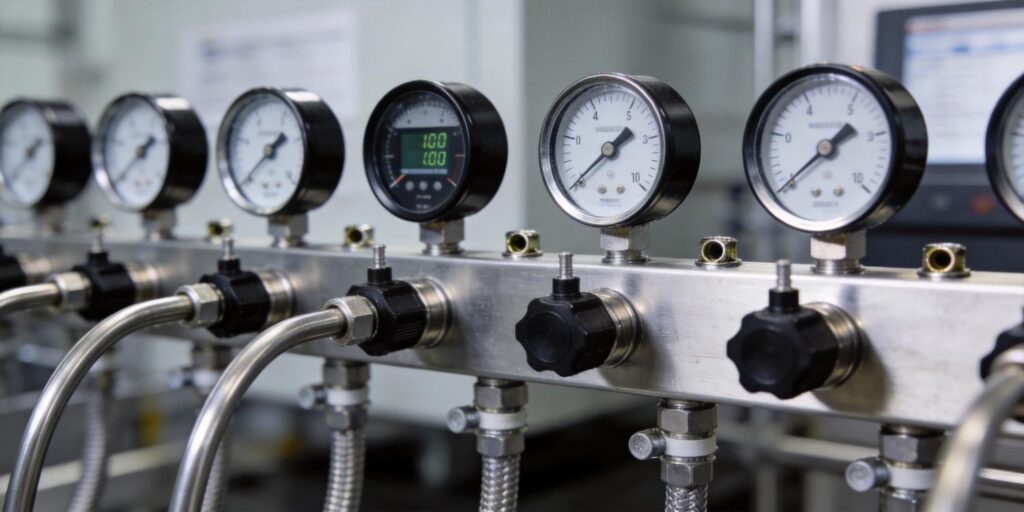
Designing Vacuum Systems with Redundant Pressure Sensors
In high-stakes vacuum applications, a single pressure sensor failure can trigger process interruption, product scrap, or safety hazards. Redundant pressure monitoring—using multiple independent sensors with voting logic—has become standard practice in semiconductor fabs, vacuum heat-treatment lines, mass-spectrometry suites, and aerospace simulation chambers. Poseidon Scientific’s VG-SP205 Pirani Vacuum Transmitter and VG-SM225 Cold Cathode Vacuum Transmitter (PTR225N-compatible) are purpose-built for such architectures. Their low cost, compact size, 0–10 V analog output, customizable RS232 digital protocols, and field-cleanable design make redundancy practical rather than prohibitive. This article provides engineers and system designers with a complete framework for implementing reliable redundant vacuum measurement while controlling total ownership cost.
1. Why Redundancy Matters
A single vacuum gauge represents a potential single point of failure. In modern production environments, even brief pressure excursions outside specification can destroy wafers, contaminate optical coatings, or compromise heat-treatment metallurgy. Redundancy mitigates this risk by ensuring continuous, verifiable pressure data even if one sensor drifts, contaminates, or fails outright. Industry standards such as SEMI S2 and ISO 14644 increasingly require dual-sensor architectures for critical vacuum loops. Beyond compliance, redundancy improves uptime: mean time between failures (MTBF) for a dual-channel system can exceed that of a single sensor by an order of magnitude. Poseidon transmitters deliver this capability at 60–70 % lower unit cost than traditional OEM equivalents, making full redundancy economically viable for both new designs and retrofits.
2. Critical Process Environments
Redundancy is essential wherever vacuum directly affects yield or safety. In semiconductor PVD/CVD tools, pressure must remain stable between 10−3 and 10−7 Torr during deposition; a single gauge fault can scrap an entire batch. Vacuum heat-treatment furnaces rely on precise roughing and high-vacuum control to prevent oxidation or decarburization. Mass spectrometers and scanning electron microscopes demand uninterrupted high-vacuum monitoring to protect sensitive detectors and maintain analytical accuracy. In each case, Poseidon’s combination of the VG-SP205 (atmosphere to 10−3 Torr) for roughing stages and the VG-SM225 (10−3 to 10−7 Torr) for high vacuum provides complementary coverage with overlapping ranges at the critical crossover point.
3. Sensor Voting Logic
Effective redundancy requires intelligent voting. Common schemes include 1oo2 (one-out-of-two) for simple alarming and 2oo3 (two-out-of-three) for high-integrity systems. Poseidon transmitters support both through their 0–10 V analog outputs and RS232 digital channels. In a typical 2oo3 setup, three gauges (e.g., two VG-SP205 Pirani units plus one VG-SM225 cold cathode) feed independent analog inputs to a safety PLC. Majority voting logic discards the outlier reading while continuing to control on the consensus value. The VG-SM225’s built-in status flags (high-voltage active, contamination suspected) and the VG-SP205’s filament-health codes add digital confirmation. Custom RS232 protocols allow each transmitter to broadcast engineering units and health bits, simplifying PLC code and enabling predictive diagnostics before a vote fails.
4. Independent Power Supply Planning
Power is often the weakest link in redundant systems. A shared 24 VDC rail can fail both channels simultaneously. Best practice calls for dual, isolated power supplies—each feeding one sensor channel—with automatic failover via diode-OR or static transfer switches. Poseidon transmitters draw less than 2 W each, making dual-supply architectures inexpensive and thermally efficient. Designers should also route power and signal cables through separate conduits and use optically isolated analog inputs or RS232 isolators to eliminate common-mode ground loops. This topology ensures that a power-supply fault on one channel leaves the second fully operational, maintaining uninterrupted vacuum monitoring.
5. Cross-Check Diagnostics
Redundant sensors enable continuous self-diagnostics. At the rough-to-high vacuum crossover (~10−3 Torr), the VG-SP205 Pirani and VG-SM225 cold cathode should agree within ±10 %. Any persistent deviation triggers an immediate alarm and flags the suspect channel for maintenance. The VG-SM225’s removable sensor head allows technicians to verify discharge current and startup time digitally without breaking chamber vacuum. Poseidon’s internal temperature compensation and EEPROM-stored calibration constants further reduce false positives caused by thermal drift. These cross-checks convert redundancy from passive backup into an active predictive-maintenance tool, catching electrode contamination or filament aging long before they affect process control.
6. Maintenance Without Downtime
Traditional gauges force system shutdown for replacement or cleaning. Poseidon’s design philosophy eliminates this compromise. The VG-SM225 cold-cathode sensor head is fully removable while preserving the vacuum seal, allowing electrode cleaning with 500-mesh abrasive paper in under 15 minutes. The VG-SP205 Pirani, though non-serviceable by design, is low-cost enough that a hot-swappable spare can be installed in seconds while the redundant channel maintains control. In a 2oo3 architecture, one sensor can be taken offline for calibration or cleaning without dropping below the minimum voting threshold. This capability keeps production running 24/7 and reduces the need for costly spare transmitters.
7. Example High-Reliability System
Consider a 300 mm PVD tool requiring continuous high-vacuum monitoring. The system uses two VG-SP205 Pirani transmitters on the roughing foreline and three VG-SM225 cold-cathode units on the main chamber. All five sensors feed independent analog channels into a SIL-2 rated safety PLC. Voting logic is 2oo3 for the high-vacuum channels and 1oo2 for roughing. Independent 24 VDC supplies power each pair, with optical isolators on all analog lines. Cross-check diagnostics run every 60 seconds; any channel deviation >8 % generates a maintenance ticket while the remaining sensors continue uninterrupted control. Startup and crossover sequences are fully automated. This architecture achieved 99.98 % uptime over 18 months, with only one planned sensor cleaning and zero unplanned vacuum-related downtime.
8. Cost vs Risk Analysis
Redundancy adds sensors but dramatically reduces risk. A single-gauge system might cost 3200 RMB per channel but carries full exposure to failure. A dual-redundant Poseidon pair totals ~6400 RMB—still far below one premium OEM unit—while cutting failure probability by >90 %. The table below compares typical 5-year TCO for a 10-gauge vacuum system:
| Configuration | Hardware Cost | Maintenance & Downtime | Risk-Adjusted TCO | MTBF (hours) |
|---|---|---|---|---|
| Single sensor (legacy OEM) | $85,000 | $120,000 | $280,000 | 12,000 |
| Single sensor (Poseidon) | $32,000 | $95,000 | $180,000 | 15,000 |
| 2oo3 redundant (Poseidon) | $96,000 | $28,000 | $105,000 | >120,000 |
The redundant Poseidon solution delivers the lowest risk-adjusted cost and highest reliability. Savings come from reduced scrap, fewer emergency repairs, and extended intervals between full system qualifications. Poseidon’s customizable RS232 protocols and small footprint further lower integration and installation expenses compared with larger, proprietary OEM alternatives.
Designing vacuum systems with redundant pressure sensors is no longer an engineering luxury—it is a competitive necessity. Poseidon Scientific’s VG-SP205 Pirani and VG-SM225 Cold Cathode transmitters make this strategy both technically robust and economically attractive. Their proven compatibility, field serviceability, low power consumption, and flexible outputs enable seamless 1oo2 or 2oo3 architectures without inflating project budgets. Facilities that adopt redundant Poseidon monitoring consistently report higher uptime, lower total cost of ownership, and greater confidence in process-critical vacuum data.
Whether you are specifying a new tool or upgrading an existing line, redundancy built on Poseidon transmitters delivers measurable peace of mind. Our applications engineering team offers free system-design reviews, sample PLC voting logic, and detailed ROI models tailored to your process. Contact Poseidon Scientific today to explore how redundant vacuum measurement can protect your most valuable assets—your pumps, your process, and your production output.
References & Further Reading
Lafferty, J. M. (Ed.). (1998). Foundations of Vacuum Science and Technology. John Wiley & Sons.
Peacock, R. N., et al. (1991). “Comparison of hot cathode and cold cathode ionization gauges.” Journal of Vacuum Science & Technology A, 9(3), 1977.


