
Integrating Vacuum Transmitters into SCADA Monitoring Systems
In modern industrial vacuum processes—from semiconductor fabrication and mass spectrometry to vacuum heat treatment and scientific instrumentation—real-time monitoring is essential for process stability, safety, and yield optimization. Vacuum transmitters such as the VG-SP205 Pirani Vacuum Transmitter and VG-SM225 Cold Cathode Vacuum Transmitter from Poseidon Scientific deliver reliable, cost-effective pressure data across wide ranges. Integrating these compact, analog-output devices into Supervisory Control and Data Acquisition (SCADA) systems transforms raw vacuum signals into actionable intelligence. This article provides engineers and procurement professionals with a practical, step-by-step guide to seamless integration, grounded in established vacuum metrology principles and field-proven SCADA architectures.
By leveraging the 0–10 V analog output (effective 2–8 V measurement range) and customizable RS232 digital protocols native to Poseidon transmitters, facilities achieve centralized visibility, automated alarms, and predictive maintenance without proprietary gateways or extensive custom coding. The result is higher uptime, lower total cost of ownership, and full compliance with industry data-integrity standards.
1. Overview of SCADA Architecture
SCADA systems consist of four hierarchical layers: field devices (sensors and actuators), programmable logic controllers (PLCs) or remote terminal units (RTUs), a supervisory computer running human-machine interface (HMI) software, and enterprise-level historians or cloud platforms. Vacuum transmitters sit at the field layer, converting physical pressure into standardized electrical signals that feed directly into PLC analog input modules.
For vacuum applications, the architecture must accommodate the non-linear response of thermal (Pirani) and cold-cathode ionization gauges, as detailed in foundational texts such as Foundations of Vacuum Science and Technology (Lafferty, 1998). Poseidon’s VG-SP205 covers atmosphere to 10–3 Torr via heat-loss principles, while the VG-SM225 extends to 10–7 Torr using Penning discharge. Both output a linear 0–10 V signal scaled to pressure, simplifying SCADA mapping compared to older logarithmic or non-standard outputs. This compatibility enables plug-and-play deployment in existing Allen-Bradley, Siemens, or Schneider Electric SCADA ecosystems.
2. Analog Input Modules
Most modern PLCs provide 4–20 mA or 0–10 V analog input cards with 12- to 16-bit resolution. Poseidon transmitters ship with a 0–10 V output (2–8 V active range), delivering better than 0.5 % full-scale accuracy across their calibrated ranges when paired with a high-impedance input module (>10 kΩ).
Key selection criteria for vacuum service include:
- Resolution: 16-bit modules yield ~0.15 mV steps, sufficient to resolve 0.01 Torr on the VG-SP205 linear region.
- Noise immunity: Differential inputs and 50/60 Hz filtering reduce electromagnetic interference common near high-voltage cold-cathode supplies.
- Channel isolation: Optically isolated modules prevent ground loops when multiple transmitters share a common PLC rack.
Both Poseidon models include built-in over-range and fault detection; the VG-SM225, for example, flashes its status LED and drops output below 2 V if high-voltage discharge cannot be sustained, signaling contamination or pressure excursion beyond 10–3 Torr. Wiring is straightforward: red (+24 VDC supply), black (common), and white (0–10 V signal) via the industry-standard RJ45 or optional DB9 connector.
3. Signal Scaling Configuration
Raw voltage must be converted to engineering units inside the PLC or SCADA database. For the VG-SP205 Pirani, the factory calibration maps 2 V to atmosphere (~760 Torr) and 8 V to 10–3 Torr, with linear interpolation in the 10–10–2 Torr high-accuracy band. The VG-SM225 follows a similar 2–8 V span scaled to its 10–3–10–7 Torr range.
Typical ladder-logic scaling equation (in engineering units):
Vacuum (Torr) = (V_out – 2) × (P_max – P_min) / 6 + P_minWhere P_max and P_min are the calibrated endpoints stored in the device EEPROM. Poseidon transmitters support custom protocol offsets via RS232, allowing users to request scaled engineering units directly from the device for digital integration. Temperature compensation is performed internally, eliminating the need for separate ambient sensors in the 15–50 °C operating window. Validation against a certified reference gauge (as described in the Chinese Journal of Vacuum Science and Technology paper on micro-magnetron gauges) confirms linearity within ±5 % in the primary operating band.
4. Alarm Threshold Setup
SCADA alarm logic protects both product and process. For a mass-spectrometer chamber using the VG-SM225, configure high-vacuum alarms at 5 × 10⁻⁶ Torr and low-vacuum warnings at 10–3 Torr (the cold-cathode upper limit). The VG-SP205 handles roughing-line interlocks: alarm if pressure exceeds 1 Torr during pump-down or falls below 10 Torr during vent.
Best practice uses dual-threshold logic—warning before trip—to allow operators time for corrective action. Poseidon’s status codes (transmitted digitally) provide additional context: “HV active,” “contamination suspected,” or “filament intact” (Pirani). Link these to HMI pop-ups and email/SMS notifications. Historical data from cold-cathode gauges show that early detection of discharge-start delays (typically 5 min at 10–6 Torr) prevents unplanned downtime.
5. Data Logging and Trend Analysis
Modern SCADA historians sample vacuum data at 1 Hz or faster, storing time-stamped values for compliance and root-cause analysis. Poseidon transmitters deliver stable readings with minimal drift when properly compensated, enabling accurate trend overlays of pump-down curves, leak rates, and outgassing behavior.
Key metrics to trend:
- Pump-down time to base pressure
- Pressure rise rate after valve closure (leak detection)
- Comparison between Pirani (roughing) and cold-cathode (high vacuum) for crossover validation
Advanced analytics packages can apply the non-linear corrections documented in Redhead’s magnetron gauge studies (1959) or Peacock’s comparative ionization-gauge papers (1991) when higher precision is required. Exporting CSV or OPC UA data streams allows correlation with temperature, flow, and power-consumption logs for full process fingerprinting.
6. Remote Diagnostics
RS232 (or optional RS485) capability on Poseidon transmitters enables Modbus RTU or custom ASCII protocols for remote interrogation. Maintenance teams can query firmware version, raw ADC counts, and internal health flags without entering the cleanroom. For the VG-SM225, remote commands can force a high-voltage restart or read discharge current—critical for diagnosing start-up delays caused by electrode contamination.
Secure VPN or cellular gateways allow off-site experts to monitor systems 24/7. This capability aligns with Industry 4.0 initiatives and reduces mean-time-to-repair by identifying issues such as filament integrity (Pirani) or carbon buildup (cold cathode) before they cause process interruption.
7. Redundancy Planning
Vacuum-critical applications demand N+1 or 2oo3 voting architectures. Install dual Poseidon transmitters—one Pirani for rough vacuum and one cold-cathode for high vacuum—on separate analog channels. Configure the SCADA to compare readings during crossover (≈10–3 Torr) and trigger an alarm if deviation exceeds 10 %. Hot-swappable designs and Poseidon’s removable cold-cathode sensor head (cleanable with 500-mesh abrasive) minimize downtime during maintenance.
Power redundancy (dual 24 VDC supplies) and watchdog timers on the PLC ensure continued data acquisition even during network outages. Field data from inverted-magnetron studies confirm that redundant cold-cathode gauges maintain measurement continuity despite occasional discharge discontinuities at ultra-high vacuum.
8. Example Integration Workflow
Follow this eight-step workflow to integrate a VG-SP205 / VG-SM225 pair into a typical Siemens TIA Portal SCADA system:
- Hardware mounting: Install KF16 or KF25 flanges directly on the chamber; orient gauges in any direction (no preferred polarity).
- Wiring: Connect 24 VDC, signal, and RS232 (if used) using shielded twisted-pair cable; ground shield at one end only.
- PLC configuration: Add analog input module; define channels as 0–10 V, 16-bit, with 100 ms scan time.
- Scaling blocks: Create function blocks using the linear equation above; store calibration constants as retentive tags.
- Alarm & interlock logic: Program high/low thresholds with hysteresis; link to pump/valve control.
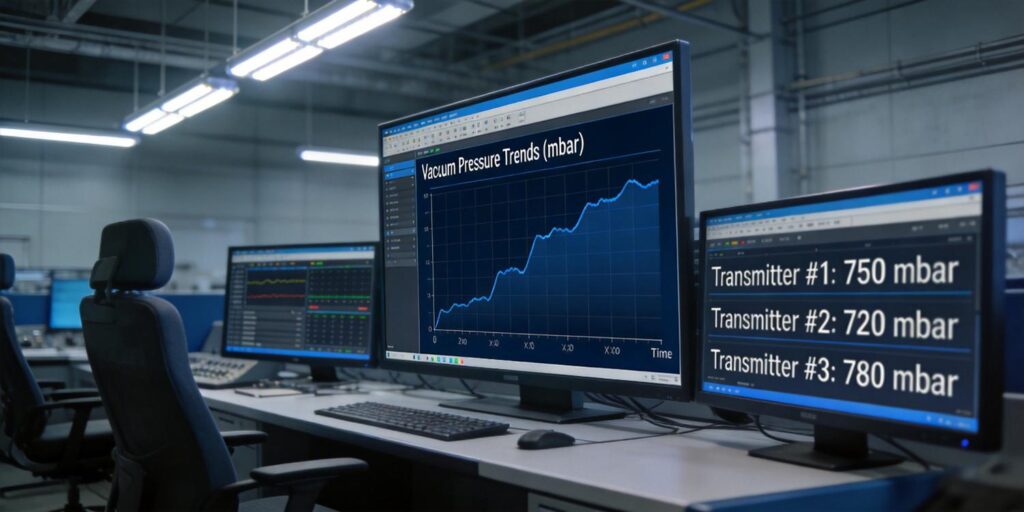
- HMI screens: Add live gauges, trend charts, and color-coded status indicators (green = good vacuum, yellow = warning, red = fault).
- Historian setup: Configure 1-second logging to SQL or InfluxDB; enable OPC UA export.
- Commissioning & validation: Pump to base pressure, compare against certified reference gauge, and verify remote diagnostics. Document as-found/as-left data per ISO 9001 or 21 CFR Part 11 requirements.
Total integration time for an experienced controls engineer is typically under four hours per transmitter pair. Poseidon provides sample ladder logic, Modbus register maps, and calibration certificates to accelerate deployment.
By following these guidelines, facilities achieve robust, auditable vacuum monitoring that scales from laboratory R&D systems to full production lines. The combination of Poseidon’s low-cost, miniature transmitters with modern SCADA delivers the precision, reliability, and insight demanded by today’s vacuum-dependent industries—without the premium pricing or integration complexity of legacy solutions.
References & Further Reading
Lafferty, J. M. (Ed.). (1998). Foundations of Vacuum Science and Technology. John Wiley & Sons.
Peacock, R. N., et al. (1991). Comparison of hot cathode and cold cathode ionization gauges. Journal of Vacuum Science & Technology A, 9(3), 1977.
Redhead, P. A. (1959). The magnetron gauge: A cold-cathode vacuum gauge. Canadian Journal of Physics, 37(11), 1260.
Ready to integrate Poseidon vacuum transmitters into your SCADA? Contact our applications engineering team for pre-configured PLC templates and on-site support.


