
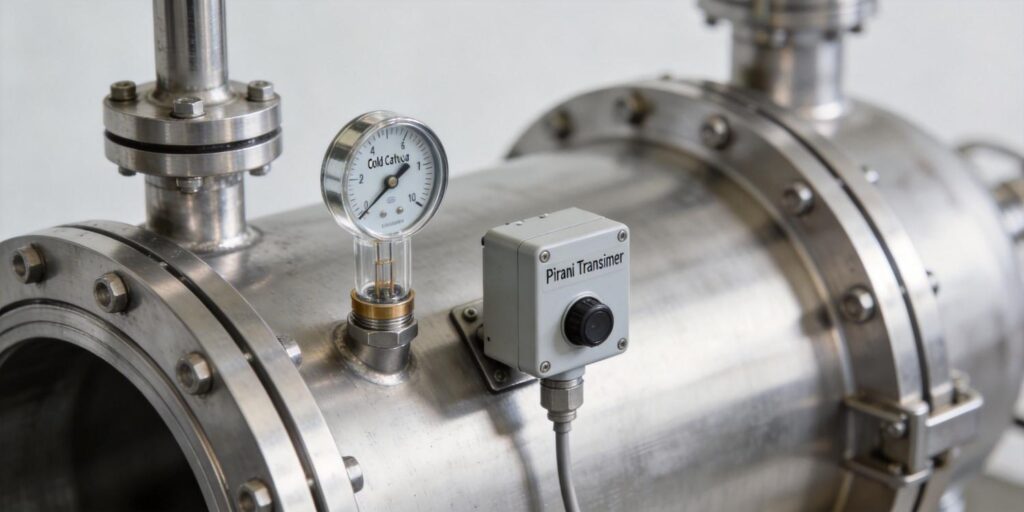
Overview of Cold Cathode and Pirani Principles
Engineers working with vacuum systems in mass spectrometry, vacuum heat treatment, battery manufacturing, or scanning electron microscopy quickly discover that no single gauge covers every pressure decade reliably. The two workhorse technologies—Pirani (thermal conductivity) and cold cathode (Penning discharge)—operate on entirely different physical principles, each excelling where the other falls short.
The Pirani gauge measures heat loss from a heated filament. A thin platinum wire (chosen for its high temperature coefficient of resistance and chemical stability) is held at constant temperature by a feedback circuit. Gas molecules collide with the filament and conduct heat away to the cooler envelope walls. At higher pressures, molecular density increases collision frequency and heat transfer, requiring more electrical power to maintain filament temperature. The controller infers pressure from the power, voltage, or current needed. This principle works from atmosphere down to the molecular-flow regime but loses sensitivity below roughly 10⁻³ Torr when gas conduction becomes negligible.
The cold cathode gauge, such as Poseidon Scientific’s VG-SM225, uses a self-sustaining Penning discharge in crossed electric and magnetic fields. A permanent NdFeB magnet produces ~100 Gauss axially while a –2000 V (after –2500 V startup) potential creates a radial electric field. Field-emitted electrons follow long spiral or cycloidal trajectories, greatly increasing their path length and collision probability with residual gas molecules even at 10⁻⁷ Torr. Each ionizing collision releases secondary electrons and positive ions in an avalanche, forming a stable plasma. The positive ion current collected at the cathode is proportional to gas density and therefore pressure. No hot filament is present, eliminating outgassing, decomposition of reactive gases, and x-ray limits that constrain hot-cathode designs.
Both principles are well documented in the vacuum literature. Lafferty’s Foundations of Vacuum Science and Technology (1998) provides the foundational thermal-conductivity equations for Pirani gauges, while Redhead’s 1959 magnetron gauge paper and subsequent inverted-magnetron studies (Peacock et al., JVST A, 1988 & 1991) detail the physics enabling cold-cathode operation at extreme low pressures.
Pressure Ranges Comparison
Choosing the correct gauge starts with matching its operating window to your process requirements. Overlapping the two technologies creates seamless full-range coverage with minimal hardware duplication.
| Gauge Type | Full Operating Range | Linear High-Accuracy Zone | Typical Industrial Use Cases |
|---|---|---|---|
| Pirani (VG-SP205) | Atmosphere to 10⁻³ Torr (10⁻¹ Pa) | 10 Torr to 10⁻² Torr | Slurry mixing, electrode drying ovens, initial electrolyte filling, roughing lines, foreline monitoring |
| Cold Cathode (VG-SM225) | 10⁻³ Torr to 10⁻⁷ Torr | 10⁻³ Torr to 10⁻⁶ Torr | High-vacuum degassing, mass-spectrometer chamber monitoring, SEM column evacuation, final pump-down in heat-treatment furnaces |
Below 10⁻³ Torr the Pirani signal flattens dramatically; above 10⁻³ Torr the cold cathode risks electrode contamination and non-monotonic current behavior. The practical solution used in thousands of production systems is a dual-gauge configuration sharing the same RJ45 interface and compact footprint. Automatic range switching in the PLC or SCADA system ensures continuous, gap-free monitoring from atmosphere to 10⁻⁷ Torr.
Accuracy and Response Time
Accuracy and speed requirements vary dramatically across processes. In battery electrode drying, ±10 % accuracy in the 1–100 Torr band is usually sufficient; in mass-spectrometer source chambers, repeatability better than ±5 % at 10⁻⁶ Torr is critical for consistent ion current.
Pirani accuracy peaks in its linear zone (±5–10 % typical after temperature compensation) but degrades to ±50 % near atmosphere and at the 10⁻³ Torr limit. Response time is thermal—typically 0.5–2 seconds to reach 90 % of final reading after a pressure step. Built-in circuit-plus-algorithm compensation keeps drift low across 15–50 °C ambient.
Cold cathode gauges deliver faster response (<<100 ms) because the Penning discharge establishes almost instantly once voltage is applied. Accuracy is generally ±10–20 % across the operating range, with slight hysteresis between pump-down and vent-up curves. Long-term drift is minimal in clean systems; contamination is the primary accuracy limiter and is easily corrected by field cleaning the removable sensor head with 200–500 grit abrasive paper—no vacuum break required.
Comparative studies (Peacock et al., JVST A 9, 1977) confirm both gauge types exhibit gas-dependent sensitivities, but the cold cathode avoids the x-ray limit and hot-filament outgassing errors that cap hot-cathode performance at 10⁻¹⁰ Torr and below.
Gas Dependency Differences
Process gases are rarely pure nitrogen or air. Battery electrolyte vapors, helium leak-test mixtures, and argon in sputtering chambers all affect gauge readings differently.
Pirani response is strongly gas-dependent because thermal conductivity varies widely (helium conducts heat ~6× better than air; heavy vapors conduct less). Factory calibration is performed in air; using the gauge with helium or solvent vapor without correction can introduce 20–100 % error. Modern transmitters include temperature compensation but still require gas-specific mapping for highest accuracy.
Cold cathode sensitivity also varies with gas species (ionization cross-section differences), but the variation is typically smaller (factor of 2–3 across common process gases) and more predictable. The discharge mechanism is less sensitive to molecular mass and more to ionization potential. Neither gauge is truly gas-independent, but the cold cathode’s error band is usually narrower in mixed-gas environments once calibrated.
Best practice: document your dominant process gas or mixture during RFQ and request factory calibration data for that gas. Poseidon Scientific supports custom gas mapping on both models at no additional charge for orders of 5–10 units or more.
Installation Scenarios
Real-world mounting constraints often dictate gauge choice as much as pressure range.
- Pirani (VG-SP205): Zero stray magnetic field, no high voltage, and maintenance-free operation make it ideal for tight spaces, ovens with thermal cycling, or areas near electron-beam instruments. Install directly on KF16/KF25 flanges or via short tube extensions. Arbitrary orientation; 0–10 V analog plus RS232 output integrates directly into PLCs.
- Cold Cathode (VG-SM225): Compact positive-magnetron design (~100 Gauss) fits where larger inverted-magnetron gauges cannot. Maintain 10 cm from personnel and 20–30 cm from sensitive electron optics or magnetic encoders. Software interlock automatically disables high voltage above 10⁻³ Torr to protect electrodes. Removable sensor head allows electrode cleaning without tools or chamber venting—critical in contamination-prone battery or PVD lines.
Hybrid installations (one Pirani + one cold cathode on the same chamber) are increasingly standard in high-throughput production. Shared RJ45 cabling and customizable digital protocol reduce panel space and integration time dramatically compared with legacy imported systems.
Cost-Performance Analysis
Total cost of ownership—not just unit price—drives purchasing decisions in 2026. Premium imported cold-cathode gauges (INFICON, MKS) list at $1,100–$1,400 with fixed protocols and larger footprints. Mid-tier domestic units run $700–$850 but lack easy customization and field-cleanable heads.
Poseidon Scientific’s VG-SP205 and VG-SM225 deliver equivalent or better performance at $420–$490 per unit thanks to in-house design (structure, electronics, and firmware by a dedicated three-person team) and positive-magnetron miniaturization. Additional savings come from:
- Free protocol customization starting at 5–10 units—no driver rewrites required
- Field-cleanable cold-cathode sensor (minutes vs. days of downtime)
- Maintenance-free Pirani with platinum filament (3–5 year life in typical industrial gases)
- Compact size that fits existing panels without redesign
For a 50-gauge production line, the first-year savings versus imported equivalents routinely exceed $30,000 while delivering smaller footprint, faster integration, and lower long-term maintenance cost. Performance matches or exceeds competitive models in repeatability, temperature stability, and contamination tolerance.
Ready to Specify the Right Gauge for Your Process?
The choice between Pirani and cold cathode—or the optimal hybrid combination—is straightforward once pressure range, gas environment, installation constraints, and integration needs are defined. The VG-SP205 Pirani Vacuum Transmitter handles rough-to-medium vacuum with zero magnetic concerns and essentially zero maintenance. The VG-SM225 Cold Cathode Vacuum Gauge delivers reliable high-vacuum measurement in a compact, cleanable package at a fraction of legacy pricing.
Whether you are scaling mass-spectrometer production, optimizing battery gigafactory drying lines, or upgrading SEM vacuum systems, Poseidon Scientific provides the precise, cost-effective solution engineers trust.
Contact our applications team today for a no-obligation consultation, custom protocol sample, or performance evaluation on your chamber. Submit your process parameters (pressure range, dominant gases, mounting style, and quantity) and receive a firm quotation plus technical recommendation within 24 hours.
Explore full specifications and request your evaluation unit:
Make the right choice the first time. Reduce cost, simplify integration, and maximize uptime—your vacuum measurement optimization starts here.


