Typical Contaminants in Environmental Water Samples
Environmental water monitoring requires robust analytical methods to detect trace levels of emerging contaminants. Hydrophilic-Lipophilic Balanced (HLB) solid-phase extraction has become the gold standard for analyzing pharmaceuticals and hormones in water matrices due to its exceptional retention capabilities across a wide polarity range.
Pharmaceutical residues commonly targeted include antibiotics (sulfonamides, fluoroquinolones, tetracyclines), anti-inflammatory drugs (diclofenac, ibuprofen), beta-blockers, and lipid regulators. These compounds typically exist at ng/L to μg/L concentrations in environmental waters, necessitating sensitive detection methods. Hormonal contaminants of concern include natural estrogens (estrone, 17β-estradiol, estriol) and synthetic hormones (17α-ethinylestradiol) that exhibit endocrine-disrupting effects at extremely low concentrations.
The balanced nature of HLB sorbents, with both hydrophilic N-vinylpyrrolidone and lipophilic divinylbenzene components, provides dual retention mechanisms ideal for these diverse compound classes. This balanced retention is particularly valuable for pharmaceuticals that often contain both polar and non-polar functional groups within the same molecule.
Large Volume Water Sample Loading (100–500 mL)
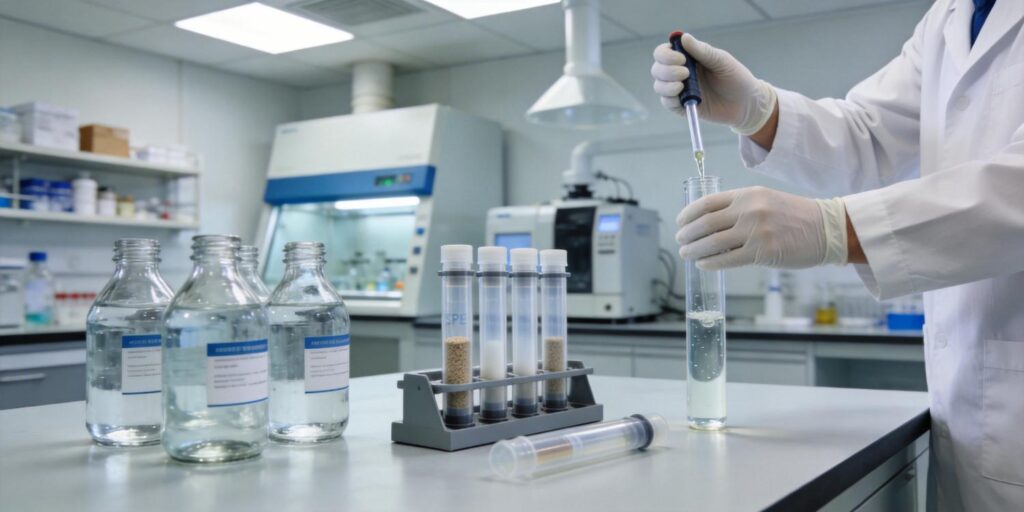
Environmental analysis typically requires processing large sample volumes to achieve adequate detection limits for trace contaminants. Loading 100–500 mL samples onto HLB cartridges presents both challenges and opportunities for method optimization.
The breakthrough volume concept is critical when handling large samples. According to SPE fundamentals, the breakthrough volume represents the maximum sample volume that can be loaded before analyte loss occurs. For HLB cartridges, typical breakthrough volumes range from 1–5 L for moderately polar compounds, but this varies significantly with analyte properties and matrix composition. Environmental chemists must consider that sample capacity is severely reduced on a dry column, emphasizing the importance of proper conditioning.
For large volume applications, cartridge selection becomes paramount. Larger bed mass cartridges (200–500 mg) provide increased capacity and are essential when processing >250 mL samples. The 6 cc/500 mg HLB cartridges are particularly well-suited for environmental applications, offering sufficient capacity while maintaining reasonable flow characteristics.
Pre-filtration and Sample Acidification
Proper sample pretreatment is essential for successful HLB extraction of environmental waters. Pre-filtration through 0.45 μm or 0.22 μm membrane filters removes particulates that could clog the SPE cartridge and interfere with analyte recovery. This step is particularly important for surface water samples containing suspended solids.
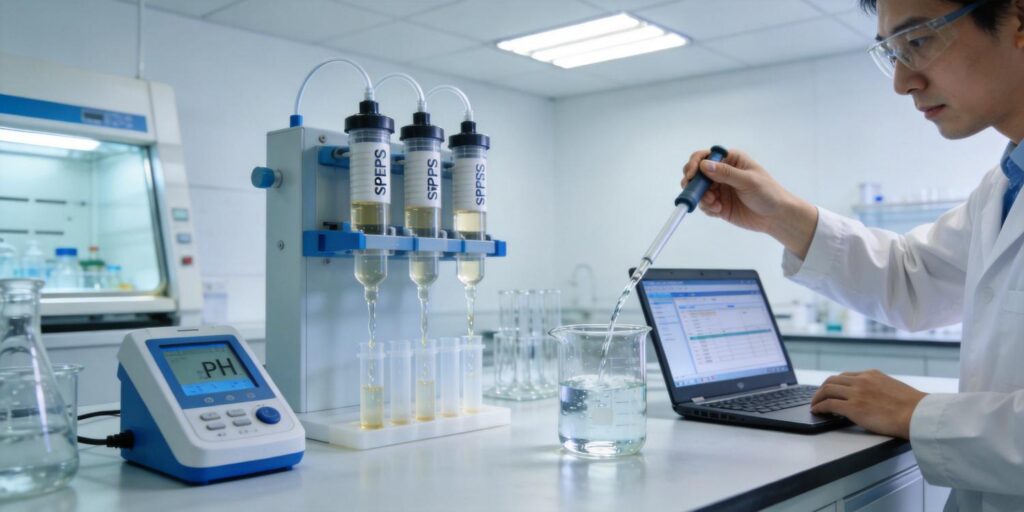
Sample acidification serves multiple purposes in environmental analysis. Adjusting pH to approximately 2.0–2.5 using hydrochloric or formic acid:
- Suppresses bacterial growth during sample storage and processing
- Enhances retention of acidic pharmaceuticals by protonating carboxyl groups
- Reduces ionization of weak acids, improving hydrophobic interactions with the HLB sorbent
- Helps preserve sample integrity during transportation and storage
Research indicates that starting at pH 2.2 results in less ionization of acidic drugs and hence better retention on the cartridge. However, the amounts of water in the sample application step should be kept as small as possible to prevent washing away more polar acidic compounds.
SPE Conditioning and Equilibration
Traditional SPE protocols require conditioning and equilibration steps to prepare the sorbent for sample introduction. The conditioning step wets the sorbent and allows liquid to enter the pores, enabling retention within the sorbent. Once wetted, the sorbent needs to be equilibrated with aqueous solution to prepare it for aqueous sample loading.
For HLB cartridges, the standard conditioning protocol involves:
- Methanol conditioning: 3–5 mL methanol per 100 mg sorbent bed mass
- Water equilibration: 3–5 mL deionized water or acidified water (pH 2–3)
At low vacuum (approximately 3 in. Hg), add 1.5 mL of methanol per 100 mg of sorbent to the sample preparation column. Release the vacuum or begin flushing immediately on completion. The more air that passes through the column before sample loading, the less solvated the sorbent will be.
Apply deionized or distilled water to remove excess solvent, which will interfere with hydrophobic binding. Use 1 mL of H₂O per 100 mg of sorbent. Momentary high volume (5–8 in. Hg) may be necessary to restart flow. At approximately 2.5 in. Hg the column will resist air displacement (vacuum may be left on without drying the sorbent). If the sorbent is accidentally dried, resolvate and reflush.
Sample Loading Flow Rate Considerations
Flow rate optimization is critical for achieving quantitative recovery while maintaining reasonable processing times. The general recommendation for environmental water samples is to maintain flow rates below 10 mL/min for optimal analyte retention.
Key considerations include:
- Retention efficiency: Recovery is inversely proportional to flow rate (recovery ∝ 1/flow). Slower flow rates allow sufficient contact time for analytes to interact with the sorbent surface.
- Practical constraints: For 500 mL samples, flow rates of 5–8 mL/min provide reasonable processing times (60–100 minutes) while maintaining good recovery.
- Vacuum control: Maintain consistent vacuum to ensure reproducible flow rates. Excessive vacuum can cause channeling and reduced recovery.
- Drop-wise flow: When time/throughput is not a major concern, drop-wise solvent flow provides optimal recovery by maximizing contact time.
Environmental applications typically apply sample at a rate of 1–2 mL/min for optimal recovery, though momentary increases in vacuum may be needed to initiate sample flow.
Wash Solvents to Remove Humic Acids
Natural organic matter, particularly humic and fulvic acids, represents a significant interference in environmental water analysis. These complex organic matrices can co-extract with target analytes, causing matrix effects in LC-MS analysis and reducing method sensitivity.
Effective wash strategies for humic acid removal include:
- Acidified water wash: 2–5 mL of water acidified to pH 2–3 with formic acid effectively removes polar interferences while retaining most pharmaceuticals.
- Low organic content wash: 2–5 mL of 5% methanol in water provides additional cleaning while maintaining analyte retention.
- Sequential washing: Combining acidified water followed by low organic wash often provides optimal cleanup.
The wash step should use solvents that won’t elute the analyte but will remove weakly retained matrix components. Ideal washing removes as many interferences as possible while retaining the analyte(s). For environmental waters, washing with the same solution in which the sample was dissolved, or another solution that will not remove the desired compounds, is recommended.
Elution Solvent Optimization for LC-MS
Elution optimization is crucial for achieving high recovery while maintaining compatibility with subsequent LC-MS analysis. The elution solvent should provide sufficient strength to quantitatively recover analytes while minimizing co-elution of interferences.
Common elution strategies for HLB cartridges include:
- Methanol elution: 2 × 2–3 mL methanol provides excellent recovery for most pharmaceuticals and hormones. Allow cartridge/plate to soak with eluent for 0.5–1 minute to improve recovery.
- Acetonitrile elution: 2 × 2–3 mL acetonitrile may provide better recovery for certain polar compounds.
- Mixed solvent elution: 90:10 acetonitrile:methanol or methanol with 2% formic acid/ammonium hydroxide can enhance recovery for ionizable compounds.
When choosing eluent, consider ease of evaporation if reconstitution is needed. Sometimes several smaller eluent aliquots can improve recovery compared to a single larger volume. For lipophilic species, it becomes desirable to rinse the walls of the SPE device to minimize sample transfer losses.
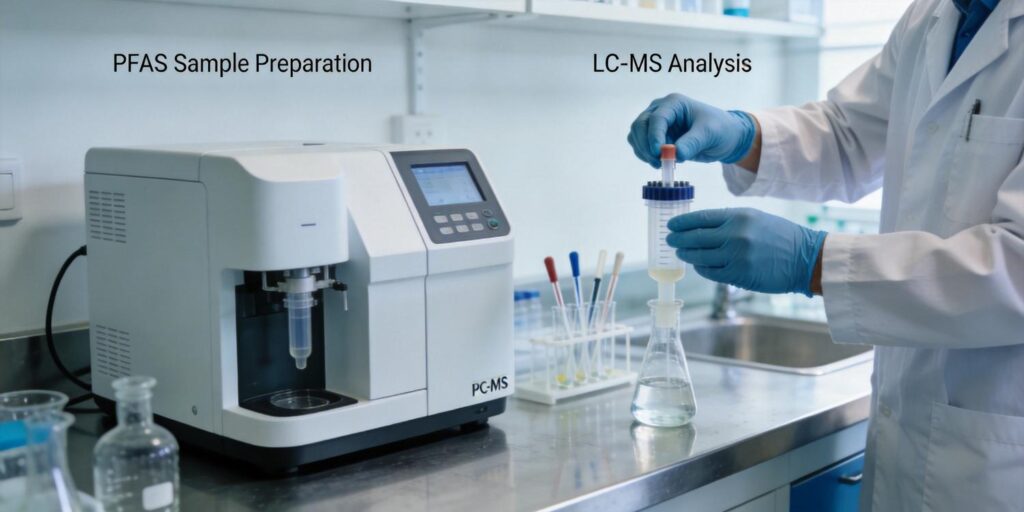
For LC-MS compatibility, elution solvents should be volatile and compatible with the mobile phase. Common approaches include:
- Evaporating eluates to dryness and reconstituting in initial mobile phase
- Direct injection after appropriate dilution with aqueous phase
- Using elution solvents that match initial mobile phase composition
Final optimization experiments should aim to improve the precision of the procedure, for which reason replicate assays (e.g., 4–6) of spiked samples should be performed. The concentration of the spiked samples should be sufficiently high to allow for estimation of recoveries even if interfering peaks are present.
Practical Recommendations for Method Development
When developing HLB SPE methods for environmental waters:
- Start with established protocols and modify based on specific analyte properties
- Use matrix-matched standards for recovery studies to account for matrix effects
- Optimize one parameter at a time while keeping others constant
- Validate method performance with QC samples at relevant concentrations
- Consider automation for improved reproducibility and throughput
The Oasis 2 × 4 strategy demonstrates that only 2 protocols and 4 sorbents are needed to analyze all types of compounds: acids, bases, and neutrals. For environmental water analysis focusing on pharmaceuticals and hormones, the HLB sorbent with appropriate pH adjustment typically provides excellent results.
Remember that SPE is a very robust technique that enables scientists to reduce chromatographic complexity, increase signal-to-noise ratios, improve detection limits, minimize risks associated with matrix effects, concentrate analytes of interest, reduce variability in analytical results, increase robustness of analysis, increase column lifetime, and reduce system downtime.