Deposition Stages: Where Vacuum Monitoring Drives Film Quality
Thin-film deposition—whether by physical vapor deposition (PVD), sputtering, evaporation, or chemical vapor deposition (CVD)—is a sequence of precisely timed vacuum phases. Each stage imposes different pressure demands, and real-time monitoring determines film adhesion, density, stoichiometry, and defect density. Engineers and procurement teams in semiconductor, optics, and display manufacturing rely on continuous pressure data to protect substrates, optimize cycle time, and meet yield targets.
1. Chamber Evacuation and Pump-Down
The process begins with roughing from atmosphere to the 10⁻³ Torr transition. Residual air, moisture, and volatiles must be removed rapidly to prevent oxidation or trapped gases in the growing film. A fast-responding gauge here confirms that roughing pumps and forelines are performing and triggers the transition to high-vacuum pumps.
2. Base-Pressure Achievement and Verification
Once below 10⁻³ Torr, turbo or cryo pumps pull the chamber to the ultimate base pressure—typically 10⁻⁶ to 10⁻⁸ Torr for high-quality optical or electronic films. This stage verifies system integrity and removes the last monolayers of adsorbed water and hydrocarbons before substrate heating or plasma ignition.
3. Substrate Preparation and Pre-Cleaning
Substrates are heated and often sputter-etched or plasma-cleaned. Pressure is held in the 10⁻⁴ to 10⁻² Torr range with low flows of inert gas. Stable monitoring prevents premature deposition or arcing.
4. Active Deposition
Process gas (Ar, O₂, N₂, or reactive mixtures) is introduced. Sputtering typically runs at 1–10 mTorr; evaporation may require deeper vacuum. Gauge readings must remain stable despite changing gas composition and plasma load.
5. Post-Deposition Pump-Down and Venting
After shutter closure, the chamber returns to base pressure before venting with dry nitrogen. This final pump-down removes excess process gas and prepares for the next load.
Across these stages, vacuum levels swing over six orders of magnitude. A single gauge cannot cover the full range with both speed and accuracy, which is why complementary Pirani and cold-cathode technologies are the industry standard.
Required Vacuum Levels: Matching Process Physics to Gauge Capability
Thin-film quality is directly proportional to the partial pressures of residual gases during key moments. Typical targets include:
- Rough vacuum (pump-down & venting): atmosphere to 10⁻³ Torr (133 Pa to 0.133 Pa)
- High-vacuum base pressure: 10⁻⁶ to 10⁻⁷ Torr (0.000133 to 0.0000133 Pa) — required for low-contamination optical coatings and semiconductor metallization
- Process pressure: 1–10 mTorr (0.133–1.33 Pa) during sputtering or reactive deposition
At base pressure, every decade improvement in vacuum reduces impurity incorporation by roughly an order of magnitude. For example, aluminum films deposited below 10⁻⁷ Torr show dramatically lower resistivity and better reflectivity than those at 10⁻⁵ Torr. During deposition itself, pressure must be held within ±5 % of target to maintain consistent deposition rate and film stress.
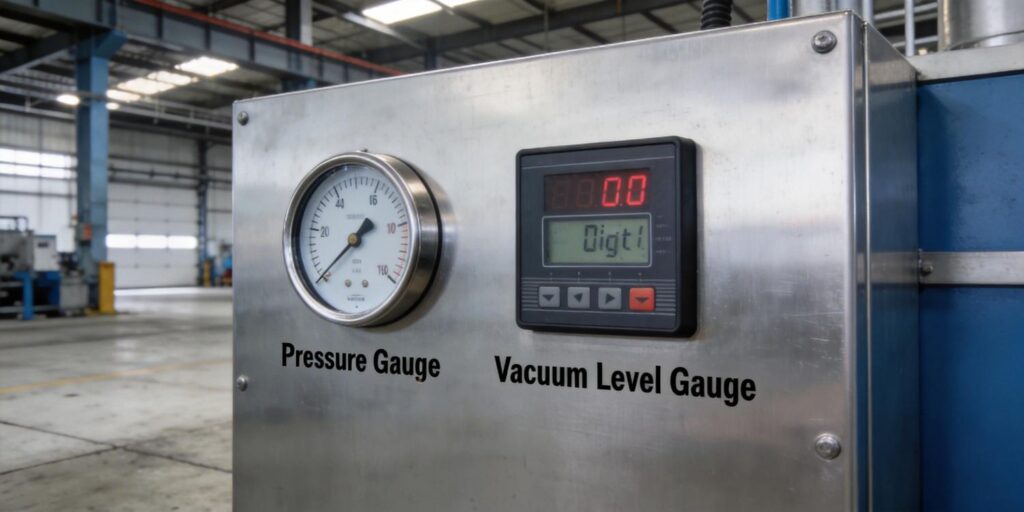
These exact ranges align with the Poseidon product pair. The VG-SP205 Pirani Vacuum Transmitter covers the entire rough-to-medium band with its thermal-conductivity principle, delivering sub-second response and temperature-compensated output. Once pressure falls below 10⁻³ Torr, the VG-SM225 Cold Cathode Vacuum Gauge (PTR225N compatible) provides linear, high-sensitivity monitoring down to 10⁻⁷ Torr via Penning discharge—without the filament burnout risk of hot-cathode alternatives.
Together they give uninterrupted coverage, automatic high-voltage protection on the cold-cathode unit, and the ability to perform pressure-rise leak tests at every cycle end.
Gauge Selection: Why Pirani + Cold Cathode Is the Optimal Combination
Selecting the right gauge pair for a thin-film tool is a balance of range, response time, contamination tolerance, and cost. The Poseidon duo was developed specifically for OEMs and end users who need INFICON/MKS performance at 40–60 % lower price.
| Stage | Recommended Gauge | Key Advantage | Typical Output |
|---|---|---|---|
| Pump-down & roughing | VG-SP205 Pirani | 200 ms response, maintenance-free, linear 10–10⁻² Torr | 0–10 V + RS232 |
| Base-pressure verification | VG-SM225 Cold Cathode | Linear to 10⁻⁷ Torr, auto HV shutdown, cleanable electrodes | 0–10 V + RS232 |
| Process pressure (mTorr) | VG-SP205 Pirani | Gas-type offset useful for endpoint detection | 0–10 V + RS232 |
| Load-lock & venting | VG-SP205 Pirani | Full atmosphere coverage, no ignition delay | 0–10 V + RS232 |
The VG-SP205 uses a platinum filament chosen for its high temperature-coefficient of resistance and chemical stability—superior to tungsten alternatives. It is fully sealed and requires no maintenance for 3–5 years in clean systems. The VG-SM225 employs a compact “工”-shaped Penning geometry with 100-gauss neodymium magnets and 2000 V operation. Its removable sensor head allows electrode cleaning in minutes with 500-grit sandpaper—no vacuum envelope breach required.
Both share the same mechanical footprint (KF16/KF25), RJ45 connector, and customizable RS232 protocol. This uniformity simplifies multi-chamber tools and spares inventory. For systems originally designed around INFICON PTR225N, the VG-SM225 is a form-fit-function replacement at significantly lower cost.
Stability Tips: Maintaining Accuracy Through Thousands of Cycles
Thin-film tools run 24/7 with frequent venting and reactive gases. The following practices keep gauge readings stable within ±10 % for years.
- Temperature control. Both gauges operate 15–50 °C with built-in circuit and algorithmic compensation. Mount away from heaters or use simple water-cooled standoffs; never exceed 50 °C at the gauge head.
- Controlled venting. Always use dry nitrogen (99.999 %) through a 0.5 µm filter. Limit rise rate to <200 Torr/s to avoid shock waves or moisture condensation on electrodes.
- Electrode maintenance for cold cathode. If ignition delay increases or readings drop one decade, remove the VG-SM225 sensor head and lightly abrade cathode/anode plates until metallic luster returns. Restore performance in <10 minutes—no recalibration needed.
- Protocol optimization. Use the customizable RS232 to disable averaging during fast pump-down and embed status flags (HV active, ready). This gives the PLC clean, real-time data without extra filtering.
- Cross-check strategy. Pair the Pirani with a capacitance manometer during process pressure; the deliberate gas-type offset of the Pirani becomes a sensitive indicator of residual moisture or endpoint.
- Isolation during aggressive processes. In fluorine- or chlorine-containing CVD, add a manual isolation valve so the gauge remains under vacuum while the chamber is exposed to reactive gases.
These simple habits—combined with the gauges’ stainless-steel construction, PEEK insulators, and leak rate <10⁻¹¹ Pa·m³/s—deliver the long-term stability required for six-sigma yield in production thin-film lines.
CTA
Thin-film deposition demands uninterrupted, full-range vacuum monitoring that is accurate, fast, and cost-effective. The Poseidon VG-SP205 Pirani Vacuum Transmitter and VG-SM225 Cold Cathode Vacuum Gauge deliver exactly that—covering atmosphere to 10⁻⁷ Torr with sub-second response, automatic protection, easy maintenance, and drop-in compatibility—at a fraction of the price of legacy imports.
Explore the VG-SP205 Pirani Vacuum Transmitter for rapid pump-down and process monitoring, and the VG-SM225 Cold Cathode Vacuum Gauge (PTR225N compatible) for precise base-pressure verification down to 10⁻⁷ Torr.
Need help specifying the optimal gauge pair for your PVD, sputtering, or evaporation tool? Send us your chamber flange size, existing controller protocol, and target base pressure. Our applications team will return a free system-layout recommendation, custom RS232 protocol sample (5–10 unit minimum), and side-by-side cost/performance data versus INFICON, MKS, or domestic alternatives. Contact us today and upgrade your thin-film vacuum monitoring without redesigning your system—while cutting instrumentation costs by 40–60 %.