
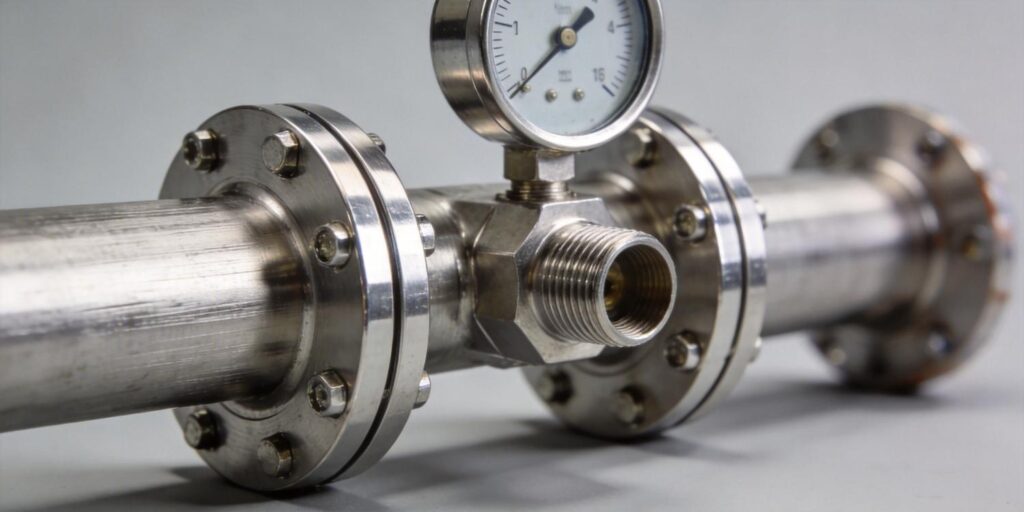
Mechanical Interfaces: Plug-and-Play Compatibility with Standard Vacuum Systems
Vacuum gauge retrofits succeed or fail at the mechanical interface. Most industrial and laboratory vacuum systems—mass spectrometers, freeze dryers, vacuum furnaces, and semiconductor tools—use standardized KF quick-flange connections. The Poseidon VG-SP205 Pirani Vacuum Transmitter and VG-SM225 Cold Cathode Vacuum Gauge are engineered around exactly these interfaces, eliminating adapters, custom machining, or costly system modifications.
Both models ship with KF16 or KF25 flanges as standard. These match the vast majority of existing ports on chambers, manifolds, and forelines from INFICON, MKS, Pfeiffer, and legacy domestic brands. The compact overall envelope (smaller than many competitive cold-cathode heads) allows direct drop-in replacement even in space-constrained locations such as load-lock walls or tight pump skids. No orientation restriction means the gauge can be mounted vertically, horizontally, or at any angle without affecting accuracy or safety.
For the VG-SM225, the removable sensor head design further simplifies retrofits. The vacuum envelope seal remains intact during electrode inspection or cleaning, so the mechanical interface never needs to be disturbed. The VG-SP205, being fully sealed and maintenance-free, requires zero mechanical service over its 3–5 year life. Both achieve leak rates below 10⁻¹¹ Pa·m³/s with standard KF centering rings and O-rings, matching or exceeding the integrity of the equipment they replace.
Procurement teams appreciate that these standard interfaces eliminate the hidden costs of custom flanges or welding that often accompany imported gauges. Installation is literally “remove old gauge, install new gauge, torque to spec”—typically under 15 minutes per unit.
Electrical Outputs: Matching Today’s Control Architectures
Modern vacuum systems communicate through a mix of analog and digital signals. Poseidon transmitters are built to speak every common language without external converters or additional I/O cards.
Analog Output
Both models provide a 0–10 V linear analog signal (effective 2–8 V working span). This is the industry workhorse for direct PLC analog inputs, chart recorders, and legacy PID controllers. Scaling is factory-set to Torr by default but can be ordered in mbar or Pa. Noise is held below 0.1 % full scale, delivering clean feedback even in electrically noisy furnace or semiconductor environments.
Digital Communication
The primary interface is RS232 over an industry-standard RJ45 connector—the same connector used on most mass-spectrometer and vacuum-pump controllers. This eliminates proprietary cables. The RJ45 jack can be field-adapted to DB9 or DB15 with simple jumper cables if your existing wiring harness demands it.
RS232 protocol is fully customizable at the 5–10 unit level. Poseidon can embed your exact data frame, baud rate, parity, and scaling so the gauge reports pressure, status (high-voltage on/off, sensor ready), and error codes in the format your SCADA or PLC already expects. RS485 is pre-reserved on the PCB; a simple board spin adds it for multi-drop networks if future expansion is planned.
Notably absent is 4–20 mA. This omission is deliberate: the majority of vacuum OEMs and end users now prefer voltage or digital for higher resolution and lower wiring cost. If 4–20 mA is required for a specific legacy loop, an off-the-shelf external converter works seamlessly with the 0–10 V output.
These outputs match the electrical footprints of INFICON MPG400 / PTR225N (cold cathode) and common Pirani transmitters, allowing direct wiring swaps in most cases.
Signal Matching: Ensuring Accurate, Drift-Free Integration
Even with perfect mechanical and electrical connections, signal mismatch can produce offset errors, scaling issues, or control-loop instability. Poseidon transmitters eliminate these risks through factory calibration and protocol flexibility.
Analog matching is straightforward. The 0–10 V output is calibrated against NIST-traceable standards across the full range. For the VG-SP205 Pirani, linearity is best from 10 Torr to 10⁻² Torr; outside this band the software applies compensation curves that keep total error within ±15 %—more than adequate for most automation. The VG-SM225 Cold Cathode maintains linear ion-current response from 10⁻³ to 10⁻⁷ Torr, with built-in protection that disables high voltage above 10⁻³ Torr to prevent false readings during roughing.
Digital signal matching goes further. The customizable RS232 protocol can include:
- Pressure value in your preferred unit (Torr / mbar / Pa)
- Real-time status flags (ready, high-voltage active, maintenance due)
- Error codes for open sensor, over-range, or ignition delay
- Software version and serial number for traceability
This eliminates the need for PLC scaling blocks or middleware that legacy gauges often require. In practice, customers replacing INFICON or MKS units report zero software changes when they supply their existing protocol template during ordering.
Temperature compensation (circuit + algorithm) keeps both gauges stable from 15–50 °C—the typical range inside control cabinets or near vacuum furnaces. No additional cold-junction compensation or external thermistors are needed.
Retrofit Strategy: A Proven Four-Step Path to Drop-In Replacement
Replacing existing vacuum gauges does not require system redesign. The following strategy, refined through dozens of mass-spectrometer and freeze-dryer retrofits, delivers plug-and-play results with minimal downtime.
- Site survey (1–2 hours)
Document flange size (KF16/KF25), existing connector (RJ45/DB9/etc.), output type (0–10 V or proprietary serial), and native units. Measure available envelope space. Poseidon’s smaller footprint almost always fits. - Mechanical swap
Isolate the chamber, vent safely, remove the old gauge, and install the Poseidon unit with the same KF centering ring and clamp. Torque to 10–15 Nm. No new flanges or welding required. - Electrical and protocol integration
Connect power and signal wires. For RS232, upload the custom protocol (provided free with order) via simple terminal command. Verify 0–10 V scaling on the PLC analog input. The entire step takes under 30 minutes per gauge. - Commissioning and validation
Pump down and compare readings against a reference capacitance manometer or the old gauge during a test cycle. Perform pressure-rise leak testing. Log data for your validation package. Both gauges require no field calibration—factory mappings are permanent.
Typical retrofit time for a dual-gauge system (Pirani + cold cathode) is one shift. Because protocol customization is available at prototype quantities, even small OEM runs or single-site upgrades avoid software redevelopment costs that can exceed the gauge price itself.
The VG-SM225 is explicitly PTR225N-compatible in form, fit, and function for INFICON users; the VG-SP205 matches the electrical and mounting envelope of common Pirani transmitters. This compatibility has been confirmed in the field with Yuchuan, MKS, and domestic Chengdu-series systems.
CTA
Upgrading to modern vacuum gauges no longer means ripping out wiring harnesses, rewriting PLC code, or machining new flanges. Poseidon Scientific’s VG-SP205 Pirani Vacuum Transmitter and VG-SM225 Cold Cathode Vacuum Gauge deliver true drop-in compatibility—standard KF flanges, 0–10 V analog, fully customizable RS232 over RJ45, and the smallest footprint in their class—at a fraction of the cost of legacy imports.
Explore the VG-SP205 Pirani Vacuum Transmitter for rough-to-medium vacuum monitoring and the VG-SM225 Cold Cathode Vacuum Gauge (PTR225N compatible) for high-vacuum extension down to 10⁻⁷ Torr.
Ready to retire aging gauges without disruption? Send us your existing gauge model, connector pinout, and protocol template. Our applications team will return a free compatibility report, custom-protocol sample (5–10 unit minimum), and side-by-side performance data versus INFICON, MKS, or domestic alternatives. Contact us today and accelerate your retrofit schedule while cutting instrumentation costs by 40–60 %.


