1. Sample Homogenization Methods
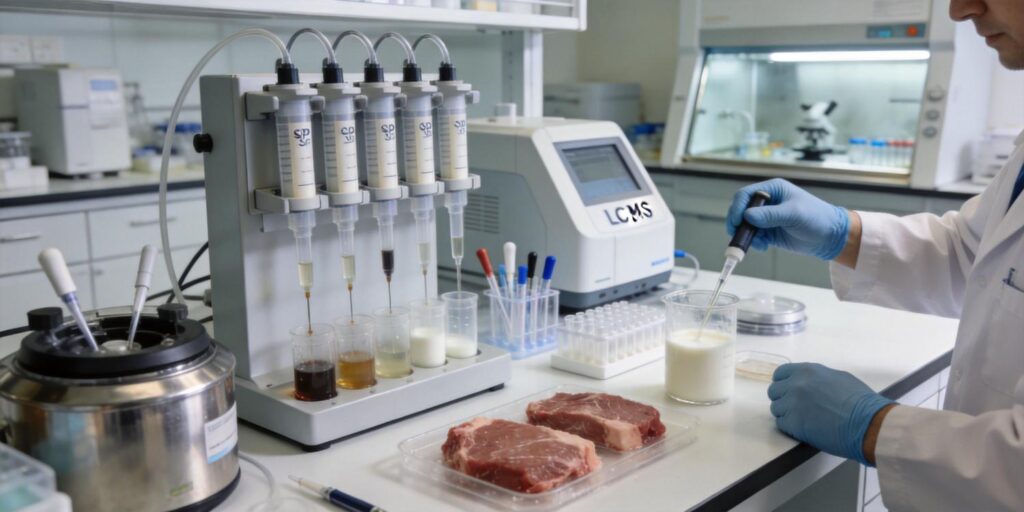
Effective pesticide residue extraction begins with proper sample homogenization. For food matrices, mechanical homogenization using high-speed blenders or food processors is essential to create a uniform sample. According to literature, the QuEChERS method (Quick, Easy, Cheap, Effective, Rugged, and Safe) has revolutionized multi-residue pesticide analysis by incorporating efficient homogenization techniques. For fruits and vegetables, samples are typically chopped and blended with extraction solvents, while for high-fat content samples like oils and lipidic materials, additional steps may be required to address variable water and fat contents that can present capacity problems during SPE.
Research by Luke (1995) demonstrates comprehensive extraction of a wide range of pesticides from various matrices, indicating that considerable sample manipulation and liquid-liquid extraction (LLE) may be required before SPE. The high or variable water and fat contents of citrus fruit, berries, and nuts can present capacity problems that must be addressed during homogenization. For solid samples like cereals and grains, cryogenic grinding with liquid nitrogen followed by thorough mixing ensures representative sampling and efficient extraction.
2. Solvent Extraction Prior to SPE (ACN Extraction)
Acetonitrile (ACN) extraction has become the gold standard for pesticide residue analysis in food samples, particularly in QuEChERS methodologies. The standard protocol involves adding 10 mL of acetonitrile to 10 g of homogenized sample, followed by vigorous shaking for 1 minute. This is typically followed by the addition of salts such as magnesium sulfate (MgSO₄) and sodium chloride (NaCl) to induce phase separation and improve pesticide partitioning into the organic layer.
Studies show that acetonitrile effectively extracts a broad range of pesticide classes while minimizing co-extraction of lipids and pigments. The extraction of benzimidazole fungicides with acetone from various fruits and vegetables followed by SPE cleanup on bonded sorbents has been reported by Pavoni and Errani (1996). The choice of extraction solvent is critical – acetonitrile provides excellent recovery for both polar and non-polar pesticides while maintaining compatibility with subsequent SPE steps.
3. Cartridge Conditioning Protocol
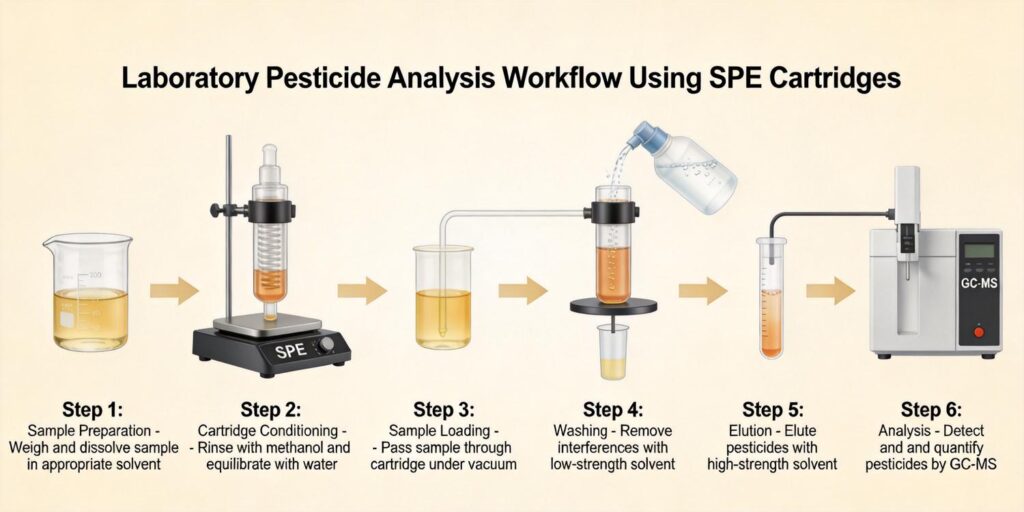
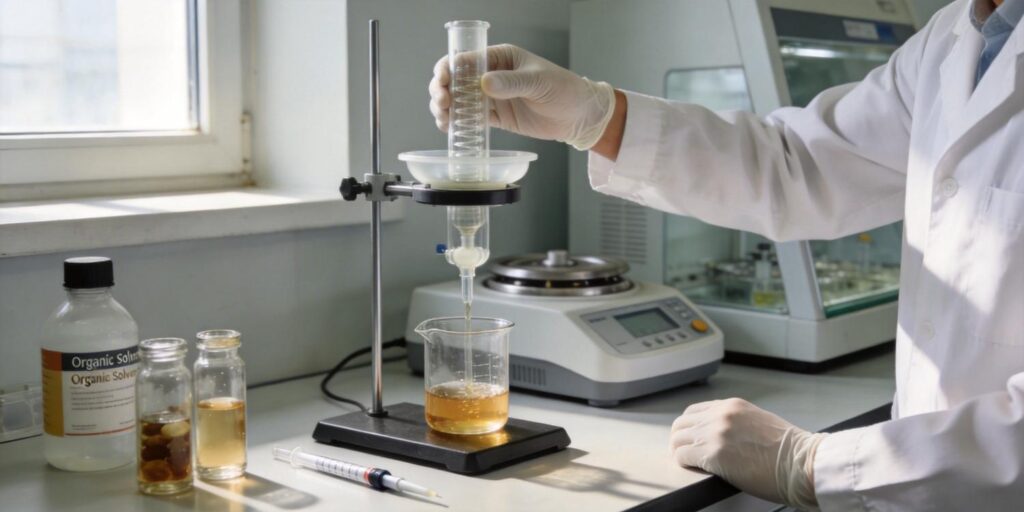
Proper conditioning of HLB SPE cartridges is essential for optimal pesticide recovery. The standard conditioning protocol involves sequential solvent washes: first with methanol (3-5 mL) to activate the hydrophilic-lipophilic balanced sorbent, followed by water or buffer solution (3-5 mL) to create the appropriate environment for analyte retention. The unique water-wettable nature of Oasis HLB allows direct loading of aqueous samples without sacrificing recovery, though conditioning remains important for consistent performance.
For pesticide applications, conditioning with methanol followed by acidified water (pH 2-3) or buffer solutions helps maintain pesticide stability and retention. Research indicates that conditioning solvent concentration in the sample can significantly influence SPE recovery, as demonstrated in factorial design studies by Hannah et al. (1987) and Wells et al. (1994a). These studies investigated SPE parameters including sample pH, elution solvent strength, ionic strength, and addition of organic modifiers.
4. Matrix Cleanup Using SPE Wash Solvents
Matrix cleanup is critical for removing interfering compounds that can affect analytical accuracy. For HLB cartridges in pesticide analysis, wash solvents typically include 5-10% methanol in water or acidified water solutions. This step removes polar matrix components such as sugars, organic acids, and some pigments while retaining target pesticides on the sorbent.
Studies by Font et al. (1993) on multi-residue pesticide analysis of water demonstrate that careful selection of wash solvents can significantly improve cleanup efficiency. For food matrices, additional cleanup may involve stacked cartridge systems or specialized sorbents. The Luke procedure (1995) utilizes SAX/PSA stacked cartridges to remove plant sugars and acids while allowing analytes to pass through unretained. This approach is particularly effective for complex food matrices where multiple classes of interfering compounds are present.
5. Removal of Lipids and Pigments
Lipids and pigments represent significant challenges in food sample analysis. HLB SPE cartridges effectively remove these interferences through selective retention mechanisms. For lipid removal, wash steps with hexane or other non-polar solvents can be incorporated, though careful optimization is required to avoid pesticide loss.
Research indicates that elimination of co-extracted waxes, often problematic in fruit analysis such as apples, may sometimes be achieved post-extraction by careful selection of solvents for reconstitution. As waxes are typically insoluble in methanol, this solvent can be used to redissolve an SPE eluate after evaporation with resultant precipitation of the waxes. For pigment removal, particularly chlorophylls and carotenoids, additional cleanup with graphitized carbon black (GCB) or specialized sorbents may be necessary, though caution is required as GCB can also retain planar pesticides.
6. SPE Elution Solvents Compatible with GC-MS / LC-MS
Elution solvent selection is crucial for both recovery and compatibility with downstream analysis. For GC-MS applications, common elution solvents include ethyl acetate, acetone, or mixtures of methylene chloride with isopropanol and ammonium hydroxide (78:20:2). These solvents provide excellent pesticide recovery while being amenable to evaporation and reconstitution in GC-compatible solvents.
For LC-MS applications, methanol, acetonitrile, or mixtures thereof are preferred. Studies show that 90:10 acetonitrile/methanol provides excellent elution efficiency for a wide range of pesticides while maintaining compatibility with LC-MS systems. The elution volume should be optimized – typically 3-5 mL for standard cartridges – with research indicating that sometimes several smaller eluent aliquots can improve recovery. Allow the cartridge to soak with eluent for 0.5-1 minute before collection to maximize recovery.
7. Example Pesticide Recoveries
Comprehensive studies demonstrate excellent recovery rates for pesticides using HLB SPE workflows. QuEChERS method evaluations show recovery rates of 90-110% for most of 229 pesticides tested in various food matrices, with relative standard deviations (RSDs) typically below 5%. Specific examples include:
- Organochlorine pesticides: Recoveries of 80-99% for compounds like α-HCH, β-HCH, γ-HCH (lindane), heptachlor, aldrin, and DDT derivatives
- Organophosphorus pesticides: Average recoveries of 85-95% with RSDs < 10%
- Carbamate insecticides: Recoveries of 88-102% in vegetable and fruit matrices
- Triazine herbicides: Recoveries of 92-98% with excellent precision
Research by Hong et al. (1993) on simultaneous analysis of 25 pesticides in crops using gas chromatography showed consistent recoveries across multiple compound classes. Similarly, studies on multi-residue methods for fruits and vegetables demonstrate that HLB SPE provides reliable cleanup and concentration for trace-level pesticide analysis, meeting regulatory requirements for food safety testing.
The evolution of multiresidue pesticide methods, as described by Luke (1995), shows how SPE technology has enabled increasingly comprehensive analysis while maintaining excellent recovery and precision. Modern HLB SPE workflows, when properly optimized, provide robust solutions for pesticide residue analysis in diverse food matrices, supporting food safety monitoring programs worldwide.
For laboratories seeking reliable SPE solutions for pesticide analysis, Poseidon Scientific’s HLB SPE cartridges offer excellent performance for food safety applications. Our products are designed to provide consistent recovery and cleanup for multi-residue pesticide analysis across various food matrices.