Metallurgy Vacuum Needs: Why Precise Pressure Control Matters
Vacuum heat treatment has become a cornerstone of modern metallurgy. Processes such as annealing, brazing, sintering, tempering, and diffusion bonding rely on controlled low-pressure environments to eliminate oxidation, decarburization, and hydrogen embrittlement while promoting uniform microstructure and surface cleanliness. Without reliable vacuum monitoring, these outcomes become inconsistent, leading to scrap, rework, or compromised mechanical properties.
Typical pressure regimes in metallurgical furnaces span several orders of magnitude:
- Rough vacuum (pump-down and initial heating): atmosphere to 10−3 Torr (1.33 Pa) — used to remove bulk air and moisture.
- Medium to high vacuum (process hold): 10−3 to 10−5 Torr (0.133–0.00133 Pa) — standard for bright annealing of stainless steels and superalloys.
- Deeper high vacuum (specialty applications): below 10−5 Torr — required for titanium sintering or high-purity brazing to minimize residual gas reactions.
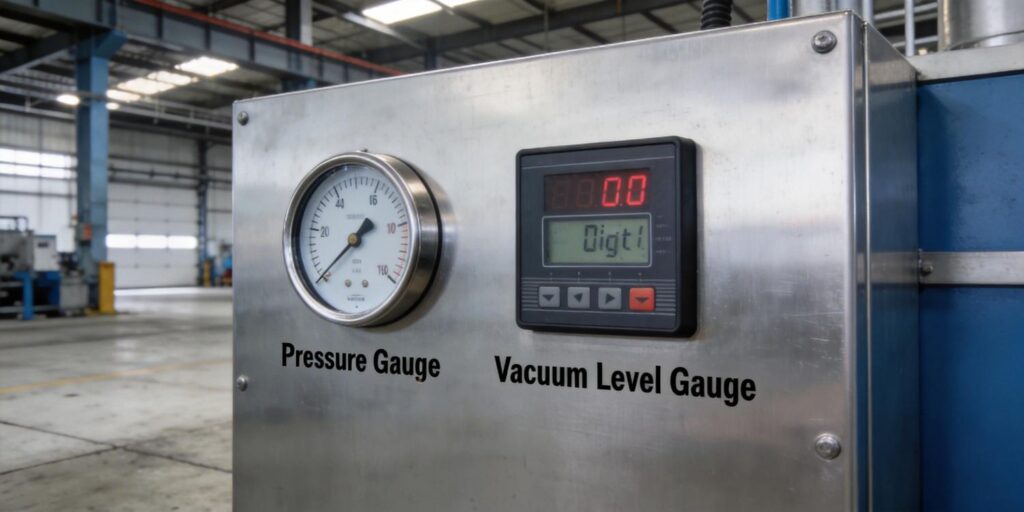
These ranges align perfectly with the complementary strengths of thermal-conductivity and cold-cathode ionization gauges. The Poseidon VG-SP205 Pirani Vacuum Transmitter covers atmosphere to 10−3 Torr with excellent repeatability in the linear band (10–10−2 Torr), making it ideal for roughing control and leak detection. Once pressure drops below 10−3 Torr, the Poseidon VG-SM225 Cold Cathode Vacuum Gauge takes over, delivering linear ion-current response down to 10−7 Torr for precise process endpoint control and base-pressure verification before backfill or quenching.
Engineers and procurement teams specify this dual-gauge strategy because it ensures full-range coverage without gaps, supports pressure-rise leak testing (a common quality gate), and satisfies traceability requirements in aerospace (AMS 2759) and automotive heat-treatment standards.
High Temperature Challenges: Keeping Gauges Safe in Hot Environments
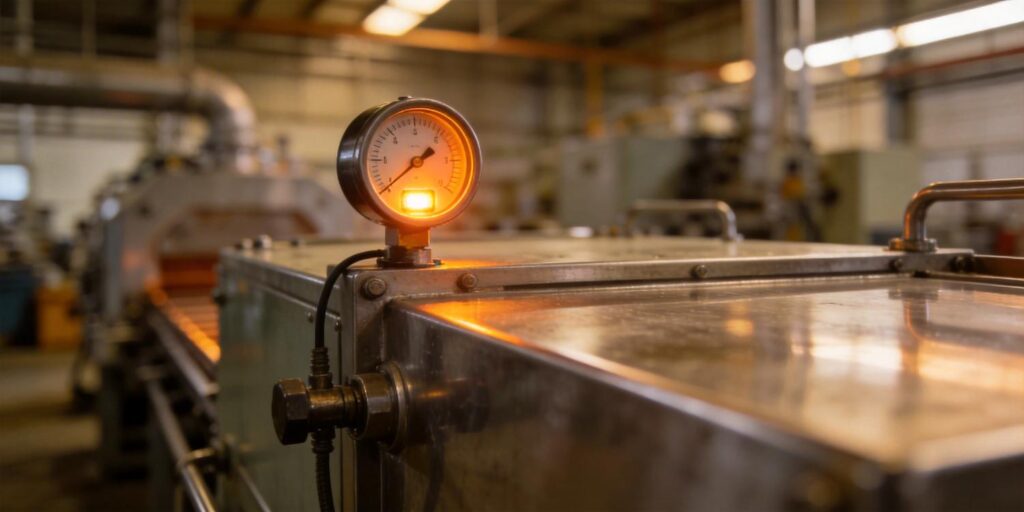
Metallurgical furnaces routinely operate at 800–1,200 °C (or higher for specialty sintering). Direct exposure would instantly destroy any vacuum gauge. The operating limit for both Poseidon transmitters is 15–50 °C ambient, with built-in circuit-plus-algorithm compensation to hold accuracy across that band. The challenge therefore shifts to thermal management at the installation point.
Proven Isolation Techniques
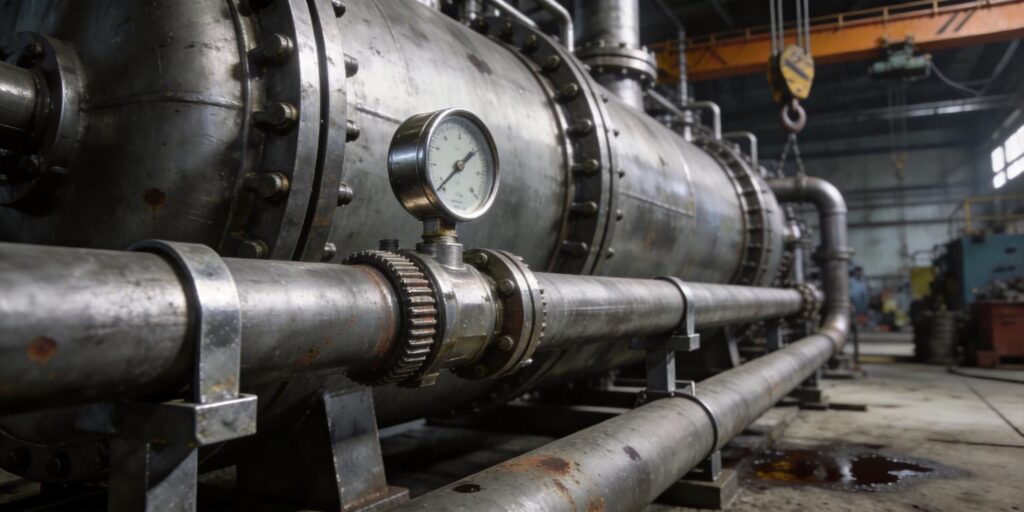
- Extension manifolds or stand-off tubes: Mount the gauge 300–600 mm from the hot zone using a KF16/KF25 nipple. Gas conductance still transmits chamber pressure accurately while radiation and convection drop sharply with distance.
- Water-cooled or radiation-shielded flanges: Common in vacuum furnaces; a simple stainless-steel baffle or water jacket keeps gauge head temperature well below 50 °C even when the chamber wall reaches 300 °C.
- Thermal breaks: Ceramic or PEEK spacers further isolate the sensor housing. Poseidon’s PEEK insulators inside the gauge already provide excellent dielectric and thermal stability.
These methods have been field-validated on vacuum tempering and annealing furnaces—the original target application for Poseidon’s cost-optimized gauges. Operators simply confirm gauge-head temperature with a surface probe during commissioning; once verified, no further adjustment is required for the life of the installation.
Another high-temperature consideration is outgassing from furnace internals. Metal vapors (Cr, Mn, Ti) or residual process gases can migrate to the gauge. The VG-SM225’s removable sensor head allows quick electrode inspection and cleaning without breaking the main vacuum envelope—an advantage over sealed legacy designs that must be replaced entirely when contaminated.
Gauge Durability: Materials, Maintenance, and Long-Term Reliability
Metallurgy environments are harsher than laboratory vacuum systems. Metal vapors, carbon residues from binders, and occasional reactive-gas excursions demand robust construction and serviceability.
| Feature | VG-SP205 Pirani | VG-SM225 Cold Cathode |
|---|---|---|
| Wetted materials | Stainless steel + platinum filament | Stainless steel electrodes + PEEK insulators |
| Contamination tolerance | Excellent (sealed filament) | Very good (cleanable electrodes) |
| Maintenance interval (clean environment) | 3–5 years (maintenance-free) | 1–3 years (electrode sanding) |
| Failure mode protection | Filament burnout (rare with proper venting) | Auto high-voltage shutdown above 10−3 Torr |
| Leak rate (sealed) | <10−11 Pa·m³/s | <10−11 Pa·m³/s |
The VG-SP205’s platinum filament offers superior chemical stability and large temperature-coefficient of resistance compared with tungsten alternatives, delivering ±15 % repeatability even after repeated thermal cycling. Because it is fully sealed and maintenance-free, it is the first choice for the roughing stage where contamination risk is highest during initial pump-down.
The VG-SM225 uses a traditional Penning (“工”-shaped) geometry with 100-gauss neodymium magnets and 2000 V operating voltage. When contamination occurs (visible as delayed ignition or readings one decade low), operators simply remove the sensor head, lightly abrade both cathode and anode plates with 500-grit sandpaper until metallic luster returns, and reinstall—typically under 10 minutes with no recalibration needed. This design directly addresses the durability pain point reported with imported cold-cathode gauges that require full replacement.
Both instruments tolerate the vibration and thermal cycling common in batch heat-treatment furnaces. Their compact size (smaller than many legacy units) reduces mechanical stress on mounting flanges and simplifies retrofits into existing furnace ports.
Integration Advice: Seamless Fit into Modern Furnace Controls
Today’s vacuum furnaces run under PLC or SCADA automation with recipe-driven pressure setpoints, leak-test interlocks, and full batch-record logging. Gauge selection must therefore prioritize signal compatibility and installation flexibility.
Output and Communication Options
- Analog: 0–10 V (effective 2–8 V span) — direct PLC input for fast PID control of roughing valves or throttle valves.
- Digital: RS232 with fully customizable protocol — ideal for 5–10 unit OEM integrations. Poseidon supports one-command switching between Torr, mbar, and Pa units and can embed status bits (high-voltage on/off, sensor ready).
- Connector: Industry-standard RJ45; field-adaptable to DB9 or DB15 without re-wiring.
Installation tips that save commissioning time:
- Mount either gauge on the chamber wall or a manifold using standard KF16/KF25 flanges—no preferred orientation required.
- Route the cable away from high-current heater leads to minimize electromagnetic interference (the 100-gauss field of the VG-SM225 is localized and harmless beyond 10 cm).
- Use the built-in protection logic of the VG-SM225 to interlock furnace heaters: high voltage must be stable before the recipe advances to hold temperature.
- For multi-zone furnaces, pair one Pirani (roughing) with one cold cathode (process) per zone; the low unit cost makes this economically attractive compared with single high-end gauges.
Because protocol customization is available at prototype quantities, furnace builders can match the exact data frame required by their existing HMI without writing new drivers—an advantage over rigid imported products that force costly software redevelopment.
CTA
Selecting the right vacuum gauges for metallurgy applications means balancing full-range coverage, thermal isolation, contamination resistance, and seamless control integration—all while controlling total cost of ownership. Poseidon Scientific’s VG-SP205 Pirani Vacuum Transmitter and VG-SM225 Cold Cathode Vacuum Gauge deliver exactly that combination: proven performance in vacuum heat-treatment furnaces, easy electrode service when needed, and customizable digital interfaces at 40–60 % lower cost than legacy imports.
Explore the VG-SP205 Pirani Vacuum Transmitter for fast, maintenance-free rough-vacuum monitoring and the VG-SM225 Cold Cathode Vacuum Gauge for reliable high-vacuum process control with simple field cleaning.
Need help mapping your furnace pressure recipe to the optimal gauge pair, thermal-isolation layout drawings, or a custom-protocol sample for 5–10 units? Contact our applications engineering team today. We provide free system-audit checklists, performance-comparison data against INFICON and MKS models, and rapid-response support that helps procurement and engineering teams specify durable, cost-effective vacuum solutions—keeping heat-treatment lines productive and compliant for years to come.