Contaminants in Environmental Water: A Growing Concern
Environmental water analysis has become increasingly critical as industrial, agricultural, and urban activities continue to introduce diverse contaminants into our water systems. These pollutants range from traditional agricultural chemicals to emerging contaminants that pose significant challenges to water quality monitoring and public health protection.
Major Contaminant Categories
Water contaminants can be broadly categorized into several groups based on their chemical properties and sources:
- Pesticides and Herbicides: Agricultural runoff introduces compounds like atrazine, metolachlor, chlorpyrifos, and triazine herbicides into surface and groundwater systems. These compounds are often present at trace levels (parts-per-trillion to parts-per-billion) but can have significant ecological and health impacts.
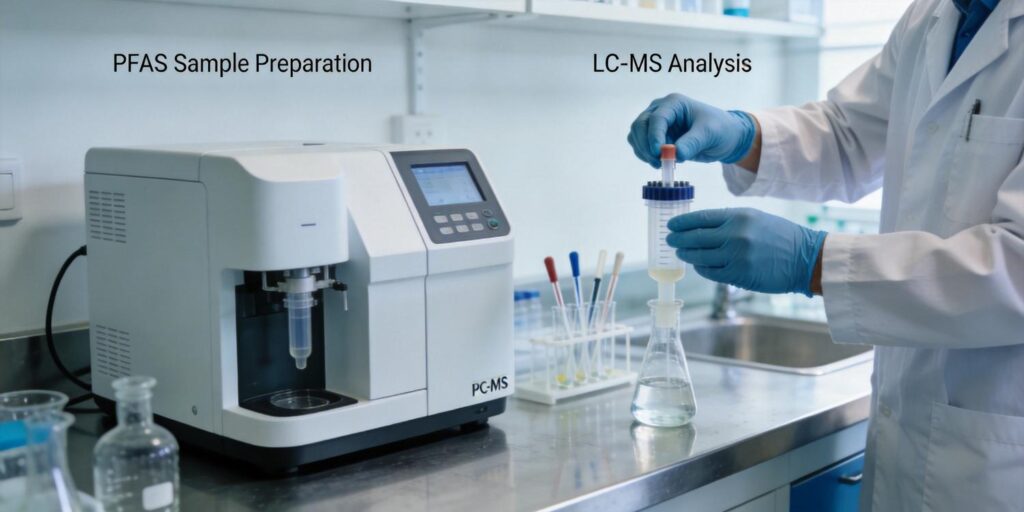
- Per- and Polyfluoroalkyl Substances (PFAS): These persistent organic pollutants have gained increasing attention due to their environmental persistence, bioaccumulation potential, and health concerns. PFAS compounds are resistant to degradation and can travel long distances in water systems.
- Industrial Chemicals: Polychlorinated biphenyls (PCBs), polycyclic aromatic hydrocarbons (PAHs), and various industrial byproducts enter water systems through industrial discharges and atmospheric deposition.
- Pharmaceuticals and Personal Care Products: These emerging contaminants enter water systems through wastewater treatment plant effluents and can have subtle but significant effects on aquatic ecosystems.
The Critical Role of SPE in Trace Detection
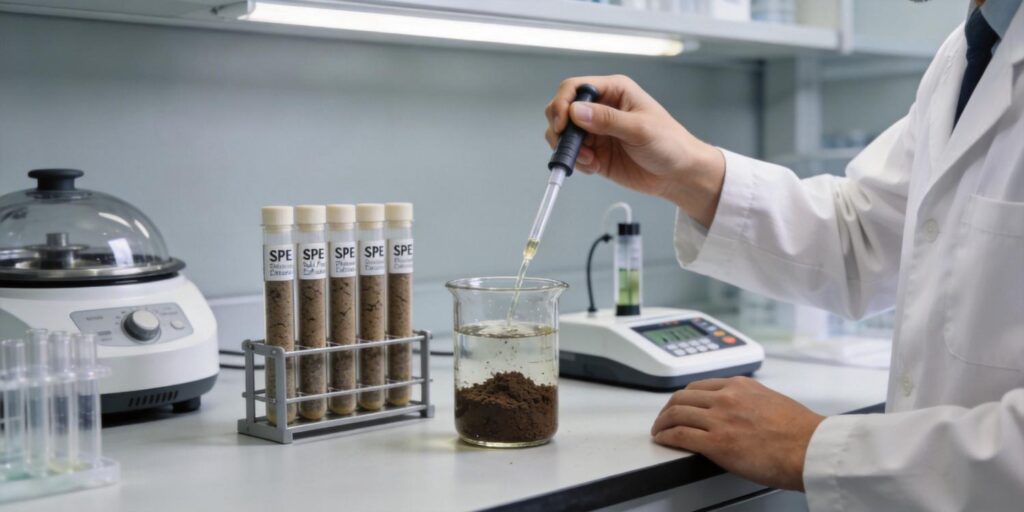
Solid Phase Extraction (SPE) has revolutionized environmental water analysis by providing a robust, efficient method for concentrating trace-level contaminants from large water volumes. The technique’s importance stems from several key advantages over traditional liquid-liquid extraction methods.
Why SPE Dominates Environmental Analysis
According to environmental chemistry literature, SPE offers several distinct advantages for water analysis:
- Improved Throughput: SPE enables parallel processing of multiple samples, significantly increasing laboratory productivity compared to serial liquid-liquid extraction methods.
- Reduced Solvent Consumption: Environmental laboratories typically use 50-90% less organic solvent with SPE compared to traditional methods, reducing both costs and environmental impact.
- Higher and More Reproducible Recoveries: SPE provides more consistent extraction efficiencies, particularly important for regulatory compliance monitoring where data quality is paramount.
- Elimination of Emulsions: Unlike liquid-liquid extraction, SPE avoids emulsion formation problems that can plague analyses of wastewater and surface water samples containing surfactants or natural organic matter.
- Tunable Selectivity: The availability of diverse SPE sorbents allows analysts to tailor extraction methods to specific analyte classes, improving both recovery and selectivity.
Trace Enrichment Capability
The ability to process large water volumes (typically 100 mL to 1 L) makes SPE ideal for trace enrichment applications. Environmental contaminants are often present at concentrations below the detection limits of analytical instruments. SPE allows analysts to concentrate these analytes by factors of 100-1000 times, bringing them within the detectable range of GC-MS, LC-MS, and other analytical techniques.
Research by Wells (2000) highlights that “the trace enrichment aspect of SPE lends itself very well to the extraction of liquids, especially clean samples such as drinking water or groundwater.” This capability is particularly valuable for monitoring compliance with increasingly stringent regulatory limits for contaminants like PFAS and certain pesticides.
Typical Analytes in Environmental Water Analysis
Pesticides: A Diverse Analytical Challenge
Pesticide analysis represents one of the most common applications of SPE in environmental laboratories. The diversity of pesticide chemical classes requires careful method development and sorbent selection:
- Organochlorine Pesticides: Compounds like DDT, chlordane, and dieldrin are typically extracted using C18 or polymeric sorbents. Florisil cartridges are often used for additional cleanup to remove interfering compounds.
- Organophosphorus Pesticides: These moderately polar compounds require careful pH control during extraction. Mixed-mode sorbents combining reversed-phase and ion-exchange mechanisms often provide optimal recovery.
- Triazine Herbicides: Atrazine, simazine, and related compounds are efficiently extracted using C18 sorbents, with recoveries often exceeding 90% when proper method conditions are employed.
- Carbamate Pesticides: These polar compounds may require specialized sorbents or derivatization approaches for optimal recovery and stability.
A study by Bengtsson and Ramberg (1995) demonstrated successful SPE extraction of pesticides from surface water using bulk sorbents, highlighting the technique’s versatility across different pesticide classes.
PFAS: The Modern Analytical Challenge
Per- and polyfluoroalkyl substances present unique challenges for SPE method development due to their amphiphilic nature and environmental persistence:
- Sorbent Selection: Weak anion exchange (WAX) and mixed-mode anion exchange sorbents have proven most effective for PFAS extraction, particularly for the ionic forms commonly found in water.
- Matrix Effects: Natural organic matter and other matrix components can significantly affect PFAS recovery, requiring careful method optimization and quality control measures.
- Background Contamination: The ubiquity of PFAS in laboratory environments necessitates rigorous procedural blanks and contamination control measures.
Other Important Analytes
Beyond pesticides and PFAS, SPE is routinely applied to numerous other contaminant classes:
- Polycyclic Aromatic Hydrocarbons (PAHs): Typically extracted using C18 or polymeric sorbents, with careful attention to breakthrough volumes for the more volatile compounds.
- Phthalate Esters: These semi-volatile compounds require careful handling to avoid contamination from laboratory plastics and equipment.
- Phenolic Compounds: Often extracted using specialized sorbents or with pH adjustment to ensure proper retention of the acidic forms.
SPE Workflow Example: Pesticide Analysis in Surface Water
To illustrate the practical application of SPE in environmental water analysis, let’s examine a typical workflow for pesticide determination in surface water samples.
Step 1: Sample Collection and Preservation
Surface water samples (typically 1 L) are collected in pre-cleaned glass containers, preserved at 4°C, and processed within 7-14 days of collection. For certain analytes, pH adjustment or addition of preservatives may be necessary to maintain analyte stability.
Step 2: Sample Preparation
Prior to SPE, samples are often filtered through glass fiber filters (0.45-0.7 μm) to remove particulate matter that could clog SPE cartridges or interfere with analysis. For samples containing significant dissolved organic matter, additional pretreatment may be required.
Step 3: SPE Cartridge Conditioning
The SPE workflow follows a systematic approach:
- Conditioning: 5-10 mL of methanol or acetonitrile is passed through the cartridge to solvate the sorbent and remove any impurities.
- Equilibration: 5-10 mL of deionized water (or water matching the sample matrix) is passed through to prepare the sorbent for aqueous sample loading.
Step 4: Sample Loading
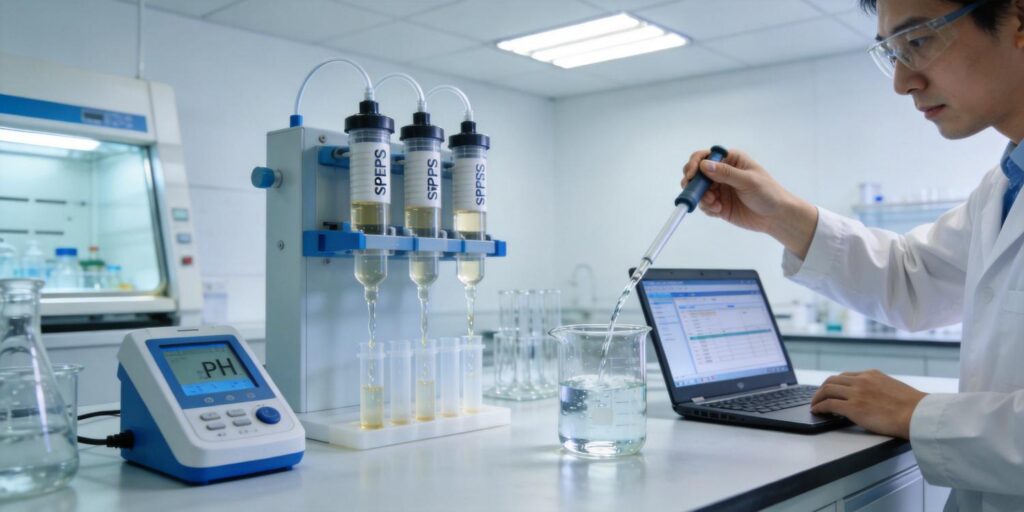
The water sample is passed through the conditioned cartridge at a controlled flow rate (typically 5-10 mL/min). Flow control is critical—too fast can lead to breakthrough and poor recovery, while too slow increases analysis time unnecessarily. Vacuum manifolds or positive pressure systems help maintain consistent flow rates.
Step 5: Interference Removal
After sample loading, the cartridge is washed with 5-10 mL of water or a weak solvent mixture to remove weakly retained matrix components while retaining the target analytes. This step is crucial for reducing matrix effects in subsequent analysis.
Step 6: Analyte Elution
Target analytes are eluted using a small volume (typically 2-10 mL) of organic solvent. Common elution solvents include:
- Methanol or acetonitrile for reversed-phase extractions
- Methanol with acid or base modifiers for ion-exchange extractions
- Solvent mixtures optimized for specific analyte classes
Step 7: Extract Concentration and Analysis
The eluate is concentrated to a small volume (typically 0.5-1 mL) using gentle nitrogen evaporation or vacuum concentration. The concentrated extract is then ready for analysis by GC-MS, LC-MS/MS, or other appropriate analytical techniques.
Case Study: Chlorpyrifos Analysis
A practical example from academic research demonstrates SPE application for chlorpyrifos analysis in water. The method involved:
- Conditioning C18 SPE cartridges with 10 mL methanol followed by 6 mL deionized water
- Loading 50 mL filtered water samples at 48-55 drops per minute
- Drying cartridges under vacuum for 15 minutes
- Washing with 10 mL deionized water
- Eluting with 5 mL hexane
- Concentrating to 1 mL for GC-ECD analysis
This approach achieved reproducible recoveries and enabled detection at environmentally relevant concentrations.
Method Development Considerations
Sorbent Selection
Choosing the appropriate SPE sorbent is critical for successful environmental analysis:
- C18 (Octadecylsilane): Most common for non-polar to moderately polar compounds; excellent for many pesticides and PAHs
- Polymeric Sorbents: Offer higher capacity and better retention for polar compounds compared to C18
- Mixed-mode Sorbents: Combine reversed-phase and ion-exchange mechanisms; ideal for compounds with ionizable functional groups
- Specialty Sorbents: Florisil, graphitized carbon black, and other materials for specific applications
Quality Control Measures
Environmental laboratories implementing SPE methods must include comprehensive quality control:
- Method Blanks: To monitor laboratory contamination
- Matrix Spikes: To assess method performance in specific sample matrices
- Surrogate Standards: To monitor extraction efficiency for each sample
- Continuing Calibration Checks: To ensure instrument performance throughout analysis batches
Future Directions and Innovations
The future of SPE in environmental water analysis continues to evolve with several promising developments:
- Automation and High-Throughput Systems: 96-well plate formats and automated SPE workstations are increasing laboratory efficiency and reproducibility
- On-line SPE-LC-MS Systems: Integrated systems that combine SPE with analytical separation and detection are reducing manual intervention and improving sensitivity
- Novel Sorbent Materials: Molecularly imprinted polymers, restricted access materials, and other advanced sorbents are expanding SPE capabilities
- Miniaturization: Smaller bed mass cartridges and disks are reducing solvent consumption and enabling analysis of smaller sample volumes
As environmental regulations become more stringent and the list of monitored contaminants continues to grow, SPE will remain an essential tool in the environmental analyst’s toolkit. Its combination of versatility, efficiency, and sensitivity makes it indispensable for protecting water quality and public health in an increasingly complex chemical environment.
For laboratories seeking reliable SPE solutions for environmental water analysis, Poseidon Scientific offers a comprehensive range of HLB SPE cartridges, MAX SPE cartridges, MCX SPE cartridges, and 96-well SPE plates designed to meet the demanding requirements of modern environmental analysis.