Vacuum Gauge

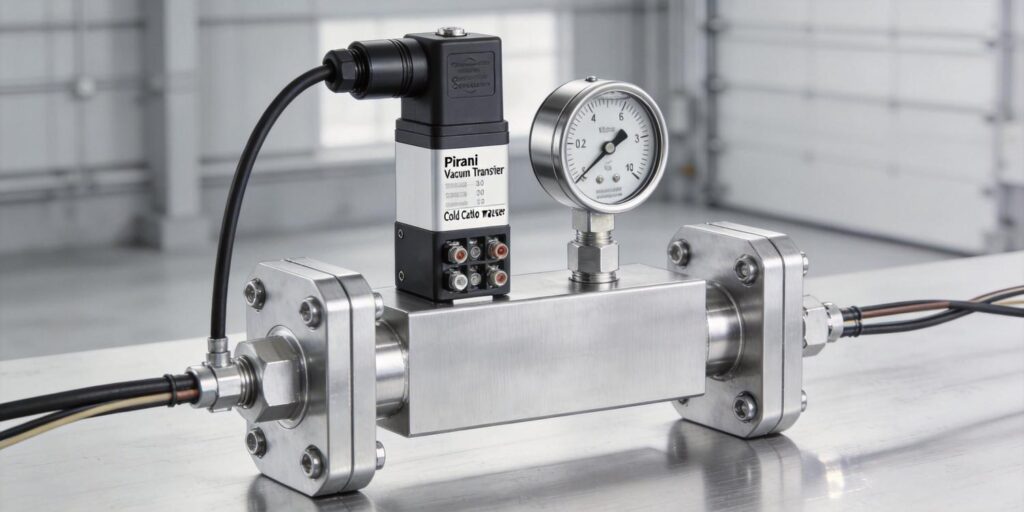
Industrial technician inspecting vacuum gauges

How to Reduce Maintenance Costs in Industrial Vacuum Systems

Introduction Industrial vacuum systems are major capital investments, yet maintenance costs often erode their ROI through unplanned downtime, premature pump failures, and frequent calibration cycles. In semiconductor fabs, PVD coaters, vacuum furnaces, and pharmaceutical dryers, even small inefficiencies compound into thousands of dollars per month in lost production and repair bills. The key to lowering […]

How to Reduce Maintenance Costs in Industrial Vacuum Systems Read More »

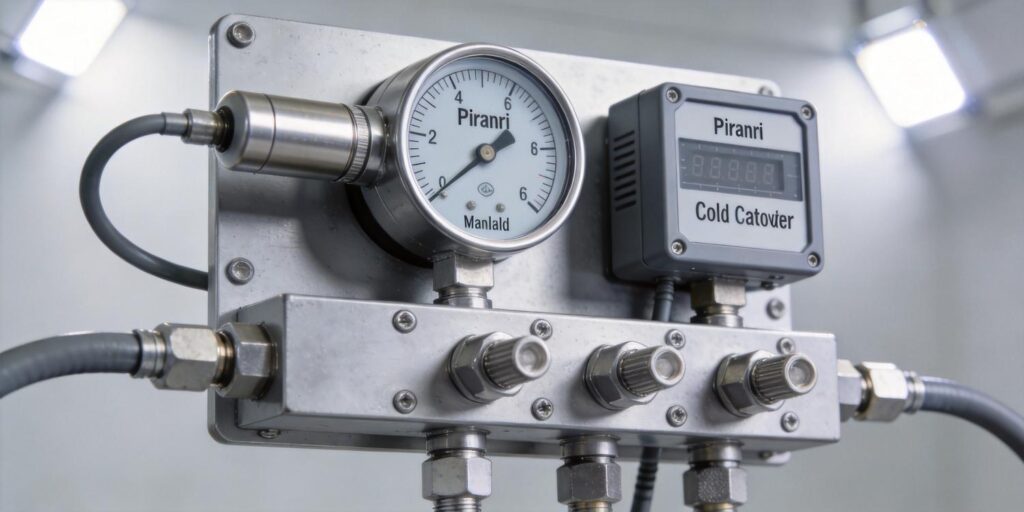
Cold cathode vacuum gauge installed on high vacuum system

How Cold Cathode Gauges Handle Ultra-Low Pressure Measurement

Introduction Cold cathode gauges are the workhorse of high-vacuum measurement in modern industrial and laboratory systems. Unlike hot-cathode ionization gauges that rely on a heated filament, cold cathode designs generate ions through a self-sustaining plasma discharge. This makes them ideal for the ultra-low pressure regime from 10−3 Torr down to 10−7 Torr, where precise, stable

How Cold Cathode Gauges Handle Ultra-Low Pressure Measurement Read More »

Compact vacuum gauges installed in research laboratory system

Selecting Vacuum Gauges for Research & Development Laboratories

Introduction Research and development laboratories operate at the forefront of vacuum science, pushing the boundaries of materials, processes, and instrumentation. Whether developing next-generation semiconductors, testing thin-film coatings, calibrating analytical instruments, or exploring surface physics, every experiment demands precise, repeatable pressure measurement across a wide dynamic range. A single gauge that covers only part of the

Selecting Vacuum Gauges for Research & Development Laboratories Read More »

Technician servicing vacuum gauge components

Vacuum Gauge Drift: Causes, Symptoms, and Solutions

What Is Measurement Drift in Vacuum Gauges? Measurement drift occurs when a vacuum gauge’s output gradually shifts away from the true pressure value over time, even though the actual chamber pressure has not changed. It is a slow, cumulative error that can reach several percent within months if left unaddressed. Unlike sudden failures, drift is

Vacuum Gauge Drift: Causes, Symptoms, and Solutions Read More »

Vacuum gauge monitoring pressure during leak test

How to Detect Vacuum Leaks Using Pressure Monitoring

Introduction Vacuum leaks are among the most common and costly issues in semiconductor tools, PVD coaters, vacuum furnaces, and analytical systems. Even a small leak can extend pump-down times, introduce contaminants, reduce yield, or damage sensitive pumps. The good news is that modern vacuum gauges provide a fast, non-destructive way to detect and locate leaks

How to Detect Vacuum Leaks Using Pressure Monitoring Read More »

Vacuum gauge mounted at optimal position on industrial vacuum chamber

Vacuum Gauge Placement Strategy: Where Should You Install It?

Introduction The position of a vacuum gauge is just as critical as the gauge itself. A sensor placed in the wrong location can deliver misleading readings, slow response times, or miss critical pressure events—leading to pump damage, process drift, extended cycle times, or scrapped batches. In semiconductor load locks, PVD coaters, vacuum furnaces, and analytical

Vacuum Gauge Placement Strategy: Where Should You Install It? Read More »

Vacuum gauge display showing different pressure units

Vacuum Measurement Units Explained: Torr, Pa, and mbar

Introduction Vacuum measurement units are more than labels—they directly affect how engineers interpret data, configure controllers, and specify process setpoints. In semiconductor fabrication, PVD coating, vacuum drying, and analytical instruments, a single misplaced decimal or misunderstood conversion can shift deposition rates, trigger false interlocks, or invalidate compliance records. The three most common units—Torr, Pa, and

Vacuum Measurement Units Explained: Torr, Pa, and mbar Read More »

Vacuum pump system monitored by pressure gauge

Improving Vacuum System Energy Efficiency with Proper Monitoring

Introduction Vacuum systems are among the largest energy consumers in semiconductor fabs, PVD coaters, vacuum furnaces, and pharmaceutical dryers. Pumps often run continuously or cycle inefficiently, wasting electricity, accelerating wear, and inflating operational costs. Proper vacuum monitoring changes this equation by delivering real-time pressure data that enables smarter pump control, shorter cycle times, and predictive

Improving Vacuum System Energy Efficiency with Proper Monitoring Read More »

Safety label near high voltage vacuum gauge installation

Preventing Electrical Shock in High Voltage Vacuum Gauges

Introduction High-voltage vacuum gauges play a vital role in modern industrial and laboratory systems, enabling precise measurement in the high-vacuum regime where hot-cathode alternatives cannot operate safely or reliably. The Poseidon Scientific VG-SM225 Cold Cathode Vacuum Gauge, for example, applies up to 2500 V to sustain its Penning discharge, delivering stable readings from 10−7 to

Preventing Electrical Shock in High Voltage Vacuum Gauges Read More »

Analog voltage signal display from industrial vacuum gauge

Analog Output Scaling for Industrial Vacuum Sensors

Introduction Industrial vacuum sensors must deliver clean, usable signals to PLCs, SCADA systems, and data loggers for closed-loop control, trending, and interlocks. The 0–10 V analog output is the most widely adopted interface because it is simple, noise-resistant when properly wired, and compatible with virtually every industrial controller. The Poseidon Scientific VG-SM225 Cold Cathode Vacuum

Analog Output Scaling for Industrial Vacuum Sensors Read More »

Shopping Cart
Poseidon Scientific
Privacy Overview

This website uses cookies so that we can provide you with the best user experience possible. Cookie information is stored in your browser and performs functions such as recognising you when you return to our website and helping our team to understand which sections of the website you find most interesting and useful.