1. Role of Wash Step in Sample Cleanup
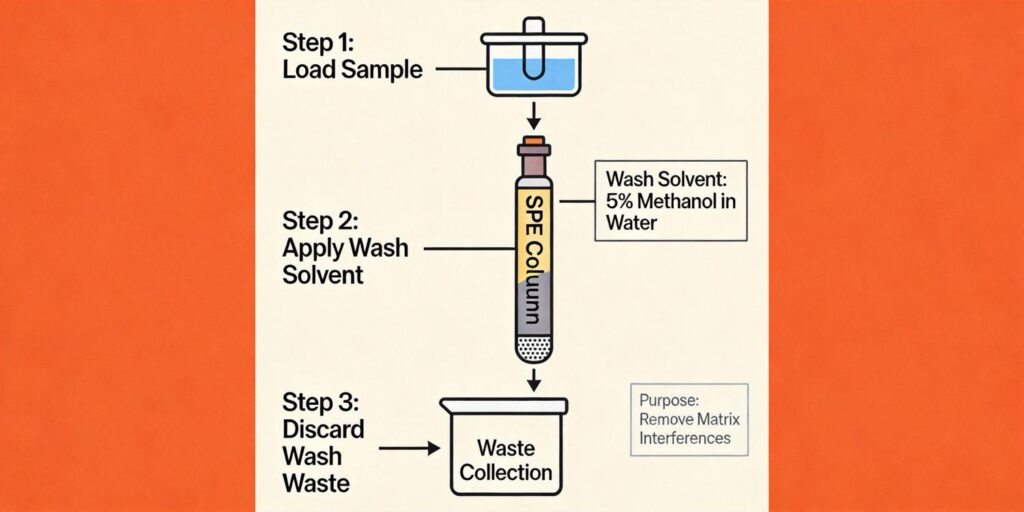
The wash step in solid-phase extraction (SPE) represents a critical juncture between sample loading and analyte elution, serving as the primary mechanism for selective matrix removal. As described in foundational SPE literature, this intermediate phase “removes unwanted, weakly retained materials” while preserving the target analytes on the sorbent bed. The wash step’s strategic importance cannot be overstated—it directly determines the purity of the final extract and the analytical method’s overall success.
During the retention phase, numerous compounds from complex biological or environmental matrices co-adsorb onto the sorbent alongside target analytes. As Simpson and Wells note in their comprehensive SPE text, “To minimize the interferences these undesirable compounds will create during the analysis stage, we may add one or more wash steps between retention and elution, to attempt to remove or rinse them out.” This selective removal process transforms SPE from a simple concentration technique into a sophisticated purification method.
The wash step’s effectiveness depends on understanding the differential retention mechanisms between target analytes and matrix components. For hydrophobic interactions, wash solvents with intermediate elution strength can remove weakly retained contaminants while maintaining strong retention of target compounds. For ion-exchange mechanisms, high percentages of organic solvents (up to 100%) can wash away interferences while ionic bonds keep target analytes firmly bound, provided the pH remains within 2 units of the relevant pKa values.
Key Functions of the Wash Step
- Matrix Component Removal: Eliminates proteins, lipids, salts, and other interfering substances that could compromise downstream analysis
- Selectivity Enhancement: Provides an additional dimension of selectivity beyond the initial sorbent-analyte interaction
- Column Protection: Prevents “column killers” from reaching expensive analytical instrumentation
- Method Robustness: Improves reproducibility by standardizing the removal of variable matrix components
2. Solvent Strength Considerations
Solvent strength optimization represents the cornerstone of effective wash step design. The fundamental principle, as articulated in SPE methodology guides, is to “wash with solutions that are stronger than the sample matrix, but weaker than needed to remove compounds of interest.” This delicate balance requires careful consideration of solvent polarity, hydrogen bonding capacity, and dielectric constant relative to both the sorbent chemistry and analyte properties.
For reversed-phase SPE applications, methanol and acetonitrile serve as the primary organic modifiers in aqueous wash solutions. Research demonstrates that “typically the wash solvent methanol composition is increased in steps of 10% from 100% water through to 100% methanol” during method development. This systematic approach allows analysts to establish the precise solvent strength threshold where matrix components elute while target analytes remain retained.
Solvent Strength Hierarchy
| Solvent | Relative Strength (Reversed-Phase) | Common Applications |
|---|---|---|
| Water | Weakest | Initial wash for polar contaminants |
| 5-10% Methanol/Water | Low | Removing hydrophilic matrix components |
| 20-40% Methanol/Water | Medium | Balanced cleanup for moderately polar compounds |
| 50-80% Methanol/Water | High | Removing lipophilic interferences |
| 100% Methanol | Strongest | Final wash before elution (risk of analyte loss) |
The Waters Oasis SPE methodology exemplifies practical solvent strength optimization, recommending “wash with 5% CH3OH in H2O” for their mixed-mode protocols. This conservative approach ensures maximum matrix removal with minimal risk of analyte displacement.
pH-Modified Wash Solvents
For ion-exchange and mixed-mode SPE, pH becomes a critical parameter in wash solvent optimization. As documented in forensic SPE applications, “wash pH may greatly affect cleanup and/or recovery. Keep analyte and sorbent pKa in mind if applicable.” For cationic exchange (MCX) phases, acidic washes (2% formic acid) maintain analyte retention while removing neutral and basic interferences. Conversely, anionic exchange (MAX) phases benefit from basic washes (5% ammonium hydroxide) for optimal cleanup.
3. Removing Matrix Components
Matrix component removal represents the practical implementation of wash step optimization. Different sample types present unique challenges that require tailored wash strategies:
Biological Matrices
Plasma and serum samples contain proteins, lipids, and endogenous compounds that can interfere with analysis. The initial wash “must be aqueous to remove the plasma proteins,” as proteins typically show minimal retention on reversed-phase sorbents under aqueous conditions. Subsequent washes with low-percentage organic solvents (5-20% methanol) can remove more hydrophobic interferences while preserving drug analytes.
Urine samples present different challenges, including high salt content and metabolic byproducts. Here, wash optimization might include “increasing concentrations of methanol or acetonitrile in water” to gradually remove increasingly hydrophobic contaminants without displacing target analytes.
Environmental Samples
Water samples often contain humic acids, particulates, and co-extracted organic matter. Sequential washing with pH-adjusted solvents can provide selective removal. For example, acidic washes can protonate and elute certain organic acids while preserving neutral or basic analytes.
Food and Agricultural Samples
These complex matrices contain pigments, fats, carbohydrates, and natural product interferences. Wash strategies often employ solvent mixtures like “n-hexane-dichloromethane (7:3, v/v)” for non-polar cleanup, as demonstrated in pharmaceutical cream analysis where hydrophobic preservatives were removed while retaining target drugs.
Strategic Wash Approaches
- Sequential Washes: Multiple wash steps with gradually increasing solvent strength
- pH-Stacked Washes: Different pH conditions to target specific interference classes
- Solvent Polarity Gradient: Moving from polar to non-polar or vice versa
- Drying Steps: Air drying between aqueous and organic washes to prevent solvent mixing
As noted in optimization guidelines, “the easiest way to make sure your column is dry is to pull maximum vacuum on the column for 5 min. Touch the column; if it is at room temperature, it is dry. If it is cold, sorbent is still evaporating off the column.”
4. Avoiding Analyte Loss
Preventing analyte loss during the wash step requires meticulous attention to solvent strength thresholds and retention mechanisms. The fundamental challenge lies in exploiting the “window of selectivity”—the solvent strength range where matrix components elute but target analytes remain retained.
Retention Margin Optimization
Successful wash optimization maintains a sufficient retention margin between the weakest retained target analyte and the strongest retained interference. This margin can be experimentally determined through systematic wash strength testing, where “recoveries obtained by washing with increasing concentrations of methanol” are plotted to identify the point of initial analyte loss.
Mechanism-Specific Considerations
Hydrophobic Interactions
For reversed-phase SPE, the wash solvent strength should remain below the analyte’s elution threshold. This can be estimated from the analyte’s log P or HPLC retention data. A practical approach involves testing wash solvents with elution strengths 20-30% below the determined elution solvent strength.
Ion-Exchange Mechanisms
Ionic interactions allow for more aggressive washing with organic solvents. As documented, “ionic bonds are strong enough to allow the analyte to remain bound while interferences are washed away with high percentages (up to 100%) of polar or nonpolar organic solvents.” However, pH control remains critical—maintaining conditions 2 pH units from relevant pKa values ensures both sorbent and analyte remain charged.
Mixed-Mode Retention
Copolymeric sorbents with dual retention mechanisms offer unique wash optimization opportunities. For ionically bound analytes, “use washes of high organic strength to remove interferences retained by hydrophobic interactions.” Conversely, for hydrophobically bound analytes with ionic character, “remove polar interferences ionically similar to your analyte by using aqueous or weak aqueous/organic washes.”
Practical Optimization Strategies
- Gradient Elution Profiling: As illustrated in SPE literature, “a novel way for optimizing elution and wash solvent strength” involves pumping a gradient mobile phase through an SPE cartridge while monitoring analyte elution profiles.
- Wash Volume Optimization: Reducing “the number of washing steps and the amount of washing solvent” during final method simplification can minimize analyte exposure to wash solvents.
- Drying Step Implementation: Air drying between incompatible wash solvents prevents unwanted solvent mixing that could inadvertently increase effective wash strength.
- pH Buffer Optimization: Using “0.05 to 0.2 N solutions of acids or bases” as wash modifiers, optimized for each application, can fine-tune selectivity.
Quality Control Measures
- Recovery Monitoring: Regular assessment of analyte recovery at different wash strengths
- Matrix Effect Evaluation: Monitoring ion suppression/enhancement in LC-MS applications
- Blank Sample Analysis: Ensuring complete removal of interfering peaks
- Carryover Assessment: Testing for analyte transfer between samples during automated processing
Advanced Considerations
For particularly challenging applications, additional strategies may be necessary:
- Back-Extraction Washes: Using immiscible solvent systems for additional cleanup
- Temperature-Controlled Washes: Modifying temperature to alter retention characteristics
- Additive-Enhanced Washes: Incorporating ion-pairing reagents or complexing agents
- Sequential Sorbent Washes: Using multiple sorbents in series for orthogonal cleanup
Conclusion
Wash solvent optimization represents a critical component of SPE method development that directly impacts analytical sensitivity, specificity, and reliability. By understanding the fundamental principles of solvent strength, matrix component behavior, and analyte retention mechanisms, analysts can design wash protocols that maximize cleanup while minimizing analyte loss. The systematic approach outlined here—beginning with conservative wash conditions and gradually optimizing based on experimental data—provides a robust framework for developing SPE methods that meet the stringent requirements of modern analytical laboratories.
For laboratories seeking optimized SPE solutions, Poseidon Scientific offers a comprehensive range of HLB, MAX, MCX, WAX, and WCX SPE cartridges, as well as 96-well SPE plates for high-throughput applications. Each product is designed with the optimization principles discussed here in mind, providing reliable performance across diverse analytical challenges.