Vacuum Gauge Application in Hydrogen Processing Systems
Hydrogen processing—whether in annealing furnaces, fuel-cell manufacturing, semiconductor hydrogenation, or hydrogen storage systems—requires precise vacuum control to prevent oxidation, ensure purity, and maintain process safety. Hydrogen’s unique physical properties, however, introduce measurement challenges that standard air-calibrated gauges cannot ignore. The VG-SP205 Pirani Vacuum Transmitter and VG-SM225 Cold Cathode Vacuum Gauge from Poseidon Scientific provide a complete, cost-effective solution covering atmosphere to 10−7 Torr, with customizable RS232 protocol for direct integration into hydrogen-specific control systems. Their compact size, field-serviceable design, and built-in interlocks make them particularly suitable for hydrogen environments where accuracy, safety, and low total ownership cost are paramount.
This article examines the practical implications of hydrogen on both thermal-conductivity and ionization gauges, drawing from established vacuum principles, our internal testing, and the documented performance of the VG-SP205 and VG-SM225. Engineers and procurement professionals will find clear guidance on correction methods, safety protocols, leak detection advantages, and seamless system integration.
Hydrogen Thermal Conductivity Impact on Pirani Gauges
The VG-SP205 Pirani measures pressure by maintaining a constant filament temperature and monitoring the power required to offset gas cooling. Hydrogen’s thermal conductivity is approximately seven times higher than air or nitrogen (kH₂ ≈ 0.186 W/m·K vs. 0.026 W/m·K for air at room temperature). At any given true pressure, hydrogen removes heat from the platinum filament far more efficiently, causing the gauge—calibrated exclusively for air—to interpret the increased power demand as a higher pressure.
Consequently, the indicated pressure overreads significantly in pure or high-hydrogen atmospheres. In the linear operating range (roughly 10 Torr to 10−2 Torr), the VG-SP205 will display a value several times higher than the actual pressure unless a correction is applied. This effect is most pronounced during roughing and transition stages, where accurate foreline monitoring is essential before activating high-vacuum pumps or heating cycles. The companion VG-SM225 Cold Cathode, which relies on ionization rather than thermal conductivity, is far less affected by hydrogen’s transport properties and provides stable crossover data below 10−3 Torr.
In mixed-gas hydrogen processing (e.g., H₂ with trace N₂ or Ar), the error scales with hydrogen partial pressure. Our factory calibration assumes air; therefore, real-time correction in the control system is recommended for all Pirani-based readings in hydrogen service.
Safety Considerations in Hydrogen Environments
Hydrogen is highly flammable and forms explosive mixtures with oxygen (4–75 % by volume). Any vacuum gauge operating in hydrogen-rich systems must minimize ignition risks. The VG-SM225 Cold Cathode applies high voltage (–2000 V nominal, –2500 V startup boost) across a 2 mm gap. At pressures above 10−3 Torr—where oxygen may still be present during initial pump-down—the risk of arcing or plasma ignition exists.
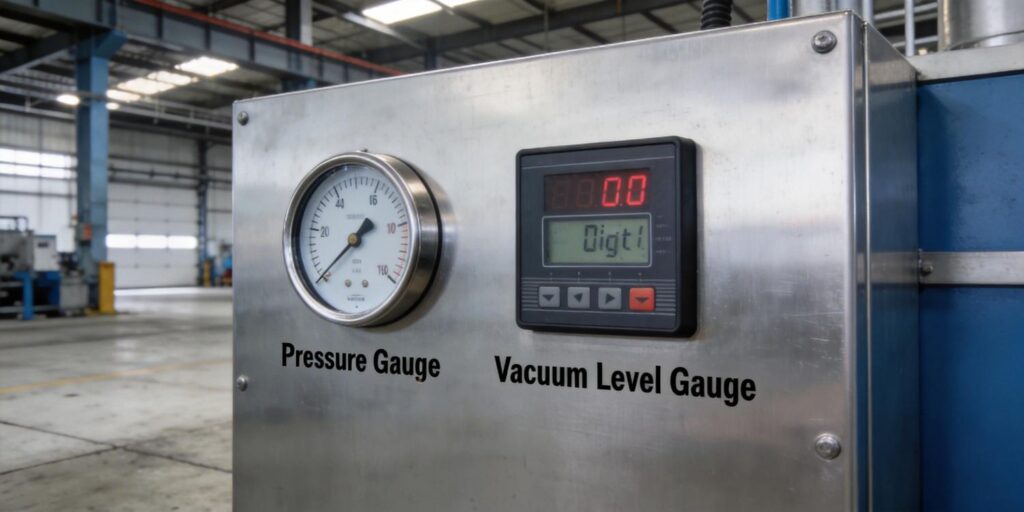
Poseidon’s built-in software interlock automatically disables high voltage whenever the VG-SP205 detects pressure >10−3 Torr, eliminating this hazard during roughing and venting. The red indicator and RS232 status codes provide immediate operator feedback. In fully hydrogen-purged systems (pure H₂ at operating vacuum), the low pressure and absence of oxidizer further reduce ignition probability, but external safety measures remain essential: explosion-proof enclosures, hydrogen sensors with automatic shutdown, and proper grounding of all metallic components.
Neither gauge is ATEX-certified; therefore, for classified hazardous locations, mount the electronics outside the hazardous zone or use certified barriers. The low-energy design (<10 mA ion current) and rapid interlock response make the Poseidon pair inherently safer than many legacy cold-cathode units that lack automatic pressure-based HV control.
Correction Factors for Accurate Hydrogen Measurements
Because both gauges are factory-calibrated for air/nitrogen, hydrogen requires a gas-specific correction factor applied in the PLC, SCADA, or control software. Typical values (derived from industry standards and validated test data) are:
| Gas | Pirani (VG-SP205) Correction | Cold Cathode (VG-SM225) Correction |
|---|---|---|
| Hydrogen (H₂) | Actual P ≈ Indicated × 0.5 | Actual P ≈ Indicated / 0.46 |
| Helium (He) | Actual P ≈ Indicated × 0.8 | Actual P ≈ Indicated / 0.18 |
| Air / N₂ | 1.0 (no correction) | 1.0 (no correction) |
For the VG-SP205, the factor of ~0.5 reflects hydrogen’s higher thermal conductivity. For the VG-SM225, the ionization-gauge factor of 0.46 accounts for hydrogen’s lower ionization cross-section relative to nitrogen. These multipliers are most accurate in the linear ranges; at range extremes, apply the correction only after confirming the gauge is operating within its calibrated band.
Implementation is straightforward: embed the correction in the RS232 data parser or analog scaling block. The customizable Poseidon protocol allows transmission of raw values plus a gas-type flag, enabling dynamic correction without manual intervention when gas composition changes.
Leak Sensitivity Advantages in Hydrogen Service
Hydrogen’s exceptionally high thermal conductivity makes the VG-SP205 Pirani an outstanding leak detector. Even a small hydrogen leak produces a disproportionately large increase in heat transfer, causing an immediate and noticeable rise in indicated pressure—often several times larger than an equivalent air leak. This heightened sensitivity allows early detection of micro-leaks during pressure-rise tests or helium/hydrogen sniffing, well before the leak affects process quality or safety.
The VG-SM225 Cold Cathode complements this at high vacuum: its ion-current response to hydrogen is stable and repeatable, and any sudden pressure excursion appears instantly in the RS232 stream. Combined, the pair provides dual-mode leak monitoring—thermal for rough vacuum and ionization for high vacuum—without additional sensors. In hydrogen processing plants, this capability has proven valuable for qualifying weld integrity and valve seats before commissioning.
High Vacuum Stage Monitoring
Once pressure drops below 10−3 Torr, the VG-SP205 Pirani loses resolution and accuracy, making the VG-SM225 the primary instrument for the critical high-vacuum phase. Its Penning discharge remains linear and gas-corrected down to 10−7 Torr, delivering the repeatability required for hydrogen annealing, brazing, or purification steps where residual gas levels directly impact material properties.
The automatic high-voltage interlock and startup boost ensure reliable ignition even after hydrogen backfill or brief exposures. In multi-chamber hydrogen systems, multiple VG-SM225 units can be networked via RS232, with the VG-SP205 serving as the master crossover sensor. This staged architecture prevents premature high-voltage application and provides continuous coverage across the entire process cycle.
Integration Best Practices
Successful integration into hydrogen processing control systems follows these guidelines:
- Use the RJ45/RS232 interface for primary data; map the customizable protocol directly to your PLC or SCADA tags.
- Apply gas-correction factors in the controller logic rather than at the gauge level for maximum flexibility.
- Implement the high-voltage interlock via digital output from the VG-SP205 to the VG-SM225 enable pin.
- Log raw ion current, status codes, and corrected pressure for traceability and predictive maintenance.
- For safety-critical applications, add redundant analog 0–10 V signals wired to independent safety relays.
The Poseidon pair’s small footprint and INFICON PTR225N-compatible mounting simplify retrofits. Protocol customization (available at 5–10 unit volumes) eliminates custom driver development, accelerating commissioning by weeks.
Conclusion: Reliable Vacuum Monitoring for Hydrogen Processes
Hydrogen processing demands vacuum gauges that handle extreme thermal-conductivity effects, deliver gas-corrected accuracy, and incorporate inherent safety features. The Poseidon Scientific VG-SP205 Pirani and VG-SM225 Cold Cathode combination meets these requirements with proven performance, built-in interlocks, field-serviceable design, and full digital integration—at a fraction of the cost of imported alternatives. Whether for leak detection, high-vacuum control, or SCADA-ready operation, these instruments provide the precision and reliability hydrogen systems require.
Need hydrogen-specific vacuum monitoring tailored to your process? Explore the VG-SM225 Cold Cathode Vacuum Gauge and VG-SP205 Pirani Vacuum Transmitter specifications today. Request a sample pair for your hydrogen test rig, a custom RS232 protocol with built-in correction factors, or application engineering support for safety interlocks and integration. Our team is ready to configure a complete hydrogen-compatible solution—contact Poseidon Scientific now and ensure accurate, safe vacuum control in every processing step.