
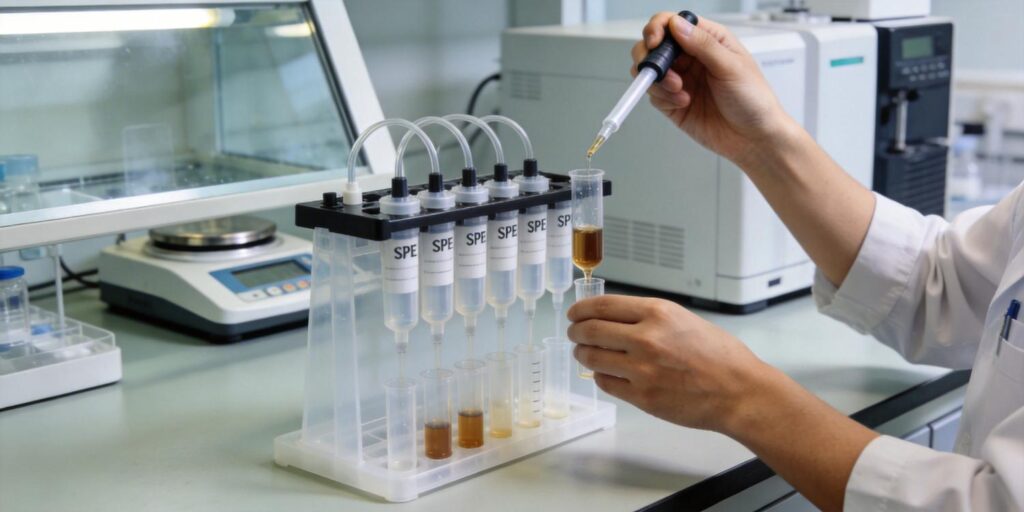
The Critical Role of Sample Cleanup in Chromatography Analysis
In analytical chemistry, sample preparation is often the most critical yet overlooked step in achieving reliable chromatography results. As Dr. Xu, product manager at Poseidon Scientific, I’ve witnessed firsthand how proper sample cleanup strategies can make or break analytical outcomes. The fundamental truth is this: no chromatography system, no matter how advanced, can compensate for poorly prepared samples.
Sample cleanup serves three primary functions that directly impact chromatography performance:
1. Concentration Enhancement
Solid-phase extraction (SPE) provides significant concentration factors by isolating analytes from large sample volumes onto small sorbent beds. As documented in SPE literature, “concentrations of several hundred fold have been achieved during the solid-phase extraction” when sample size is not limited. This concentration capability is particularly crucial for trace analysis where analytes exist at parts-per-billion or lower levels.
2. Interference Removal
The most common reason for failed chromatography analysis is interfering compounds that mask analytes during separation. As shown in hypothetical chromatograms comparing “before SPE” and “after SPE” results, cleaned-up extracts provide clearly identifiable signals from extracted components. Clean-up may be achieved either by retaining the analyte on a solid phase sorbent and washing out interferences or by retaining the interferences and washing out the analyte.
3. Matrix Removal and Solvent Exchange
Many analytical instruments require samples in specific environments. For instance, aqueous samples would ruin delicate gas chromatography systems. SPE allows conversion of diverse sample matrices—from drinking water to whole blood, urine to face cream—into forms compatible with analytical instruments. A significant advantage of SPE over liquid-liquid extraction is that solvents miscible with the sample matrix may be used to elute analytes.
Understanding Common Contaminants in Analytical Samples
Effective cleanup requires understanding what contaminants you’re dealing with. Common contaminants fall into several categories:
Matrix Components
These include proteins from biological samples, humic acids from environmental samples, lipids from food matrices, and inorganic salts from various sources. Plasma or urine samples typically require centrifugation (1500 × g, 10 minutes) before transfer to SPE cartridges to prevent clogging.
Chemical Interferences
These compounds share similar chemical properties with target analytes, potentially co-eluting during chromatography. For example, preservatives like methyl- and propyl-p-hydroxybenzoate in pharmaceutical creams exhibit UV spectral properties that can interfere with spectrophotometric drug assays.
Device-Related Contaminants
SPE devices themselves can contribute contaminants, though modern manufacturing has reduced this issue. Common sources include:
- Plasticizers/phthalates from polypropylene cartridges or polyethylene frits
- Various polymer residuals and phthalates from sorbents
- Mold release agents, antioxidants, and monomers from device components
Quality manufactured SPE devices should not contribute measurable contaminants above low nanogram (ppb) levels. Below nanogram levels, prewashing with the strongest elution solvent (10–20 times bed volume) is recommended to reduce potential contamination.
SPE vs. Filtration: Choosing the Right Approach
When to Use Filtration
Filtration is appropriate for:
- Removing particulate matter from samples
- Clarifying turbid solutions before SPE
- Applications where only physical separation is needed
- Simple removal of insoluble components
However, filtration alone cannot provide the selective separation, concentration, or matrix exchange capabilities of SPE.
When SPE is Essential
SPE becomes necessary when:
- Analytes need concentration from large sample volumes
- Specific chemical interferences must be removed
- Sample matrix is incompatible with analytical instrumentation
- High selectivity is required for complex matrices
- Solvent exchange is needed for compatibility with downstream analysis
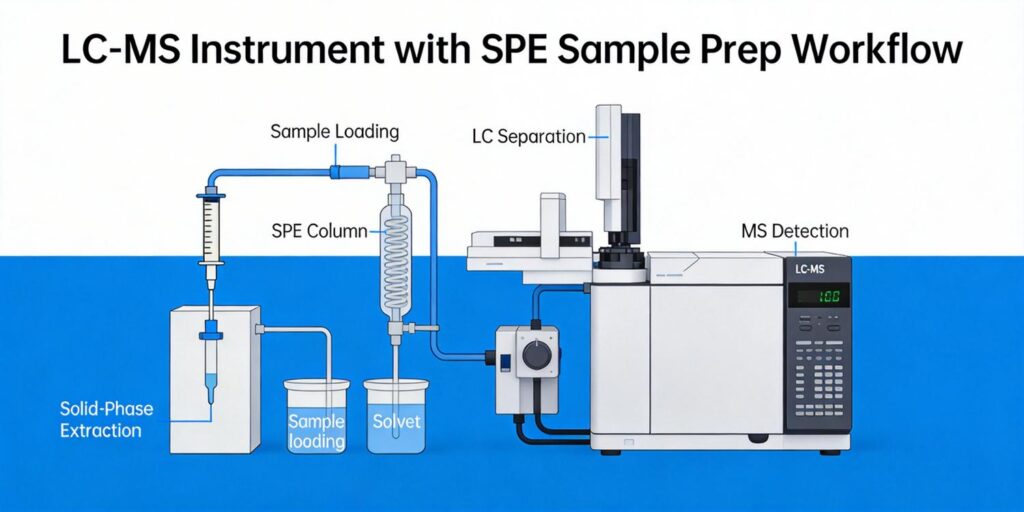
The SPE strategy generally comprises isolation of analytes from complex matrices by adsorption onto appropriate sorbents, removal of interfering impurities by washing with suitable solvent systems, and selective recovery of retained analytes with modified solvent systems of suitable elution strength.
Choosing the Right Cartridge Chemistry
Selecting appropriate SPE chemistry is fundamental to successful sample cleanup. At Poseidon Scientific, we offer several specialized SPE cartridges, each designed for specific applications:
HLB (Hydrophilic-Lipophilic Balance) Cartridges
Our HLB SPE cartridges feature a unique polymeric sorbent that retains both polar and non-polar compounds. This makes them ideal for:
- Extracting a wide range of pharmaceuticals from biological fluids
- Environmental analysis of diverse contaminant classes
- Applications where analyte polarity varies widely
MAX (Mixed-mode Anion Exchange) Cartridges
The MAX SPE cartridges combine reversed-phase and strong anion-exchange mechanisms. They excel at:
- Extracting acidic compounds from complex matrices
- Pharmaceutical analysis requiring high selectivity
- Applications where both hydrophobic and ionic interactions are needed
MCX (Mixed-mode Cation Exchange) Cartridges
Our MCX SPE cartridges feature reversed-phase and strong cation-exchange properties, making them perfect for:
- Basic compound extraction from biological samples
- Drug analysis in forensic and clinical applications
- Selective isolation of cationic analytes
WAX (Weak Anion Exchange) Cartridges
The WAX SPE cartridges offer reversed-phase and weak anion-exchange capabilities, ideal for:
- Extracting moderately acidic compounds
- Applications requiring pH-dependent selectivity
- Analytes with carboxylic acid functional groups
WCX (Weak Cation Exchange) Cartridges
Our WCX SPE cartridges combine reversed-phase and weak cation-exchange mechanisms, suitable for:
- Extracting basic compounds with pKa values in specific ranges
- Applications requiring pH control for optimal recovery
- Selective isolation of weakly basic analytes
96-Well SPE Plates
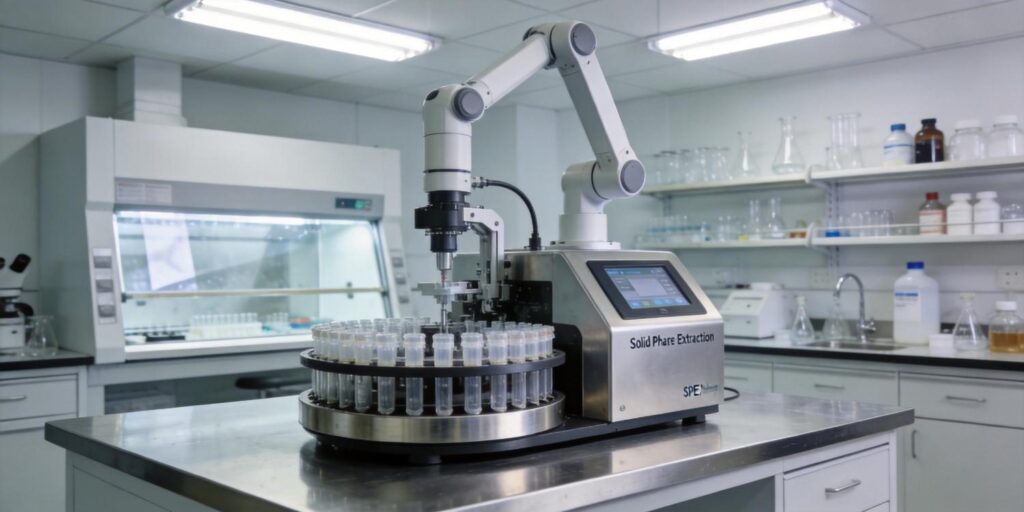
For high-throughput applications, our 96-well SPE plates provide automation compatibility and parallel processing capabilities, essential for:
- Pharmaceutical screening and drug discovery
- Clinical research requiring multiple sample processing
- Any application where throughput and reproducibility are critical
Optimizing Elution Solvents for Maximum Recovery
Fundamental Principles of Elution Optimization
Elution solvent selection directly impacts recovery, purity, and concentration factors. Key considerations include:
1. Solvent Strength
The elution solvent must be strong enough to displace analytes from the sorbent but not so strong that it co-elutes unwanted interferences. For reversed-phase SPE, solvent strength generally follows this order: water (weakest) < methanol < acetonitrile < acetone < ethyl acetate < dichloromethane (strongest).
2. Solvent Volume
Use the smallest volume possible to achieve complete elution. Typically, 200 μL to 2 mL depending on tube size, or 5-10 mL for disk formats. Sometimes several smaller eluent aliquots can improve recovery compared to a single large volume.
3. Drying Considerations
Cartridge drying may be necessary when two immiscible reagents are used in sequence or when water from an aqueous wash step could contaminate an anhydrous eluent. Evaluate drying time by observing changes in recovery with drying time in time-course experiments.
Practical Elution Optimization Strategies
Step 1: Initial Solvent Selection
Start with solvents that provide excellent elution while permitting further concentration if needed. Consider:
- Analyte solubility in various solvents
- Compatibility with downstream analysis (HPLC, GC, etc.)
- Evaporation characteristics if reconstitution is needed
Step 2: Soaking Time Optimization
Allow cartridge/plate to soak with eluent for 0.5-1 minute to improve recovery. This contact time allows solvent penetration into the bonded phase and enhances analyte displacement.
Step 3: Flow Rate Control
Maintain slow, controlled flow rates during elution. As documented in SPE literature, recovery decreases with increasing flow rates. For optimal results, keep flow rates below 10 mL/min for cartridges and even slower for critical applications.
Step 4: Multiple Elution Fractions
Consider collecting multiple small fractions rather than one large elution volume. This approach can:
- Improve recovery of strongly retained analytes
- Allow monitoring of elution profile
- Provide options for combining or discarding fractions based on purity
Advanced Elution Techniques
pH-Controlled Elution
For ion-exchange SPE cartridges (MAX, MCX, WAX, WCX), pH adjustment can dramatically improve selectivity and recovery. For example:
- Acidic eluents for basic analytes on cation-exchange phases
- Basic eluents for acidic analytes on anion-exchange phases
- pH gradients for separating compounds with different pKa values
Solvent Mixtures
Binary or ternary solvent mixtures often provide better elution characteristics than single solvents. Common examples include:
- Methylene chloride/isopropyl alcohol/ammonium hydroxide (78/20/2) for opiate extraction
- Methanol/water mixtures with varying organic content
- Acetonitrile/buffer combinations for polar analytes
Temperature Considerations
While not commonly discussed, temperature can affect elution efficiency. Warmer solvents generally provide better penetration into bonded phases and improved analyte solubility.
Implementing an Effective Sample Cleanup Workflow
Based on extensive experience and literature review, I recommend this systematic approach to sample cleanup:
1. Sample Assessment
Characterize your sample matrix and analytes. Consider pH, ionic strength, organic solvent content, and potential interferences.
2. Pretreatment Selection
Choose appropriate pretreatment methods: centrifugation, filtration, pH adjustment, or dilution based on sample characteristics.
3. SPE Cartridge Selection
Select the appropriate chemistry from our SPE cartridge portfolio based on analyte properties and cleanup requirements.
4. Method Development
Systematically optimize conditioning, loading, washing, and elution steps. Document flow rates, solvent volumes, and recovery data.
5. Validation
Validate the method for recovery, precision, selectivity, and robustness. Include carryover assessment and contamination checks.
6. Implementation and Monitoring
Implement the validated method with appropriate quality controls. Monitor performance regularly and be prepared to troubleshoot as needed.
Conclusion
Effective sample cleanup before chromatography analysis is not merely a preparatory step—it’s a critical component of analytical success. By understanding contaminant types, selecting appropriate cleanup technologies (SPE vs. filtration), choosing optimal cartridge chemistry, and systematically optimizing elution conditions, analysts can achieve cleaner extracts, better chromatography, and more reliable results.
At Poseidon Scientific, we’ve designed our SPE product line to address the diverse needs of modern analytical laboratories. Whether you’re working with biological fluids, environmental samples, pharmaceuticals, or food matrices, our specialized cartridges provide the selectivity and performance needed for successful sample cleanup. Remember: the quality of your final chromatogram begins with the quality of your sample preparation.

Very useful discussion of sample cleanup and its role in improving chromatography results. Proper sample preparation can make a significant difference by reducing matrix effects, protecting analytical columns, and improving the reliability of the final data. I also think that pairing good sample-preparation practices with well-characterized research materials and appropriate quality documentation is important for reproducible analytical work. A practical guide like this is especially helpful for researchers troubleshooting inconsistent chromatographic results.