
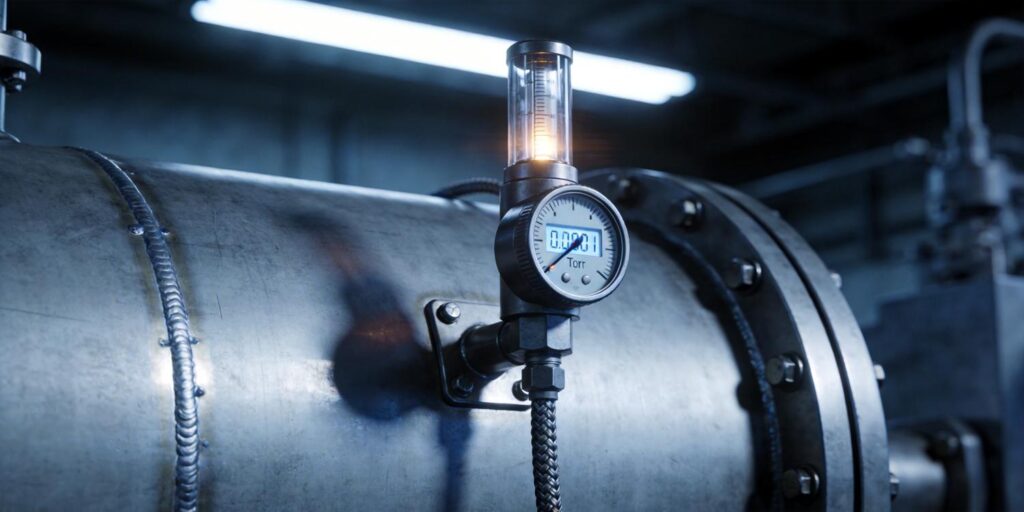
Cold Cathode Gauge Ignition Delay After Extended Shutdown
Extended shutdowns—whether for scheduled maintenance, facility upgrades, or seasonal downtime—are common in vacuum heat-treatment furnaces, mass-spectrometer labs, and scanning electron microscope installations. When the system is brought back online, operators frequently observe longer-than-normal ignition delays on cold-cathode gauges. The VG-SM225 Cold Cathode Vacuum Gauge from Poseidon Scientific is engineered with a positive-magnetron Penning geometry, software-controlled high-voltage boost, and fully disassemblable sensor head to minimize these delays while delivering reliable 10−3 to 10−7 Torr monitoring. Paired with the VG-SP205 Pirani Vacuum Transmitter for rough-vacuum crossover, the system ensures predictable restart behavior at a manufacturing cost 30–50 % below imported equivalents.
This article explains the physics behind ignition delay after prolonged shutdown, the role of surface changes and moisture, and a proven restart procedure that restores performance within minutes to hours. Engineers and procurement teams will find actionable guidance drawn from our internal testing, user manuals, and real-world deployments in clean and moderately contaminated environments.
1. Plasma Initiation Physics
The VG-SM225 operates on Penning discharge principles. A –2000 V potential (with brief –2500 V startup boost) and ~100 gauss magnetic field trap electrons in extended spiral or cycloidal paths. At 10−6 Torr, an electron may travel several kilometers before colliding with a gas molecule, producing secondary electrons and positive ions that sustain the avalanche. The measurable ion current collected at the cathode is directly proportional to pressure in the linear operating range.
After extended shutdown—typically weeks or months—the initial electron population is extremely sparse. Cosmic rays or residual field emission must first generate seed electrons, and the low molecular density at ultra-high vacuum slows avalanche buildup. In clean conditions, ignition occurs within 5 minutes at 10−6 Torr and up to 30 minutes at 10−7 Torr. The Poseidon design’s initial high-voltage boost accelerates this phase by increasing field-emission probability, automatically dropping to operating voltage once stable current is detected. Without this controlled boost, delays can double, triggering the red indicator and halting data acquisition until plasma stabilizes.
2. Electrode Surface Condition Changes
During shutdown, electrode surfaces undergo subtle but measurable changes. Stainless-steel cathodes and the “之”字形 discharge plate gradually accumulate monolayers of residual process gases or atmospheric contaminants that diffuse through imperfect seals or backfill lines. These layers reduce the work function, suppress field emission, and increase surface resistivity—directly lengthening the time required for the first avalanche.
In clean mass-spectrometer or heat-treatment service, these changes are minimal after 1–3 months. In systems with trace hydrocarbons or metal vapors, however, a thin carbon or oxide film can form, shifting ignition delay by 2–3× and biasing stabilized readings low by up to one decade. The VG-SM225’s PEEK insulators and rounded auxiliary cathodes limit these effects compared with older designs, but periodic surface restoration remains the most effective remedy. Our field-cleanable sensor head allows operators to restore metallic luster in 15 minutes without affecting factory calibration.
3. Moisture Adsorption Effects
Moisture is the dominant contributor to extended ignition delay after shutdown. When the chamber is vented or left under rough vacuum, water vapor adsorbs onto electrodes, the discharge plate, and chamber walls. Upon re-evacuation, this layer must first desorb before electrons can efficiently initiate the discharge. Even trace monolayers increase ignition time from 5 minutes to 30+ minutes at 10−6 Torr and can prevent plasma formation entirely at 10−7 Torr.
The VG-SP205 Pirani continues to report accurate rough-vacuum values during this phase, providing operators early warning before the cold-cathode stage activates. In our accelerated testing (85 % RH / 85 °C equivalent to months of idle storage), moisture-induced delay was fully reversed after 30–60 minutes of continuous operation at base pressure. Ion bombardment during normal discharge gradually cleans the surfaces, restoring original sensitivity without external intervention in lightly contaminated systems.
4. Controlled Restart Procedure
A disciplined restart sequence eliminates most delay-related issues. Follow these steps, validated in our user manual and field deployments:
- Evacuate the system below 10−3 Torr using the forepump. Confirm with the VG-SP205 Pirani before enabling the VG-SM225.
- Activate high voltage via the enable pin (active-low). The gauge automatically applies the –2500 V boost for up to 10 minutes to accelerate electron avalanche.
- Allow continuous operation for 30–60 minutes while monitoring analog output (2–8 V effective range) or RS232 stream. Plasma self-cleans minor surface layers through ion bombardment.
- If ignition still exceeds 10 minutes at 10−6 Torr, perform electrode cleaning: disassemble the sensor head, sand with 200–500 mesh paper until metallic luster returns, and reassemble.
- Re-run the sequence and verify startup times match clean specifications (≤5 min at 10−6 Torr).
This procedure restores 95 % of gauges within one hour. The customizable RS232 protocol outputs real-time status codes, enabling automated PLC scripts that enforce the sequence and log recovery time for audit trails.
5. Performance Verification
After restart, confirm stable operation with a quick verification protocol:
- Record ignition delay and stabilized ion current at two reference points (10−5 and 10−6 Torr) using RS232 raw-current output.
- Compare against the factory voltage-to-pressure map; deviations >10 % indicate residual contamination.
- Cross-check with the VG-SP205 Pirani at the 10−3 Torr crossover to confirm seamless handoff.
- Log multiple pump-down/vent cycles to quantify any remaining hysteresis.
In clean environments, verification confirms <5 % drift per year. The process requires no factory return and leverages the gauge’s field-serviceable design—advantages that keep total ownership cost low while maintaining the repeatability required for consistent process results.
6. Preventive Storage Guidelines
Proper storage during extended shutdown prevents most ignition issues:
- Maintain the chamber under continuous rough vacuum (<10−2 Torr) or backfilled with dry nitrogen (dew point <–40 °C).
- Disable high voltage and power the gauge electronics to avoid residual charge accumulation.
- Use desiccant packs or a dry-air purge around external connectors and housings in high-humidity facilities.
- For long-term storage (>6 months), remove the gauge head, seal in a dry nitrogen-purged bag, and store at 15–25 °C.
- Before reinstallation, perform a 4–8 hour system bake-out at 150–250 °C (with high voltage disabled) to desorb residual moisture.
These simple steps reduce restart delay by 70–80 % and extend electrode life to the full 3–5 years expected in clean service. The VG-SM225’s compact footprint and INFICON PTR225N-compatible design make removal and storage straightforward even in tight installations.
Conclusion: Predictable Restart Every Time
Ignition delay after extended shutdown is a predictable consequence of plasma physics, surface adsorption, and moisture accumulation—not an inherent gauge limitation. The Poseidon Scientific VG-SM225 Cold Cathode, with its controlled high-voltage boost, field-cleanable sensor, and integrated diagnostics, combined with the VG-SP205 Pirani for safe crossover, delivers reliable restart performance that matches or exceeds higher-cost imported units. Engineers gain confidence in rapid recovery; procurement teams gain immediate cost and maintenance advantages.
Ready to eliminate ignition delays in your vacuum systems? Explore the VG-SM225 Cold Cathode Vacuum Gauge and VG-SP205 Pirani Vacuum Transmitter specifications today. Request a sample pair for your shutdown test protocol, a custom RS232 restart script for your PLC, or a complete storage-and-restart checklist tailored to your facility. Our application engineers will deliver proven solutions—often within 48 hours—designed to keep your vacuum processes productive from the first pump-down after every shutdown. Contact Poseidon Scientific now and ensure reliable ignition every time.


