
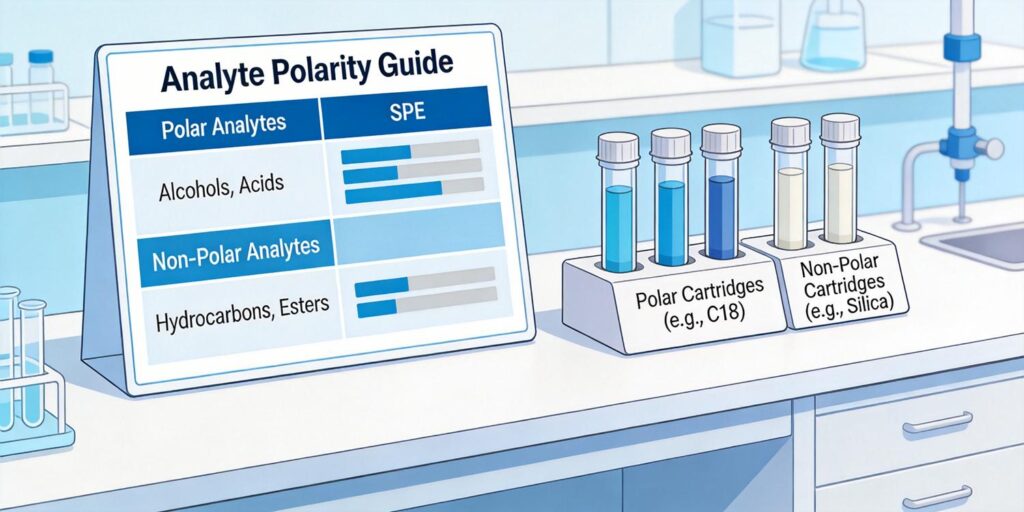
Understanding Analyte Polarity: The Foundation of SPE Sorbent Selection
Solid-phase extraction (SPE) represents a cornerstone technology in modern analytical chemistry, enabling scientists to isolate, concentrate, and purify target compounds from complex matrices. At the heart of successful SPE method development lies a fundamental understanding of analyte polarity and its relationship to sorbent chemistry. As Dr. Xu, product manager at Poseidon Scientific, I’ve witnessed firsthand how proper sorbent selection based on analyte polarity can dramatically impact extraction efficiency, recovery rates, and analytical sensitivity.
Analyte polarity refers to the distribution of electrical charge across a molecule, which determines its interaction with various solvents and solid phases. This property directly influences whether a compound will be retained on reversed-phase, ion-exchange, or mixed-mode sorbents. The selection framework we’ll explore today provides a systematic approach to matching analyte characteristics with optimal SPE sorbent chemistry.
The Three Primary SPE Retention Mechanisms
1. Reversed-Phase SPE: The Workhorse for Non-Polar to Moderately Polar Compounds
Reversed-phase SPE operates on the principle of hydrophobic interactions, where non-polar sorbents retain non-polar to moderately polar analytes from polar matrices. According to established literature, “non-polar sorbents retain analytes better out of polar solvents, whereas normal phase absorbents extract better out of nonpolar solvents” (Forensic and Clinical Applications of Solid Phase Extraction). This mechanism primarily involves van der Waals forces and hydrophobic interactions with bond energies typically ranging from 1-5 kcal/mol.
Common reversed-phase sorbents include:
- C18 (Octadecyl): The most widely used SPE sorbent, accounting for over two-thirds of all solid-phase extractions according to surveys. With carbon loading typically ranging from 5-18%, C18 offers excellent retention for hydrocarbons, fat-soluble vitamins, triglycerides, steroids, and other non-polar compounds.
- C8 (Octyl): Provides slightly less retention than C18 but offers better recovery for moderately polar compounds.
- C2 (Ethyl) and C1 (Methyl): Used for more polar compounds that might be too strongly retained on C18.
- Phenyl and Cyclohexyl: Six-membered ring structures offering unique selectivity based on π-π interactions.
- Hydrophilic-Lipophilic Balanced (HLB) Polymers: Water-wettable copolymers that provide balanced retention for acids, bases, and neutrals across a wide pH range (0-14).
For reversed-phase SPE, sample matrices should be aqueous or water/polar organic mixtures. Elution typically employs organic solvents like methanol or acetonitrile, which effectively wet the non-polar surface, dissolve the analytes, and displace them from the sorbent.
2. Ion-Exchange SPE: Precision Retention for Charged Species
Ion-exchange SPE utilizes electrostatic interactions between oppositely charged sorbents and analytes. This mechanism offers superior selectivity and cleanup capabilities, with bond energies ranging from 50-250 kcal/mol—significantly stronger than hydrophobic interactions. As noted in SPE literature, “ionic bonds are strong enough to allow the analyte to remain bound while interferences are washed away with high percentages (up to 100%) of polar or nonpolar organic solvents” (Forensic and Clinical Applications of Solid Phase Extraction).
Cation-Exchange Sorbents:
- SCX (Strong Cation Exchange): Contains aromatic benzene sulfonic acid groups for retention of strong bases and metals at pH 4-8.
- PRS (Propylsulfonic Acid): Another strong cation exchanger for basic compounds.
- CBA (Carboxyethyl): A weak cation exchanger suitable for specific applications.
- WCX (Weak Cation Exchange)</strong: Mixed-mode sorbent combining reversed-phase and weak cation exchange functionality, ideal for strong bases and quaternary amines.
Anion-Exchange Sorbents:
- SAX (Strong Anion Exchange): Contains trimethylammonium propyl groups for retention of strong acids and halides at pH 5-8.
- DEA (Diethylaminoethyl): Weak anion exchanger/polar sorbent.
- NH2 (Aminopropyl): Weak anion exchanger/polar sorbent.
- MAX (Mixed-mode Anion Exchange)</strong: Combines reversed-phase and anion exchange with tightly controlled ion-exchange capacity (0.25 meq/g).
- WAX (Weak Anion Exchange)</strong: Mixed-mode sorbent for strong acids.
The critical factor in ion-exchange SPE is pH control. For effective retention, basic compounds must be at least 2 pH units below their pKa for full ionization, while acidic compounds must be at least 2 pH units above their pKa. This ensures both sorbent and analyte remain appropriately charged for electrostatic interaction.
3. Mixed-Mode SPE: Orthogonal Selectivity for Complex Applications
Mixed-mode sorbents represent the pinnacle of SPE technology, employing two or more binding mechanisms in the same column. As documented in forensic applications, “mixed-mode SPE columns are prevalent in drug extractions because they offer multiple binding mechanisms for improved sensitivity and excellent sample cleanup” (Forensic and Clinical Applications of Solid Phase Extraction).
These sorbents typically combine reversed-phase hydrophobic interactions with ion-exchange functionality, creating orthogonal selectivity that can simultaneously retain neutral parent compounds and their charged metabolites. The dual retention mechanism allows for:
- Enhanced specificity and sensitivity
- Superior reduction of matrix effects
- Cleaner extracts with higher signal-to-noise ratios
- Flexibility in method development
Mixed-mode sorbents can be manufactured as true copolymers where different functional silanes are polymerized to the substrate, or as blended phases combining sorbents of each functional type. Copolymers typically offer greater lot-to-lot reproducibility, while blended phases provide flexibility in adjusting carbon loading and ion-exchange capacity.
Decision Framework: Mapping Analyte Polarity to Sorbent Selection
The following systematic approach will guide your sorbent selection based on analyte characteristics:
Step 1: Determine Analyte Polarity and Ionization State
Begin by assessing your target compounds:
- Non-polar compounds (log P > 2): Hydrocarbons, steroids, triglycerides, fat-soluble vitamins
- Moderately polar compounds (log P 0-2): Many pharmaceuticals, pesticides, environmental contaminants
- Polar compounds (log P < 0): Carbohydrates, amino acids, highly water-soluble compounds
- Ionizable compounds: Determine pKa values and predominant ionization state at your sample pH
Step 2: Match Analyte Characteristics to Primary Retention Mechanism
Use this decision tree:
- For non-polar to moderately polar neutral compounds: Start with reversed-phase sorbents (C18, C8, HLB)
- For basic compounds (pKa > 7): Consider cation-exchange (SCX, WCX) or mixed-mode cation exchange (MCX)
- For acidic compounds (pKa < 7): Consider anion-exchange (SAX, MAX) or mixed-mode anion exchange (WAX)
- For compounds with multiple functional groups or complex matrices: Evaluate mixed-mode sorbents
- For very polar neutral compounds: Consider normal-phase or hydrophilic interaction sorbents
Step 3: Consider Secondary Interactions and Matrix Effects
Even with silica-based reversed-phase sorbents, secondary polar interactions can occur due to residual silanol groups. These Si-OH groups are very active and readily bond with analytes containing polar functional groups. At pH above 4.0, silanols are charged and form ion pairs, while at pH below 3.0, they are neutral and form hydrogen bonds. These secondary interactions can be quite strong and may require strong polar solvents for disruption during elution.
Matrix considerations include:
- Aqueous matrices: Favor reversed-phase extractions
- Organic matrices: Favor normal-phase or polar extractions
- High ionic strength: May require dilution or pH adjustment
- Complex biological matrices: Often benefit from mixed-mode approaches
Step 4: Optimize Protocol Parameters
Once you’ve selected your sorbent, optimize these critical parameters:
- Conditioning: Properly solvate the sorbent and create optimal chemical environment
- Sample loading pH: Adjust to ensure desired ionization state
- Wash solvents: Remove interferences without eluting target analytes
- Elution conditions: Simultaneously disrupt all binding mechanisms for mixed-mode sorbents
- Flow rates: Maintain optimal mass transfer without breakthrough
Practical Applications and Case Studies
Pharmaceutical Analysis
In drug metabolism studies, mixed-mode sorbents excel at extracting both neutral parent drugs and their charged metabolites from biological fluids. The Oasis 2×4 strategy, for example, uses only two protocols and four sorbents to analyze all types of compounds: acids, bases, and neutrals.
Environmental Monitoring
For environmental water analysis, reversed-phase sorbents like C18 and HLB effectively concentrate pesticides, PAHs, and other organic contaminants. The high capacity of modern polymeric sorbents allows processing large sample volumes without breakthrough.
Forensic Toxicology
Mixed-mode extractions have become standard in forensic laboratories for drug screening in biological fluids. The strong ionic bonds allow aggressive washing to remove matrix interferences while maintaining high recovery of target analytes.
Poseidon Scientific’s SPE Portfolio
At Poseidon Scientific, we offer a comprehensive range of SPE products designed to address every analytical challenge:
- HLB SPE Cartridges: Our hydrophilic-lipophilic balanced sorbents provide excellent retention for acids, bases, and neutrals across the entire pH range.
- MAX SPE Cartridges: Mixed-mode anion exchange sorbents for acidic compounds with controlled ion-exchange capacity.
- MCX SPE Cartridges: Mixed-mode cation exchange sorbents for basic compounds.
- WAX SPE Cartridges: Mixed-mode weak anion exchange sorbents for strong acids.
- WCX SPE Cartridges: Mixed-mode weak cation exchange sorbents for strong bases and quaternary amines.
- 96-Well SPE Plates: High-throughput format for automated sample preparation.
Conclusion: Mastering the Art of Sorbent Selection
Selecting the appropriate SPE sorbent based on analyte polarity is both a science and an art. The decision framework presented here provides a systematic approach, but successful method development also requires understanding your specific analytical goals, matrix characteristics, and instrumentation requirements.
Remember these key principles:
- Match the primary retention mechanism to your analyte’s polarity and ionization state
- Consider secondary interactions that may affect retention and elution
- Optimize pH conditions to control ionization for ion-exchange mechanisms
- For complex applications, mixed-mode sorbents often provide the best balance of selectivity and recovery
- Always validate your method with appropriate quality controls
By applying this systematic approach to sorbent selection, you’ll develop more robust, efficient, and reliable SPE methods that deliver the clean extracts and high recoveries essential for accurate analytical results. Whether you’re analyzing pharmaceuticals, environmental contaminants, or forensic samples, understanding the relationship between analyte polarity and sorbent chemistry is the key to successful solid-phase extraction.


