
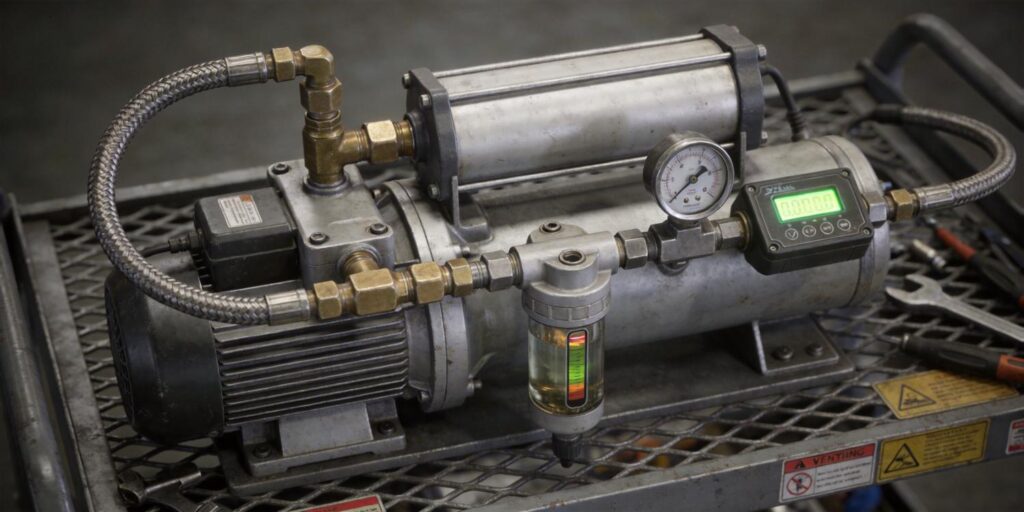
Oil Vapor Migration Mechanism
Oil backstreaming remains one of the most common yet preventable causes of vacuum-gauge failure in systems backed by oil-sealed rotary-vane or diffusion pumps. The mechanism is rooted in molecular-flow physics. When chamber pressure drops below ~10⁻² Torr, the mean free path of gas molecules exceeds the diameter of connecting tubing. Oil vapor molecules—liberated from the pump’s hot oil reservoir—now travel ballistically upstream, unimpeded by collisions with process gas.
Even with steady pumping, a small fraction of oil vapor diffuses against the main flow gradient. Condensation occurs on any surface cooler than the pump’s oil temperature (~40–80 °C), including gauge envelopes, filaments, and electrodes. Poseidon Scientific’s compact gauges minimize exposed internal surface area compared with legacy designs, yet the risk persists whenever downward-facing or remote-mounted sensors are used without proper protection. This vapor migration is invisible until it accumulates over weeks or months, gradually degrading measurement accuracy and ultimately triggering system alarms or process scrap.
Cold Cathode Contamination Risk
The VG-SM225 Cold Cathode Vacuum Gauge operates on the Penning-discharge principle: electrons spiral in crossed electric (~2000 V) and magnetic (~100 gauss) fields, ionizing residual gas to produce a measurable ion current. Oil vapor molecules reaching the discharge volume crack under ion bombardment, depositing conductive carbon layers on the “工”-shaped cathode and perforated anode.
Consequences appear in stages. First, starting voltage rises and ignition delay lengthens—from seconds at 10⁻⁴ Torr to minutes at 10⁻⁶ Torr. Next, the current-versus-pressure curve shifts downward by up to one decade, producing falsely low readings. In severe cases the electrodes short, extinguishing the discharge entirely. Field data from mass-spectrometer installations show that unprotected downward-mounted cold-cathode gauges can require cleaning every 3–6 months instead of the 3–5 years typical in clean environments.
Poseidon’s positive-magnetron geometry and slotted PEEK insulators maintain high gas conductance while reducing direct line-of-sight deposition paths. The gauge’s built-in software protection automatically disables high voltage above 10⁻³ Torr, preventing arcing during roughing when backstreaming risk peaks. These design choices give the VG-SM225 measurably longer intervals between maintenance than larger inverted-magnetron competitors.
Pirani Filament Damage Scenario
The VG-SP205 Pirani Vacuum Transmitter measures pressure via thermal conduction from a platinum filament held at constant temperature. Oil vapor condensation alters the filament’s effective heat-transfer coefficient, shifting the power-versus-pressure calibration curve. In the non-linear regions (atmosphere to 10 Torr and below 10⁻² Torr) this shift can exceed ±50 % error.
More critically, cracked oil residues release corrosive fragments that slowly attack the platinum wire. Although platinum offers superior chemical stability over tungsten or rhenium-tungsten filaments, prolonged exposure still accelerates burnout—especially at elevated filament temperatures during high-pressure operation. Because the VG-SP205 is sealed and non-serviceable, filament failure is irreversible and requires full transmitter replacement. Real-world case: a vacuum-furnace line experienced three Pirani failures in 14 months after installing gauges directly downstream of an untrapped rotary pump; switching to protected mounting and the Poseidon model eliminated replacements for over two years.
Poseidon’s platinum filament selection and onboard temperature-compensation algorithm (circuit + firmware) reduce thermal-drift sensitivity, but cannot eliminate the need for upstream contamination control.
Prevention via Traps and Filters
Effective prevention combines hardware, placement, and operational practices. Inline oil-mist filters and zeolite or activated-alumina traps capture >99 % of backstreaming vapor before it reaches the chamber. For budget-conscious systems, a simple water-cooled baffle or LN₂ cold trap mounted between pump and gauge often suffices. Poseidon’s compact KF16/KF25 flange footprint fits easily behind such traps without adding significant conductance loss.
Mounting orientation matters. Horizontal or 15°–45° upward placement lets gravity pull condensate away from active sensing elements. Avoid direct downward mounting on pump ports; use short tubulation only when chamber geometry forces it. For oil-free alternatives, consider switching to dry-scroll or turbo pumps where process compatibility allows—though many legacy systems remain oil-sealed, making traps essential.
Additional best practices include periodic pump-oil changes with low-vapor-pressure grades and automatic valve sequencing that isolates the gauge during roughing. Poseidon transmitters ship with clear installation guidance in their user manuals, emphasizing these steps to extend service life from months to years.
Maintenance Recovery Steps
When contamination has already occurred, systematic recovery restores performance at minimal cost. For the VG-SM225 Cold Cathode:
- Power down and vent the system safely.
- Remove the gauge; the modular sensor head separates without breaking chamber seals.
- Inspect electrodes for black carbon or colored oxide layers.
- Lightly polish both cathode and anode with 500-mesh (or 200-mesh for heavy buildup) emery paper until metallic luster returns—no mirror finish required.
- Reassemble, reinstall, and perform a factory-recommended high-voltage burn-in at 10⁻³ Torr to recondition the discharge.
Most users report full recovery after one cleaning cycle; the gauge returns to within ±10 % of original calibration across its 10⁻³–10⁻⁷ Torr range.
The VG-SP205 Pirani offers no field maintenance; if filament damage is suspected (erratic readings or open-circuit status via RS232), replace the entire transmitter. Its low replacement cost—engineered for OEM budgets—makes this economically viable. Always verify recovered or new gauges against a NIST-traceable reference at two known pressures (atmosphere and 10⁻⁴ Torr nitrogen) before returning to service.
Poseidon’s design philosophy—durability first, precision second—means cold-cathode recovery is fast and inexpensive, while Pirani simplicity keeps total ownership costs among the lowest in the industry.
Conclusion and Next Steps
Oil backstreaming is not an inevitable gauge killer; it is a preventable failure mode once its molecular-flow mechanism is understood. By combining proper traps, strategic mounting, and the robust construction of Poseidon Scientific transmitters, engineers and procurement teams eliminate months of downtime and thousands in replacement costs. The VG-SP205 Pirani delivers maintenance-free operation from atmosphere to 10⁻³ Torr, while the VG-SM225 Cold Cathode offers field-cleanable electrodes that extend life in contaminated environments.
Both gauges feature 0–10 V analog plus customizable RS232 output, temperature compensation across 15 °C–50 °C, and leak rates ≤10⁻¹¹ Pa·m³/s—engineered specifically for mass spectrometers, vacuum furnaces, and coating systems where oil-sealed pumps remain common.
Ready to protect your vacuum investment? Explore the VG-SP205 Pirani Vacuum Transmitter and VG-SM225 Cold Cathode Vacuum Gauge today. Both ship with detailed backstreaming-prevention guidance and support 5–10 unit protocol customization for seamless PLC integration.
Contact our applications engineering team for a free system-audit checklist, trap-selection recommendations, or a side-by-side contamination-tolerance comparison. We’re here to keep your gauges reading accurately—long after the pump oil has been changed.


