The Critical Importance of Monitoring Metal Chelates in Water Systems
Environmental monitoring of trace metals in water systems represents one of the most challenging analytical tasks facing environmental chemists today. While total metal concentrations provide valuable information, the speciation of metals—particularly their complexation with organic ligands—determines their bioavailability, toxicity, and mobility in aquatic environments. Metal chelates, formed through coordination bonds between metal ions and organic ligands, exhibit dramatically different environmental behaviors compared to their free ionic counterparts.
According to established literature, the role of solid-phase extraction (SPE) in atomic spectroscopy sample preparation is largely one of concentration, though elimination of interfering metal ions is desirable where it may be easily accomplished. Environmental matrices present unique challenges, with large volume aqueous samples requiring careful handling, especially when dealing with particulate-laden samples like river water or wastewater. The trace enrichment aspect of SPE lends itself particularly well to the extraction of liquids, especially clean samples such as drinking water or groundwater.
Why Metal Speciation Matters
Metal chelates can significantly alter the environmental impact of heavy metals. For instance, chelated forms of mercury, lead, and cadmium may exhibit reduced toxicity compared to their free ionic forms, while certain chelates of essential metals like iron and copper can enhance bioavailability. Regulatory frameworks increasingly recognize the importance of speciation data, moving beyond total metal concentrations to consider the specific chemical forms present in environmental samples.
Challenges in Trace Detection of Metal Chelates
The analysis of trace metal chelates presents multiple analytical hurdles that must be overcome for reliable environmental monitoring:
Ultra-Trace Concentration Levels
Environmental chemists must often track trace pollutants at part-per-billion (ppb) or part-per-trillion (ppt) levels, necessitating highly sensitive analytical techniques and effective preconcentration methods. As noted in environmental SPE applications, large volume samples are common because typical concentrations of potential analytes determine the degree to which they need to be concentrated from the sample prior to analysis.
Matrix Complexity
Natural water systems contain dissolved organic matter (DOM), particulates, and competing ions that can interfere with metal chelate analysis. Early in the development of SPE for environmental applications, analysts became aware of both a potential pitfall and a benefit to be derived from the interaction between DOM and sorbents used for SPE, particularly reversed-phase bonded silica sorbents. Organic pollutants and metals are known to bind to DOM such as humic or fulvic acids, complicating speciation analysis.
Stability Considerations
Metal-ligand complexes can be labile, with equilibrium constants that shift under different environmental conditions (pH, ionic strength, temperature). This lability requires careful sample handling to preserve the original speciation during collection, storage, and analysis.
SPE Sorbents for Metal-Ligand Complex Extraction
The selection of appropriate SPE sorbents is critical for successful extraction of metal chelates from environmental samples. Different sorbent chemistries offer distinct advantages for specific applications:
Complexing Agent-Modified Sorbents
While some complexing products have been developed by manufacturers and commercialized, most literature references describe the use of either complexation in the bulk sample before extraction or immobilization of complexing agent on the surface of the SPE sorbent during the conditioning step. The latter often uses a generic sorbent like C18. In such cases, retention is usually, though not always, obtained by non-polar mechanisms and hence elution off the SPE sorbent may occur with solvents like acetone.
Specialized Chelating Sorbents
Increasingly, specialized sorbents featuring covalently bound chelating groups are being reported for ion-chromatography and HPLC applications. For example, iminodiacetate-type chelating resins have been prepared for the retention of rare earth cations from aqueous solution, with elution of the retained species being achieved by acidification with nitric acid. In a further example, an immobilized crown ether sorbent has been used to extract Pb²⁺ ions from acidic solution and eluted with a competing ligand such as oxalate or citrate.
Ion-Pair Mechanisms
Van Elteren et al. (1990) demonstrate an approach for extraction of As(III) from aqueous samples in which two different schemes were developed. One utilizes a C18 cartridge with an ion pairing mechanism between cetyl trimethyl ammonium and pyrrolidene dithiocarbamate ions; the other employs a combination of SAX and C18, with the pyrrolidene dithiocarbamate species retaining on the SAX until it complexes with the As(III).
Example Extraction Workflow for Metal Chelates
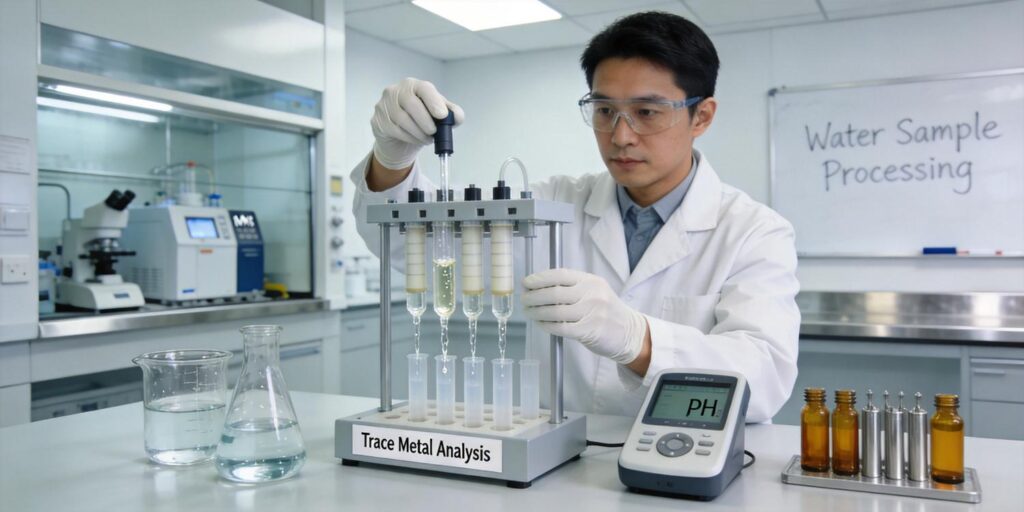
A typical SPE workflow for metal chelate extraction from environmental water samples involves several critical steps:
Sample Pretreatment
Environmental samples may contain inorganic, organic, and/or biological particulates. Unlike dissolved organic carbon, particulates can more successfully be removed from the sample prior to analysis by SPE. For SPE determination of contaminants in seawater samples, researchers have prefiltered samples in a step-wise manner through glass-fiber filters at 0.7 μm, followed by filtration with 0.45 μm glass-fiber filters to trap particulate matter.
SPE Cartridge Conditioning
Proper conditioning prepares the sorbent to accept the sample matrix. For metal chelate extraction, this often involves passing a solution containing the complexing agent through the cartridge to immobilize it on the sorbent surface before sample loading.
Sample Loading and Washing
The pretreated sample is passed through the conditioned SPE cartridge at controlled flow rates (typically 1-3 drops per second for optimal recovery). Washing steps remove weakly retained matrix components while retaining the target metal chelates.
Elution and Concentration
Metal chelates are eluted using appropriate solvents—often acetone or acidified organic solvents for non-polar retention mechanisms, or competing ligands for chelating sorbents. The eluate is typically concentrated to a small volume for subsequent analysis.
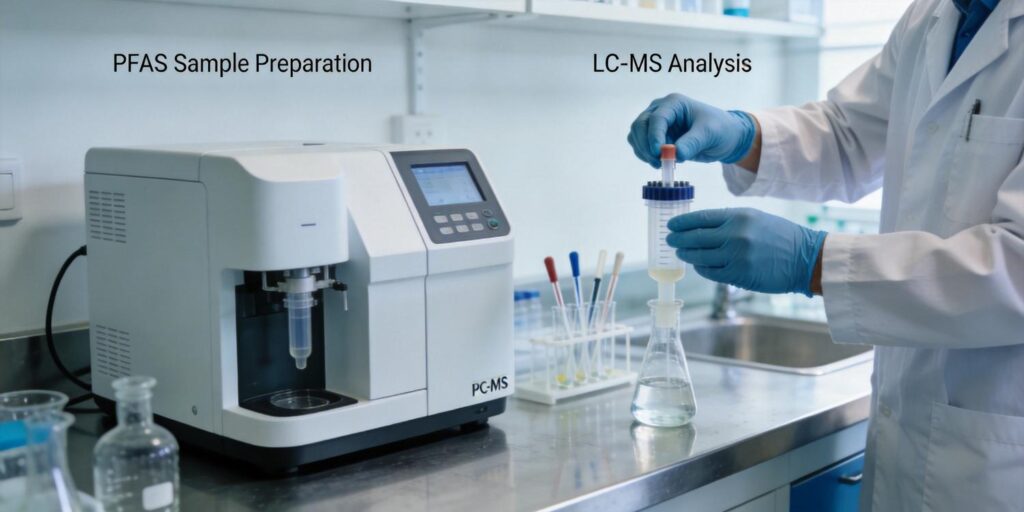
Detection by LC-ICP-MS or LC-MS
The combination of separation techniques with sensitive detection methods provides the specificity and sensitivity required for trace metal chelate analysis:
Liquid Chromatography-Inductively Coupled Plasma-Mass Spectrometry (LC-ICP-MS)
LC-ICP-MS represents the gold standard for metal speciation analysis, offering exceptional sensitivity (often sub-ppb detection limits) and element-specific detection. The chromatographic separation resolves different metal species, while ICP-MS provides sensitive, multi-element detection capabilities.
Liquid Chromatography-Mass Spectrometry (LC-MS)
For metal chelates with organic ligands of interest, LC-MS provides complementary information about both the metal and ligand components. Tandem mass spectrometry (MS/MS) enables structural elucidation and confirmation of metal-ligand complexes.
Alternative Detection Strategies
Analysis of acetone eluents off C18 sorbent in metal chelate extraction schemes has been performed by hydride generation atomic absorption spectroscopy. Other researchers have demonstrated the use of laser desorption as an alternative to solvent desorption, by inserting a sorbent disc into the cell of a Fourier transform mass spectrometer.
Method Validation Strategies for Metal Chelate Analysis
Comprehensive method validation ensures the reliability and regulatory acceptance of SPE-based methods for metal chelate analysis:
Recovery Studies
Recovery against various experimental parameters like flow rate, loading of the complexing ion during conditioning, sample pH, and presence of competing ions in the sample must be thoroughly evaluated. These studies determine the optimal conditions for quantitative extraction of target analytes.
Matrix Effects Assessment
Method performance should be evaluated across different environmental matrices (drinking water, surface water, groundwater, seawater) to account for variations in dissolved organic matter, ionic strength, and competing ions.
Stability Testing
The stability of metal chelates during sample collection, storage, and analysis must be established to ensure that reported concentrations reflect environmental conditions rather than analytical artifacts.
Quality Control Measures
Implementation of appropriate quality control samples (blanks, spikes, duplicates, certified reference materials) throughout the analytical process ensures data quality and identifies potential contamination or loss issues.
Method Comparison
Where possible, SPE-based methods should be compared with established reference methods to demonstrate equivalence or superiority for specific applications.
Conclusion
The SPE extraction of trace metal chelates from environmental samples represents a sophisticated analytical approach that addresses the growing need for metal speciation data in environmental monitoring. By combining selective extraction with sensitive detection techniques, environmental chemists can obtain crucial information about the bioavailability, toxicity, and fate of metals in aquatic systems. As regulatory requirements evolve and analytical technologies advance, SPE-based methods will continue to play a vital role in protecting water resources and public health through accurate metal speciation analysis.
For laboratories seeking reliable SPE solutions for environmental applications, Poseidon Scientific offers a comprehensive range of SPE cartridges and plates designed for demanding analytical challenges. Our HLB SPE cartridges, MAX SPE cartridges, MCX SPE cartridges, WAX SPE cartridges, WCX SPE cartridges, and 96-well SPE plates provide the flexibility and performance needed for successful metal chelate analysis across diverse environmental matrices.