Chemical Complexity of Cosmetic Formulations
Cosmetic products represent some of the most challenging matrices for analytical chemists due to their complex and diverse formulations. Unlike pharmaceutical preparations, cosmetics contain a wide array of ingredients designed for aesthetic appeal, texture enhancement, and product stability. These formulations typically include emollients, surfactants, thickeners, preservatives, fragrances, colorants, and active ingredients like UV filters or anti-aging compounds.
The emulsion-based nature of creams and lotions creates additional analytical hurdles. Oil-in-water or water-in-oil emulsions contain both hydrophilic and lipophilic components that can interfere with target analyte extraction and detection. As noted in SPE literature, “the matrix, though still likely to contain plant sugars, acids and colorants, does not contain the co-formulated excipients and therefore does not present many of the problems associated with them” (Simpson, 2000). This complexity necessitates robust sample preparation strategies to isolate target analytes from interfering matrix components.
Common cosmetic excipients like parabens (methyl- and propyl-p-hydroxybenzoate) exhibit UV spectral properties that can interfere with spectrophotometric assays of active ingredients. Research has shown that these preservatives “exhibit UV spectral properties which can interfere with the spectrophotometric assay of the drug” (Bonazzi et al., 1995). This interference underscores the importance of effective cleanup procedures in cosmetic analysis.
Target Analytes: Preservatives and UV Filters
In cosmetic product testing, two primary categories of analytes require careful monitoring: preservatives and UV filters. Preservatives like parabens, formaldehyde-releasing agents, and isothiazolinones are essential for product safety but must be quantified within regulatory limits. UV filters including organic compounds like avobenzone, octinoxate, and oxybenzone, along with inorganic filters like zinc oxide and titanium dioxide, require accurate measurement to ensure sun protection efficacy and safety compliance.
These target analytes span a wide range of chemical properties. Preservatives like parabens are relatively hydrophobic with pKa values around 8.5, while UV filters vary from highly lipophilic compounds to more polar derivatives. This chemical diversity necessitates flexible SPE approaches that can accommodate different analyte characteristics within a single method.
Research has demonstrated successful SPE applications for cosmetic components, including the determination of “1,4-dioxane in cosmetic products following extraction on silica and C18 sorbents” (Scalia et al., 1992). Similarly, “the lipid-soluble vitamins A and E have also been determined following the SPE extraction of cosmetic oils and creams” (Kountourellis et al., 1992), indicating the versatility of SPE techniques for cosmetic matrices.
SPE Sorbent Selection for Cosmetic Matrices
Selecting the appropriate SPE sorbent is critical for successful cosmetic sample cleanup. The choice depends on the chemical properties of both target analytes and matrix components. For cosmetic applications, several sorbent types have proven effective:
Reversed-Phase Sorbents (C18, C8, HLB)
Hydrophilic-lipophilic balanced (HLB) sorbents like those in Poseidon Scientific’s HLB SPE cartridges are particularly valuable for cosmetic applications. These sorbents retain both hydrophilic and hydrophobic compounds, making them ideal for the diverse analyte profiles found in cosmetics. As noted in SPE methodology, “the hydrophobic and acidic-basic properties of the drug as well as the nature of the excipients constitute critical elements for determining the choice of a reversed-phase or ion-exchange methodology for optimisation of the SPE” (Bonazzi et al., 1995).
Mixed-Mode Sorbents (MCX, MAX, WCX, WAX)
For ionizable analytes like certain preservatives and UV filters, mixed-mode sorbents offer superior selectivity. MCX (mixed-mode cation exchange) and MAX (mixed-mode anion exchange) cartridges provide dual retention mechanisms through both reversed-phase and ion-exchange interactions. Research has shown that “ion-exchange methodology also proved to be suitable for the clean-up of cream samples containing hydrophobic, acidic drugs such as Ketoprofen (pKa=5.9) and Ibuprofen (pKa=5.2)” (Bonazzi et al., 1995).
Normal Phase Sorbents (Diol, Silica)
For non-aqueous cosmetic extracts, normal phase sorbents can be effective. A diol sorbent “was found to be suitable for the analysis of formulations containing neutral or acidic drugs of different polarity, such as hydrocortisone acetate, fentiazac and piroxicam” (Bonazzi et al., 1995). In these applications, the cream sample was dissolved in an appropriate dichloromethane-n-hexane mixture where the solvent ratio was adjusted to favor sorbent-analyte interactions.
Example Cleanup Protocol for Creams and Lotions
Based on established SPE methodologies for pharmaceutical creams, here’s a practical protocol adaptable to cosmetic products:
Sample Preparation
1. Weigh approximately 1.0 g of cosmetic product into a suitable container.
2. Add 10 mL of appropriate solvent (typically 20% methanol in water for hydrophilic analytes or dichloromethane-hexane mixtures for lipophilic compounds).
3. Sonicate for 15 minutes to ensure complete dissolution/dispersion.
4. Centrifuge at 3000 rpm for 10 minutes to separate insoluble components.
5. Filter supernatant through 0.45 μm membrane if necessary.
SPE Procedure Using HLB Cartridges
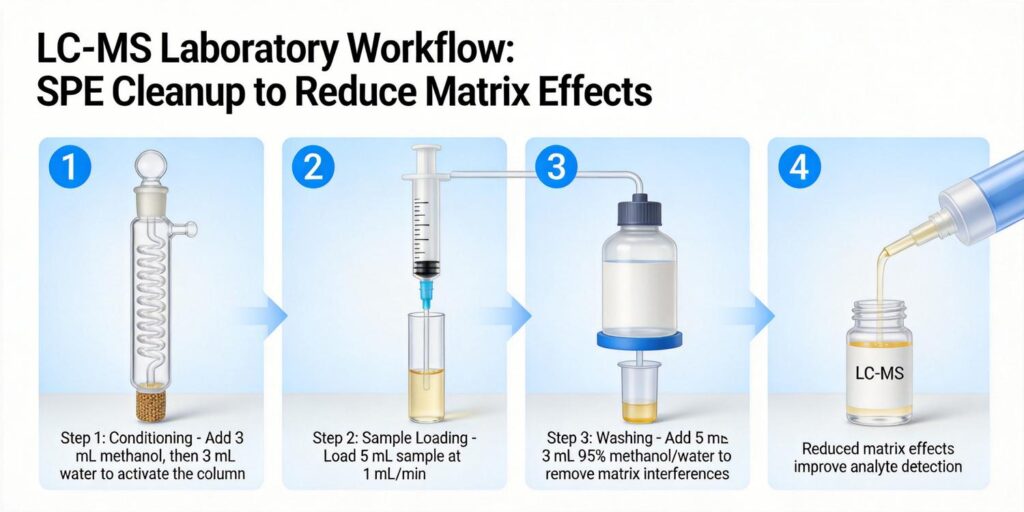
1. Condition the HLB cartridge with 3 mL methanol followed by 3 mL water or appropriate buffer.
2. Load the prepared sample solution at a controlled flow rate (1-2 mL/min).
3. Wash with 3 mL of 5% methanol in water to remove weakly retained matrix components.
4. Dry the cartridge under vacuum for 5 minutes to remove residual water.
5. Elute target analytes with 3-5 mL of appropriate solvent (methanol, acetonitrile, or mixtures with acid/base modifiers).
6. Evaporate eluate to dryness under gentle nitrogen stream and reconstitute in mobile phase for analysis.
Alternative Protocol for Ionizable Analytes
For preservatives like parabens or acidic UV filters:
1. Use MAX cartridges for anion exchange capability.
2. Condition with methanol and pH-adjusted buffer.
3. Load sample at basic pH to ensure analytes are in ionized form.
4. Wash with methanol or methanol-water mixtures.
5. Elute with acidified methanol to protonate analytes and disrupt ion-exchange interactions.
LC-MS Analysis of Purified Extracts
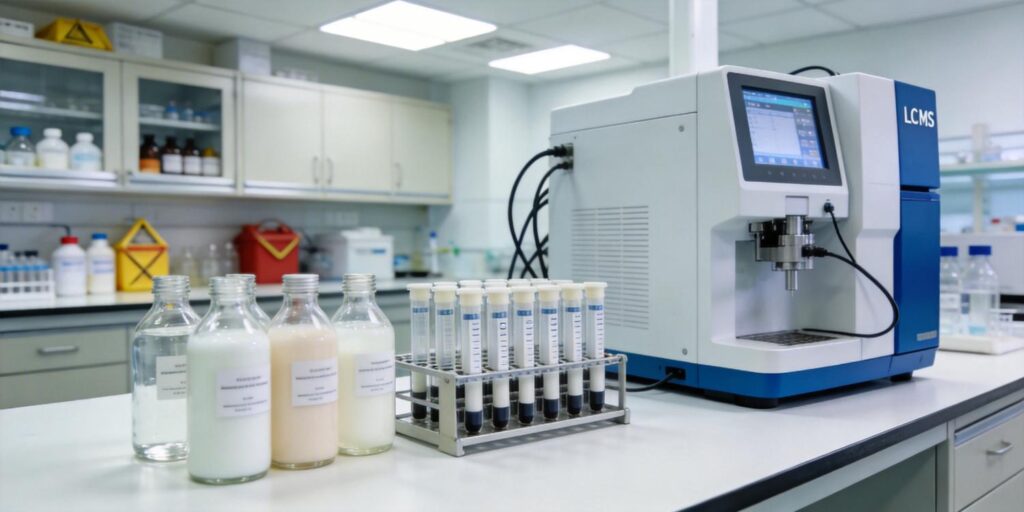
Following SPE cleanup, liquid chromatography-mass spectrometry (LC-MS) provides the sensitivity and selectivity required for cosmetic analyte quantification. The effectiveness of SPE prior to chromatographic analysis is well-documented: “The proposed SPE procedures may also be adopted in chromatographic (HPLC) analyses to avoid overloading and deleterious effects upon the analytical column performance and lifetime” (Bonazzi et al., 1995).
LC Conditions
1. Column: C18 or phenyl-hexyl stationary phase (100 × 2.1 mm, 1.7-2.6 μm)
2. Mobile Phase: Gradient of water and methanol/acetonitrile with 0.1% formic acid or ammonium acetate
3. Flow Rate: 0.3-0.5 mL/min
4. Column Temperature: 30-40°C
5. Injection Volume: 1-10 μL
MS Detection
1. Ionization: Electrospray ionization (ESI) in positive or negative mode depending on analyte properties
2. Scan Mode: Multiple reaction monitoring (MRM) for target analytes
3. Source Parameters: Optimized for each instrument and analyte class
4. Data Acquisition: Scheduled MRM to maximize sensitivity across retention time windows
Method Validation Parameters
1. Linearity: 5-7 concentration levels covering expected range
2. Accuracy: 85-115% recovery
3. Precision: <15% RSD for intra- and inter-day variability
4. Limit of Detection/Quantification: Based on signal-to-noise ratios
5. Matrix Effects: Evaluate using post-extraction spiking
Quality Control Considerations
Implementing robust quality control measures ensures reliable cosmetic testing results:
Process Controls
1. Method Blanks: Process solvents through entire SPE procedure to monitor contamination.
2. Matrix Spikes: Fortify cosmetic matrices with known analyte concentrations to assess recovery.
3. Duplicate Analyses: Analyze samples in duplicate to monitor precision.
4. Continuing Calibration: Include calibration standards at beginning and end of analytical batches.
Sorbent Performance
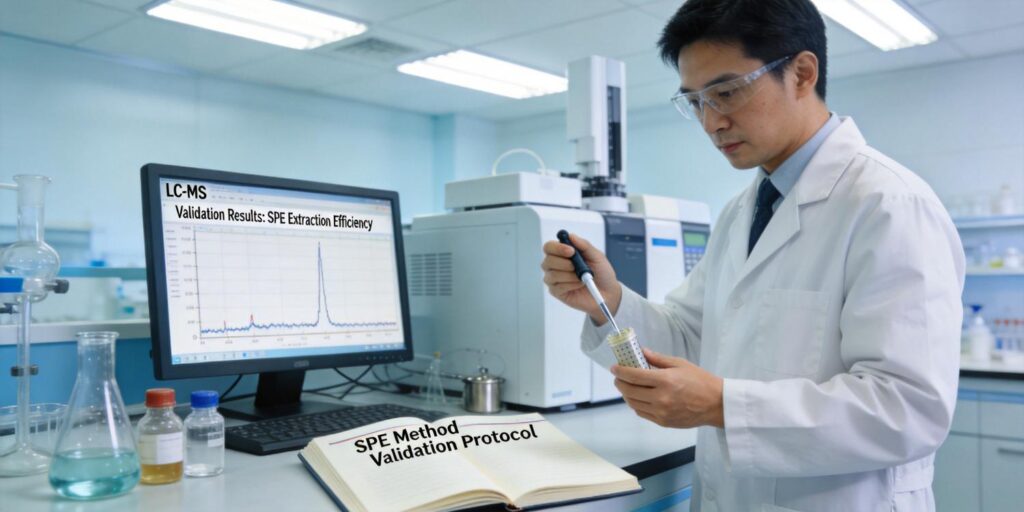
Regular testing of SPE sorbent performance is essential. As noted in SPE literature, “Because of the generally high recoveries and the good precision (RSD < 1.5%, with the exception of promethazine) which can be attained from experience with the method, SPE-UV spectrophotometry can be considered to be a useful combination for the routine quality control" (Bonazzi et al., 1995).
Solvent Quality
Solvent purity significantly impacts SPE results. “Impurities may bind temporarily to the sorbent, concentrate and be eluted later. The potential for concentration of impurities from the solvent may mean that a compound present but unobservable in a solvent blank, can appear in an SPE extract” (Simpson, 2000). Use HPLC-grade solvents and consider additional purification if necessary.
System Suitability
1. Column Performance: Monitor retention times, peak shapes, and resolution.
2. MS Sensitivity: Verify detector response with quality control standards.
3. Carryover: Assess between high-concentration samples and blanks.
4. Recovery Consistency: Track SPE recovery across multiple batches.
Documentation and Traceability
Maintain comprehensive records including:
1. SPE cartridge lot numbers and expiration dates
2. Solvent preparation details
3. Instrument calibration data
4. Analyst qualifications and training records
5. Method deviations and corrective actions
Conclusion
Effective SPE cleanup strategies are essential for accurate cosmetic product testing. The chemical complexity of cosmetic formulations demands careful sorbent selection and method optimization. By leveraging appropriate SPE technologies like HLB, MAX, and MCX cartridges, analysts can achieve the necessary cleanup for reliable LC-MS analysis of preservatives and UV filters. Implementing robust quality control measures throughout the analytical process ensures data integrity and regulatory compliance in cosmetic testing laboratories.
For high-throughput applications, consider 96-well SPE plates that offer automation compatibility and improved workflow efficiency. Regular method review and optimization based on evolving cosmetic formulations and regulatory requirements will maintain analytical excellence in this challenging field.