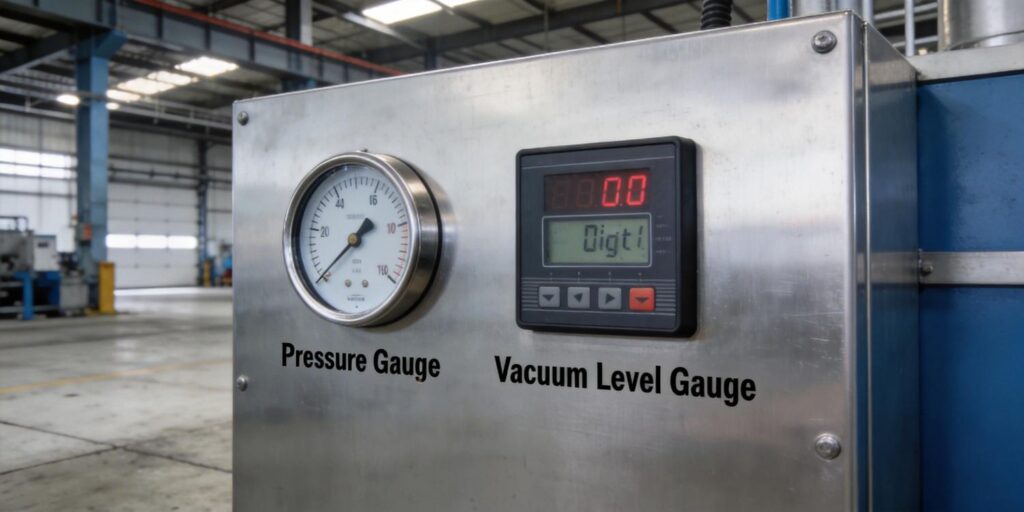
In medical device sterilization, precise vacuum control is non-negotiable. Whether removing air from steam autoclaves, preconditioning chambers for ethylene oxide (ETO) cycles, or achieving the high-vacuum conditions required for hydrogen peroxide plasma sterilization, vacuum gauges ensure repeatable lethality, protect product integrity, and support regulatory compliance. At Poseidon Scientific, our VG-SP205 Pirani Vacuum Transmitter and VG-SM225 Cold Cathode Vacuum Transmitter were developed specifically to meet the cost, size, and reliability demands of OEM medical equipment manufacturers while delivering the measurement performance required for validated sterilization processes.
This article explores the critical role of vacuum gauges in medical device sterilization systems. From the fundamental physics of sterilization cycles to practical selection of Pirani versus cold cathode technology, we provide engineers and procurement teams with actionable insights grounded in real-world vacuum metrology. The content draws on established principles of vacuum science and the proven performance of Poseidon’s compact, low-cost gauges in demanding instrumentation environments.
Vacuum’s Role in Sterilization Cycles
Vacuum serves three primary functions in modern medical device sterilization:
- Air removal and steam penetration – Pre-vacuum pulses in autoclaves eliminate trapped air pockets that would otherwise shield microorganisms from moist heat.
- Gas distribution and penetration – In ETO or vapor-phase hydrogen peroxide processes, vacuum lowers chamber pressure to facilitate uniform sterilant diffusion into complex device lumens and packaging.
- Moisture and residual removal – Deep vacuum stages accelerate drying and outgassing, reducing cycle time and preventing condensation-related recontamination.
Without reliable vacuum monitoring, these steps become variables rather than controlled parameters. Inconsistent pressure can lead to failed biological indicators, extended cycle times, or—more critically—non-sterile product reaching the market. Poseidon’s gauges address this need with factory-calibrated, temperature-compensated outputs that maintain stability across the 15–50 °C operating range typical of cleanroom and production-floor environments.
Pressure Stages During Sterilization
A typical sterilization cycle includes distinct pressure phases that demand different gauge technologies. The table below summarizes the stages common to steam, ETO, and plasma systems:
| Stage | Typical Pressure Range | Purpose | Recommended Poseidon Gauge |
|---|---|---|---|
| Pre-vacuum / Roughing | Atmosphere to 10-1 Torr (133 to 0.13 Pa) | Air removal, steam or sterilant admission | VG-SP205 Pirani |
| Intermediate Hold | 1 to 10-2 Torr | Sterilant dwell / penetration | VG-SP205 Pirani (linear region) |
| Deep Vacuum / Drying | 10-3 to 10-5 Torr | Moisture removal, outgassing | VG-SM225 Cold Cathode |
| Final Vacuum / Aeration | 10-5 to 10-7 Torr (plasma systems) | Residual sterilant elimination | VG-SM225 Cold Cathode |
The VG-SP205 covers the rough-to-medium vacuum range (atmosphere to 10-3 Torr) using platinum-filament thermal conductivity, while the VG-SM225 extends into high vacuum (10-3 to 10-7 Torr) via Penning discharge. Together they provide continuous coverage across the full cycle without gaps or expensive overlapping instrumentation.
Leak Integrity Requirements
Medical sterilizers must demonstrate leak rates low enough to maintain chamber pressure within tight tolerances—typically better than 0.1–0.5 mbar·L/s depending on chamber volume and cycle specification. Vacuum gauges play a direct role in leak testing during installation qualification (IQ), operational qualification (OQ), and performance qualification (PQ).
The VG-SP205’s high-resolution linear region (10 Torr to 10-2 Torr) allows precise detection of pressure rise during isolated hold tests. For deeper integrity checks, the VG-SM225’s ion-current sensitivity confirms that the chamber reaches and holds the target high-vacuum level. Both gauges feature robust stainless-steel construction and KF16/KF25 flange options, ensuring compatibility with medical-grade vacuum systems while resisting the corrosive effects of residual sterilants.
Pirani for Roughing Monitoring
During the initial roughing and pre-vacuum pulses, the VG-SP205 Pirani Vacuum Transmitter excels. Its thermal-conductivity principle delivers fast response and excellent linearity in the pressure band where most air-removal work occurs. The compact transmitter body fits easily into space-constrained sterilizer designs, and the 0–10 V analog output (effective 2–8 V) integrates directly with PLC or DCS systems.
Key advantages for medical OEMs include:
- Platinum filament for superior contamination resistance and 3–5 year typical lifetime
- Built-in temperature compensation (hardware + algorithm) minimizing drift to <±3 % across 15–50 °C
- Customizable RS-232 protocol (5–10 unit minimum) for direct PLC integration without additional converters
In steam autoclaves, the Pirani reliably monitors the transition from atmospheric pressure to the 10–50 mbar range required for effective Bowie-Dick testing and air removal.
Cold Cathode for Final Vacuum
Once roughing is complete, many advanced sterilizers—particularly low-temperature plasma systems—require deeper vacuum to ensure complete sterilant removal and dryness. Here the VG-SM225 Cold Cathode Vacuum Transmitter takes over. Its Penning discharge design provides reliable measurement from 10-3 Torr down to 10-7 Torr without a hot filament, eliminating outgassing and reactive-gas decomposition concerns common in medical applications.
Practical features tailored for sterilization equipment include:
- Automatic high-voltage shutdown above 10-3 Torr to protect electrodes during roughing
- Removable sensor head for simple field cleaning with 200- or 500-grit abrasive
- Integrated status indicators and RS-232 digital output for real-time health monitoring
The gauge’s positive-magnetron geometry keeps the package smaller than most inverted-magnetron competitors, an important consideration for compact medical device sterilizers destined for hospital central sterile supply departments (CSSDs) or OEM integration.
Validation Documentation
Regulatory bodies require documented evidence that vacuum instrumentation performs consistently throughout the product life cycle. Poseidon Scientific supplies comprehensive validation support packages for both the VG-SP205 and VG-SM225, including:
- Factory calibration certificates traceable to NIST standards
- Repeatability and hysteresis data across the full temperature and pressure operating envelope
- Long-term drift studies (typically <5 % over 12 months in clean environments)
- Material compatibility declarations for 316L stainless steel, PEEK, and Viton seals
These documents accelerate IQ/OQ/PQ activities and simplify customer audits. Our engineering team also provides on-site or remote support for cycle-specific mapping studies, ensuring the gauges are installed at locations that represent true chamber conditions rather than pump-line artifacts.
Regulatory Considerations
Medical device sterilization equipment falls under strict global standards:
- FDA 21 CFR Part 820 – Quality System Regulation requires calibrated and validated process monitoring equipment
- ISO 11135 (ETO) and ISO 17665 (steam) – Mandate pressure/vacuum monitoring with defined accuracy and repeatability
- ISO 14937 (general sterilization) – Emphasizes process validation and equipment suitability
- EU MDR 2017/745 and ISO 13485 – Demand risk-based approaches to measurement system reliability
Both Poseidon gauges are designed with these requirements in mind: non-user-adjustable factory calibration, built-in diagnostics, and low outgassing materials. Their digital communication options further simplify audit trails by enabling timestamped pressure logging directly into the sterilizer’s control system.
Why Poseidon Gauges Deliver Value in Medical Sterilization
Medical OEMs and CSSD equipment builders face intense pressure to reduce costs without compromising safety or compliance. Imported gauges often carry premium pricing and rigid protocols; domestic alternatives frequently lack the combination of miniaturization, maintainability, and customization that Poseidon provides. Our VG-SP205 and VG-SM225 pair offers seamless range coverage at a fraction of the cost of traditional solutions, with the added benefit of field-replaceable cold cathode heads and fully customizable RS-232 protocols for seamless PLC integration.
Early adopters in medical vacuum systems have reported simplified validation, reduced spare-parts inventory, and improved cycle-to-cycle repeatability—direct contributors to higher throughput and lower total cost of ownership.
Ready to discuss your medical sterilization vacuum requirements? Whether you are designing a new low-temperature plasma sterilizer, upgrading an ETO system, or seeking a cost-effective drop-in replacement for legacy gauges, Poseidon Scientific’s applications engineering team is available for a technical consultation. Download the latest datasheets for the VG-SP205 Pirani Vacuum Transmitter and VG-SM225 Cold Cathode Vacuum Gauge, or contact us directly to explore OEM volume pricing, custom calibration, and validation support packages tailored to medical device sterilization systems.