
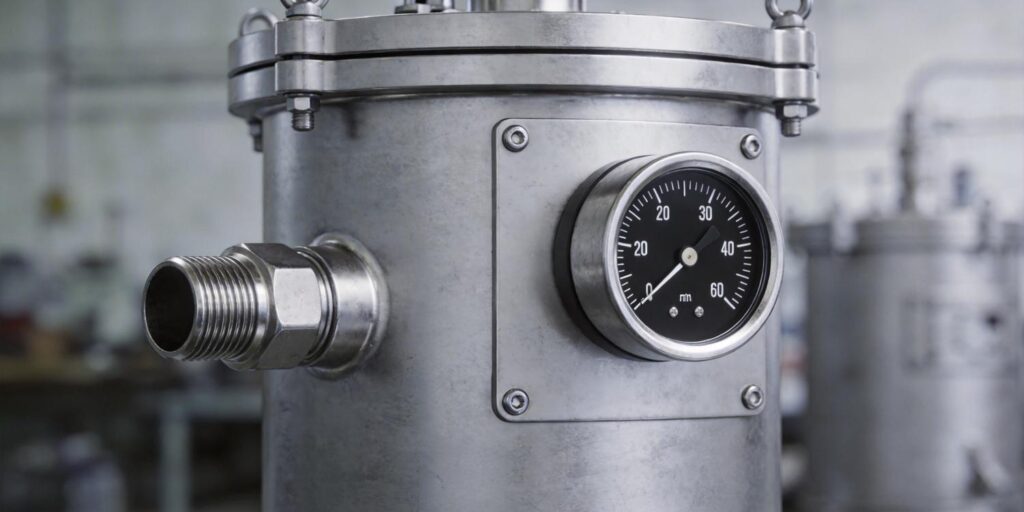
In high-throughput vacuum processes such as reactive sputtering, plasma-enhanced CVD, and large-scale PVD coating, continuous gas injection creates significant gas loads—often 10–100 Torr·L/s or more. Maintaining stable process pressure while pumping away the introduced gas demands precise, repeatable vacuum measurement. Yet many gauges struggle under these conditions: thermal sensors drift with gas composition changes, while ionization gauges can suffer from discharge instability or contamination buildup.
Poseidon Scientific’s VG-SP205 Pirani Vacuum Transmitter (atmosphere to 10⁻³ Torr) and VG-SM225 Cold Cathode Vacuum Gauge (10⁻³ to 10⁻⁷ Torr) were developed with exactly these industrial realities in mind. The VG-SP205 uses a platinum-filament thermal-conductivity design with full temperature compensation; the VG-SM225 employs a compact positive-magnetron Penning discharge with automatic high-voltage protection. Both deliver 0–10 V analog output plus user-customizable RS-232 protocol in a footprint small enough for KF16/KF25 ports on coating chambers. The sections below explain how each performs under high gas load and why the combination delivers reliable control where legacy gauges falter.
Defining Gas Load and Throughput
Gas load, or throughput Q, quantifies the quantity of gas entering (or leaving) a vacuum system per unit time. It is expressed as
Q = P × S
where P is pressure and S is effective pumping speed. Units are typically Torr·L/s or Pa·m³/s. In a coating tool, argon or reactive gases (N₂, O₂, C₂H₂) are introduced at controlled flow rates of 50–500 sccm while turbo or cryo pumps remove the gas. The resulting steady-state pressure is set by the balance between inflow and pumping speed.
High gas load processes therefore operate at elevated throughput levels—often orders of magnitude above simple pump-down cycles. Pressure may fluctuate rapidly during recipe steps (gas ramp-up, plasma ignition, shutter actuation). Gauges must track these transients without lag or false readings, because even a 10 % pressure excursion can shift film stoichiometry, stress, or adhesion. Both Poseidon gauges are calibrated for air but include firmware that reports status and internal temperature, enabling engineers to apply gas-specific correction factors when process gas composition is known.
Impact on Pirani Response
The VG-SP205 measures pressure via the power required to keep a platinum filament at constant temperature. Heat loss occurs primarily through gas-molecule collisions; higher pressure or higher thermal-conductivity gases increase cooling, requiring more heater power. In high gas load environments this principle delivers two key advantages:
- Fast response: <50 ms to 90 % of final value across the entire range, ideal for tracking gas-valve ramps or pressure-swing cycles.
- Linear region usability: The most accurate band (10 Torr to 10⁻² Torr) exactly matches typical coating process pressures (0.1–10 mTorr for sputtering, 50–500 mTorr for PECVD).
However, two limitations appear under high gas load. First, the reading is gas-species dependent: argon (lower thermal conductivity than air) produces a lower indicated pressure for the same true pressure; helium produces a higher reading. Second, at the very high-pressure end (>10 Torr) and very low end (<10⁻² Torr) the curve becomes non-linear, with potential ±50 % error. In practice, most coating recipes stay inside the linear band, and engineers apply a simple scaling factor once the process gas is fixed. The gauge’s built-in temperature compensation (hardware + algorithm) further minimizes drift when chamber wall temperature varies during plasma operation.
Cold Cathode Stability at Fluctuating Pressure
The VG-SM225 generates a self-sustaining Penning discharge: electrons spiral in crossed electric (–2000 V) and magnetic (~100 gauss) fields, ionizing gas molecules and producing a cathode ion current proportional to density. Because the discharge is maintained by space-charge effects rather than a hot filament, it tolerates pressure fluctuations better than hot-cathode designs.
Automatic protection circuitry shuts off high voltage above 10⁻³ Torr to prevent excessive current and electrode contamination. In high gas load coating processes—where base pressure rarely drops below 10⁻⁴ Torr during active deposition—the gauge therefore operates well within its stable band. Startup time remains short (<15 s at 10⁻⁵ Torr) once the chamber has been pumped below the protection threshold. Ion-current output shows only minor hysteresis between pump-down and gas-injection phases, typically <5 % deviation when pressure is cycled repeatedly.
The removable sensor head is especially valuable here: any sputtered metal or hydrocarbon buildup from reactive gases can be cleaned in <15 minutes with 500-mesh paper, restoring the original calibration curve without breaking chamber vacuum. This in-situ serviceability keeps the gauge stable even after thousands of high-gas-load cycles.
Signal Filtering Considerations
High gas load processes generate rapid pressure noise from gas-flow turbulence, plasma instabilities, and pump speed variations. Raw analog output can jitter by several percent, triggering false interlocks or recipe aborts.
Both Poseidon gauges incorporate internal low-pass filtering on the 0–10 V signal (factory default ~1 Hz cutoff). For tighter control, engineers add simple software averaging in the PLC or SCADA system:
- 10–20 point moving average (100–200 ms window) removes turbulence while preserving recipe-step transitions.
- Digital RS-232 output (updated every 50 ms) allows direct filtering in the controller without analog noise.
- Status byte flags over-range or discharge-unstable conditions instantly, preventing reliance on noisy readings.
In one implementation, a 15-point digital filter reduced apparent pressure noise from ±8 % to <±1.5 % without introducing measurable lag in gas-valve response time. The customizable RS-232 protocol lets users request filtered or raw values on demand, giving complete flexibility.
Recommended Filtering Settings for Coating Tools
| Process Phase | Filter Type | Window | Purpose |
|---|---|---|---|
| Gas ramp / ignition | Moving average | 5 points (50 ms) | Capture transients |
| Steady deposition | Moving average + median | 15 points (150 ms) | Reject plasma noise |
| Pressure-swing cycles | Raw digital | N/A | Max speed |
Process Control Implications
Stable gauge output translates directly into tighter process windows. In reactive sputtering, pressure must be held within ±5 % of setpoint to maintain film stoichiometry; in PECVD, pressure swings control deposition rate and stress. The VG-SP205’s fast response and linear region let PID loops adjust mass-flow controllers in real time. The VG-SM225 provides verification at the lowest process pressures and flags any unexpected rise that could indicate a leak or pump degradation.
Because both gauges share the same mounting flange and RJ45 connector, a single KF25 port can host both instruments with a short manifold—giving full-range coverage and automatic crossover at 10⁻³ Torr. The PLC simply ORs the “vacuum-ready” status bits or switches between analog channels based on pressure level. Custom RS-232 protocol mapping ensures seamless integration with any brand of automation controller without extra gateways.
Real Coating System Example
A mid-volume PVD coater for automotive decorative trim ran legacy hot-cathode gauges that drifted >15 % after every 500 hours of reactive TiN deposition due to filament contamination. Switching to a VG-SP205 (roughing port) + VG-SM225 (chamber wall) pair eliminated filament failures entirely. Process pressure stability improved to ±2.5 %, reducing color-variation scrap by 38 %. Electrode cleaning on the Cold Cathode was performed every 6 months during scheduled maintenance—taking 12 minutes with the chamber still under vacuum. Over 18 months the line achieved 99.7 % gauge-related uptime, and total cost of ownership dropped 65 % versus the previous hot-cathode solution. The same configuration is now standard across three additional coating tools at the plant.
Optimize Your High Gas Load Processes Today
High gas load does not have to compromise vacuum measurement accuracy or reliability. The VG-SP205 Pirani and VG-SM225 Cold Cathode combination delivers fast response, gas-load-tolerant stability, simple filtering options, and in-situ maintenance—all in a compact, low-cost package ready for any PLC or SCADA system.
Download the VG-SP205 datasheet and user manual for detailed gas-correction tables and response-time curves.
Download the VG-SM225 datasheet and user manual for electrode-cleaning procedures and discharge-stability specifications.
Need help calculating gas-load-specific correction factors, designing a filtered PID loop, or creating a dual-gauge manifold drawing for your coater? Contact our applications engineering team at engineering@poseidon-scientific.com or request a 48-hour evaluation kit. We support 5-piece pilot orders with full protocol customization and deliver production volumes with lifetime technical support.
Stable pressure. Clean films. Maximum throughput.


