Artificial Sweeteners as Environmental Tracers
Artificial sweeteners have emerged as powerful environmental tracers in recent years, providing unique insights into water contamination pathways and human activity patterns. Unlike traditional wastewater indicators, these compounds exhibit remarkable persistence in aquatic environments and resist conventional water treatment processes. Their widespread use in food, beverages, and pharmaceutical products, combined with their chemical stability, makes them ideal markers for tracking wastewater contamination in drinking water sources.
Research has demonstrated that artificial sweeteners can serve as reliable indicators of wastewater impact on surface waters and groundwater systems. Their presence in drinking water supplies signals potential contamination from septic systems, sewage leaks, or inadequate wastewater treatment. As noted in environmental SPE literature, “The trace enrichment aspect of SPE lends itself very well to the extraction of liquids, especially clean samples such as drinking water or groundwater” (Simpson, 2000). This characteristic makes SPE particularly suitable for concentrating these trace-level contaminants from large-volume water samples.
Target Analytes: Sucralose and Acesulfame
Among artificial sweeteners, sucralose and acesulfame have gained particular attention as environmental markers due to their exceptional persistence and widespread consumption. Sucralose, approximately 600 times sweeter than sucrose, exhibits remarkable stability in aquatic environments with minimal biodegradation. Acesulfame potassium, another high-intensity sweetener, demonstrates similar persistence and has been detected in various water matrices worldwide.
These compounds present unique analytical challenges for environmental monitoring. Their high polarity and water solubility require specialized extraction approaches, as traditional reversed-phase SPE methods may not provide adequate retention. The chemical structures of sucralose and acesulfame contain multiple functional groups that influence their interaction with SPE sorbents, necessitating careful method optimization for reliable recovery.
SPE Enrichment Strategies for Polar Compounds
Extracting polar compounds like artificial sweeteners from aqueous matrices requires strategic sorbent selection and method optimization. Traditional reversed-phase sorbents (C18, C8) often exhibit limited retention for highly polar analytes, necessitating alternative approaches. Mixed-mode sorbents combining reversed-phase and ion-exchange mechanisms have proven particularly effective for artificial sweetener extraction.
Research indicates that “a growing body of publications and official methods are available to the analyst, ensuring this technique’s viability and use for environmental sample preparation for many years to come” (Simpson, 2000). For polar compounds, several strategies enhance SPE performance:
Mixed-Mode Sorbent Selection
Mixed-mode sorbents containing both hydrophobic and ion-exchange functionalities provide superior retention for polar sweeteners. Weak anion exchange (WAX) and weak cation exchange (WCX) sorbents can be particularly effective when pH conditions are optimized to ensure proper ionization of target analytes.
pH Optimization
Controlling sample pH is critical for maximizing retention of ionizable compounds. For sucralose and acesulfame, which contain acidic functional groups, adjusting pH to suppress ionization enhances retention on reversed-phase sorbents. Alternatively, pH adjustment to promote ionization can improve retention on ion-exchange sorbents.
Sample Pre-treatment
Environmental samples often contain dissolved organic matter that can interfere with SPE extraction. As noted in SPE literature, “dissolved organic matter (DOM) may also hamper quantitation by co-extracting with the analytes and by enhancing the ‘matrix effect'” (Simpson, 2000). Pre-treatment strategies including filtration and pH adjustment help minimize these interferences.
Example Large-Volume Drinking Water Extraction Workflow
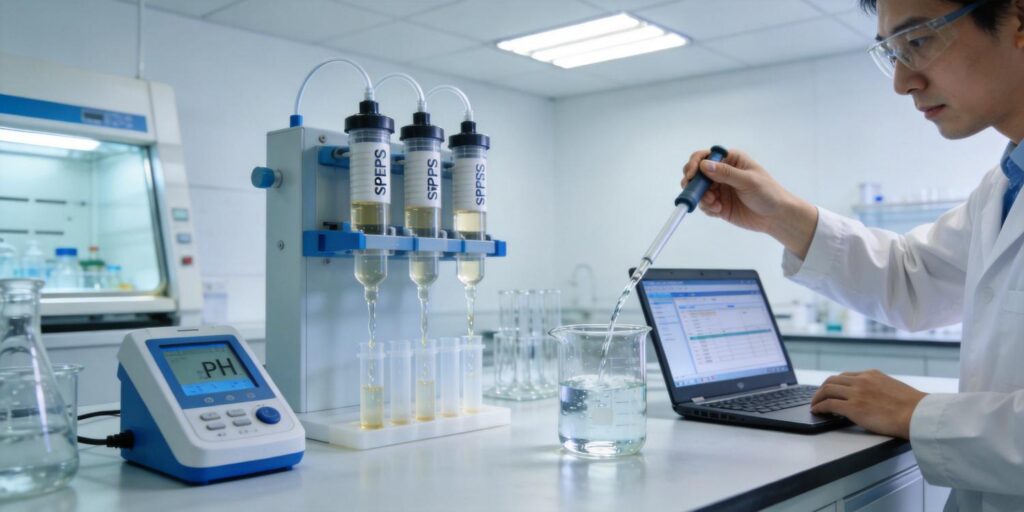
A robust SPE workflow for artificial sweetener analysis in drinking water involves several critical steps optimized for large-volume samples. The following protocol has been validated for 1-liter drinking water samples:
Sample Preparation
Begin with filtration through 0.45 μm glass-fiber filters to remove particulates. Adjust sample pH to 3.0 using hydrochloric acid to suppress ionization of acidic sweeteners. Add appropriate internal standards at this stage to monitor extraction efficiency throughout the process.
SPE Cartridge Conditioning
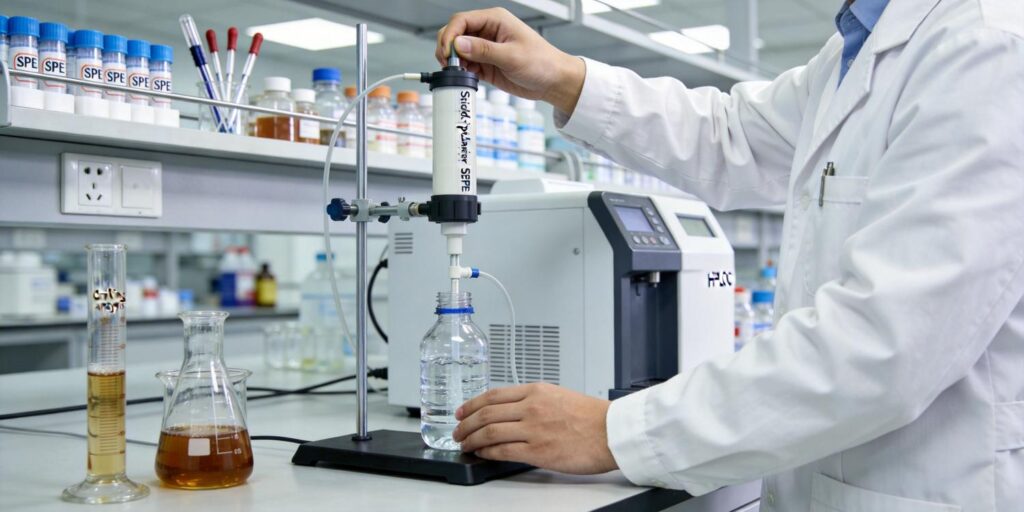
Condition mixed-mode anion exchange cartridges (such as Poseidon Scientific’s WAX cartridges) sequentially with 6 mL methanol, 6 mL deionized water, and 6 mL pH 3.0 water. Maintain a consistent flow rate of 5-10 mL/min during conditioning to ensure proper sorbent activation.
Sample Loading
Load 1-liter samples at controlled flow rates of 10-15 mL/min. For large-volume applications, “a sorbent mass of 1 g has become a standard starting point for SPE method development using reversed-phase sorbents” (Wells, 2000). Monitor for breakthrough by analyzing small fractions of effluent during method development.
Cartridge Washing
After sample loading, wash cartridges with 6 mL of 5% methanol in pH 3.0 water to remove weakly retained interferences while maintaining target analyte retention.
Analyte Elution
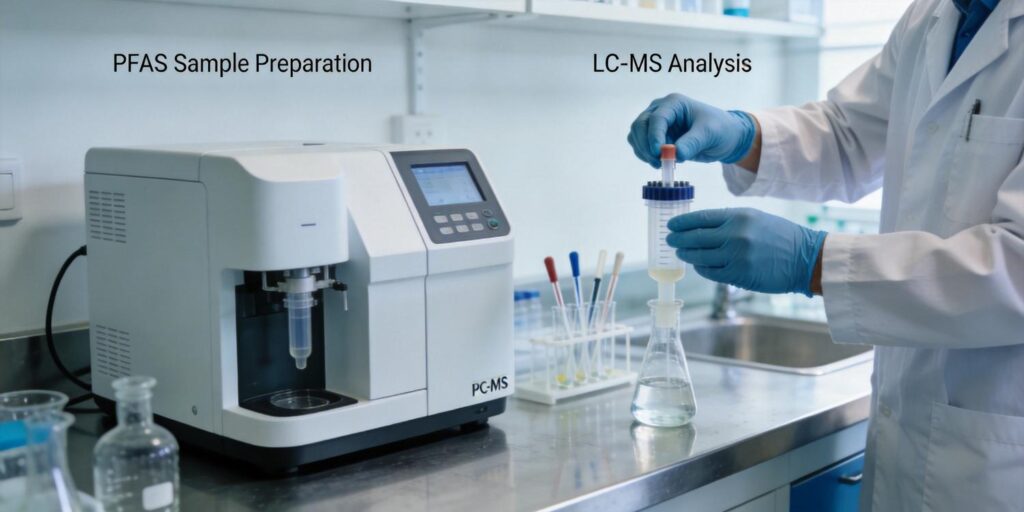
Elute retained sweeteners using 6 mL of 5% ammonium hydroxide in methanol. Collect eluate in calibrated tubes and evaporate to near dryness under gentle nitrogen stream at 40°C. Reconstitute in 1 mL of mobile phase compatible with subsequent LC-MS analysis.
LC-MS Detection Methods
Liquid chromatography-mass spectrometry provides the sensitivity and selectivity required for artificial sweetener detection at environmentally relevant concentrations (ng/L to μg/L). Electrospray ionization in negative mode typically yields optimal sensitivity for sucralose and acesulfame.
Chromatographic Conditions
Utilize reversed-phase columns (C18 or equivalent) with gradient elution using water and methanol, both containing 0.1% formic acid or ammonium acetate buffer. Typical gradients start at 5% organic and increase to 95% over 10-15 minutes, providing adequate separation of sweeteners from matrix interferences.
Mass Spectrometric Detection
Multiple reaction monitoring (MRM) transitions provide the specificity needed for trace-level detection in complex matrices. For sucralose, monitor transitions m/z 395→359 and 395→35; for acesulfame, monitor m/z 162→82 and 162→78. Internal standards (typically deuterated analogs) compensate for matrix effects and instrument variability.
Quality Control Measures
Implement comprehensive quality control including method blanks, laboratory control samples, matrix spikes, and duplicate analyses. As emphasized in SPE methodology, “careful selection of conditions used at this stage will ensure that a minimum of biological debris and inorganic matrix will be co-extracted” (Simpson, 2000).
Environmental Monitoring Significance
The monitoring of artificial sweeteners in drinking water has profound implications for water quality assessment and public health protection. These compounds serve as sensitive indicators of wastewater contamination, often detecting problems before traditional indicators show significant changes.
Source Tracking and Pollution Assessment
Artificial sweetener profiles can help identify contamination sources and pathways. Different usage patterns and metabolic stability create distinctive environmental signatures that support source apportionment studies. Their persistence allows tracking of contamination over extended distances and timeframes.
Treatment Process Evaluation
Monitoring sweetener removal through water treatment processes provides valuable data on treatment efficiency. Their resistance to conventional treatment highlights the need for advanced treatment technologies and informs process optimization decisions.
Regulatory and Public Health Implications
While current regulations don’t specifically address artificial sweeteners in drinking water, their presence signals potential co-contamination with pharmaceuticals, personal care products, and other emerging contaminants. This information supports proactive water management and informs future regulatory developments.
Research and Method Development
The analysis of artificial sweeteners continues to drive advances in environmental analytical chemistry. As noted in SPE literature, “the need for a greater understanding of the requirements of an SPE extraction have resulted in the approach explored by Hannah et al. (1987) using factorial design for simultaneous investigation of multiple variables” (Simpson, 2000). This methodological rigor ensures reliable data for environmental decision-making.
For laboratories implementing artificial sweetener monitoring programs, Poseidon Scientific offers specialized SPE products including WAX cartridges and 96-well SPE plates optimized for polar compound extraction. These products, combined with proper method development and quality control, enable reliable detection of artificial sweeteners at environmentally relevant concentrations, supporting comprehensive water quality assessment programs.