Sources of Personal Care Product Contaminants in Coastal Waters
Personal care products (PCPs) represent a significant class of emerging contaminants in coastal environments, with their presence primarily attributed to wastewater discharge pathways. These compounds enter aquatic systems through multiple routes: direct discharge from wastewater treatment plants (WWTPs) that often incompletely remove PCPs, recreational activities such as swimming and bathing in coastal areas, and runoff from urban and residential areas during rainfall events.
The persistence of these contaminants in marine environments is particularly concerning due to their continuous introduction and potential for bioaccumulation. Unlike traditional pollutants that may have point sources, PCP contamination represents a diffuse, ongoing challenge for environmental monitoring programs. Coastal waters near densely populated areas and popular tourist destinations typically show higher concentrations of these compounds, reflecting their anthropogenic origins and the limitations of current wastewater treatment technologies.
Target Analytes: UV Filters and Fragrances
Among the numerous PCP contaminants, UV filters and synthetic fragrances have emerged as priority analytes due to their widespread use, environmental persistence, and potential ecological effects. Common UV filters include organic compounds such as benzophenone-3 (oxybenzone), octocrylene, and 4-methylbenzylidene camphor, which are designed to absorb UV radiation but can exhibit endocrine-disrupting properties in aquatic organisms.
Synthetic fragrances, particularly polycyclic musks (galaxolide and tonalide) and nitro musks, represent another critical class of PCP contaminants. These compounds are extensively used in perfumes, cosmetics, and cleaning products, and their lipophilic nature facilitates bioaccumulation in marine organisms. The analytical challenge lies in detecting these compounds at trace levels (ng/L to μg/L) in complex saline matrices while distinguishing them from natural organic matter and other anthropogenic contaminants.
SPE Sorbent Selection for Hydrophobic Compounds
Solid-phase extraction (SPE) represents the cornerstone methodology for concentrating and isolating PCP contaminants from coastal water samples. The selection of appropriate sorbent chemistry is critical for achieving optimal recovery and minimizing matrix effects. For hydrophobic PCP compounds like UV filters and fragrances, reversed-phase sorbents offer the most effective retention mechanism through hydrophobic interactions.
According to Waters Oasis documentation, Oasis HLB (Hydrophilic-Lipophilic Balanced) sorbent represents the gold standard for such applications. This water-wettable polymeric sorbent provides several advantages for coastal water analysis:
- High capacity for hydrophobic compounds: The balanced hydrophilic-lipophilic nature ensures effective retention of both polar and non-polar PCP contaminants
- pH stability (0-14): Allows flexibility in sample pH adjustment to optimize compound retention
- No conditioning required: Unlike traditional silica-based sorbents, Oasis HLB can be used without conditioning and equilibration steps, simplifying protocols and reducing solvent consumption by up to 70%
- Compatibility with saline matrices: The polymeric structure maintains performance in high-salt environments typical of coastal waters
For particularly challenging matrices or when enhanced selectivity is required, mixed-mode sorbents like Oasis MAX (Mixed-mode Anion eXchange) or Oasis MCX (Mixed-mode Cation eXchange) can provide orthogonal retention mechanisms. However, for most hydrophobic PCP contaminants in coastal waters, Oasis HLB offers the optimal balance of recovery, simplicity, and cost-effectiveness.
Example Coastal Water Extraction Workflow
A robust SPE workflow for PCP analysis in coastal waters typically follows these optimized steps:
1. Sample Preparation
Collect 1L coastal water samples in pre-cleaned glass containers. Filter through 0.45μm glass fiber filters to remove particulate matter. Adjust pH to 7.0 using dilute HCl or NaOH as needed. Add appropriate internal standards (deuterated analogs of target compounds) to monitor extraction efficiency.
2. SPE Procedure Using Oasis HLB
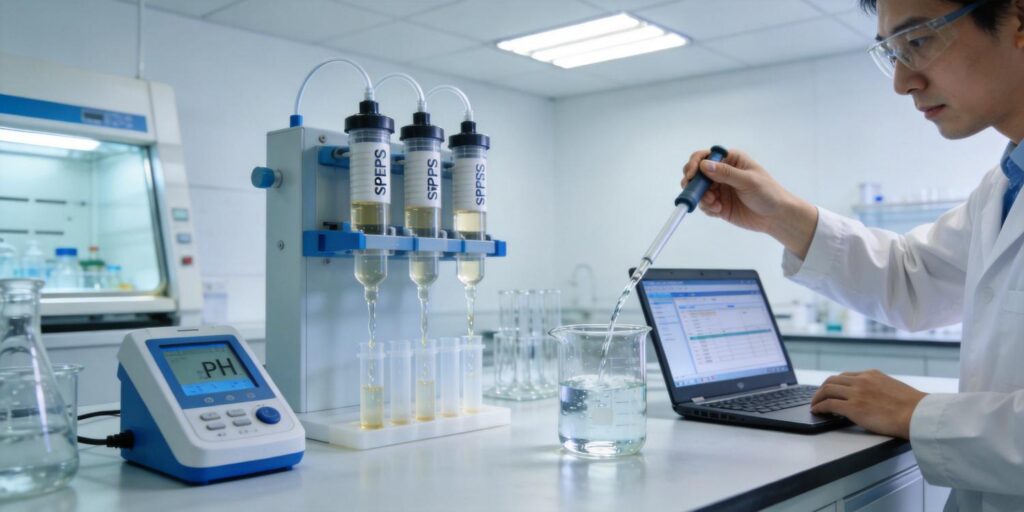
Utilize Oasis HLB cartridges (typically 6cc/500mg for 1L samples) following this simplified protocol:
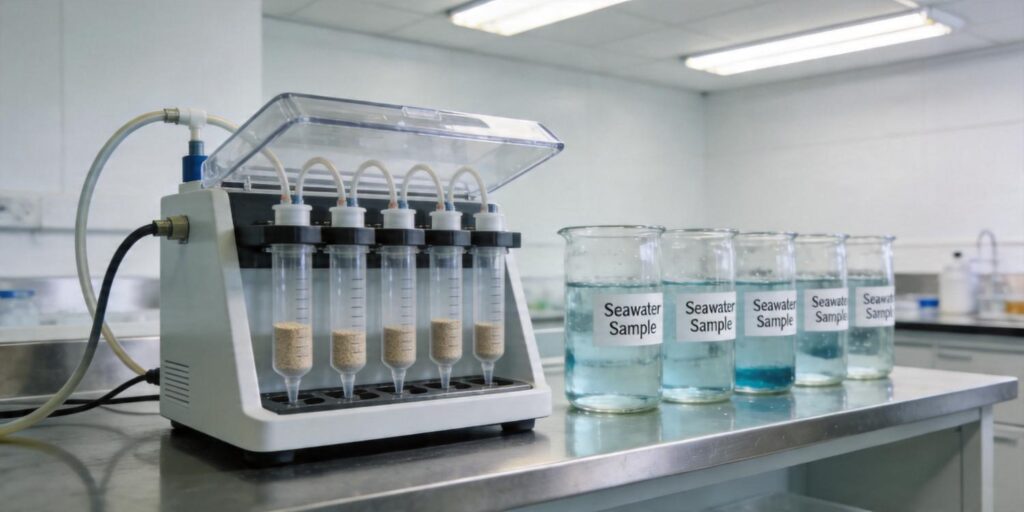
- Load sample: Pass the entire 1L sample through the cartridge at a controlled flow rate of 5-10 mL/min using a vacuum manifold
- Wash step: Rinse with 5-10 mL of 5% methanol in water to remove weakly retained matrix components
- Dry cartridge: Apply vacuum for 10-15 minutes to remove residual water
- Elution: Elute retained compounds with 2 × 5 mL of methanol or methanol:acetonitrile (90:10) mixture
3. Extract Concentration
Evaporate eluate to near dryness under gentle nitrogen stream at 40°C. Reconstitute in 1 mL of methanol:water (50:50) for LC-MS/MS analysis. This 1000-fold concentration factor enables detection at environmentally relevant levels.
LC-MS/MS Analysis of Contaminants
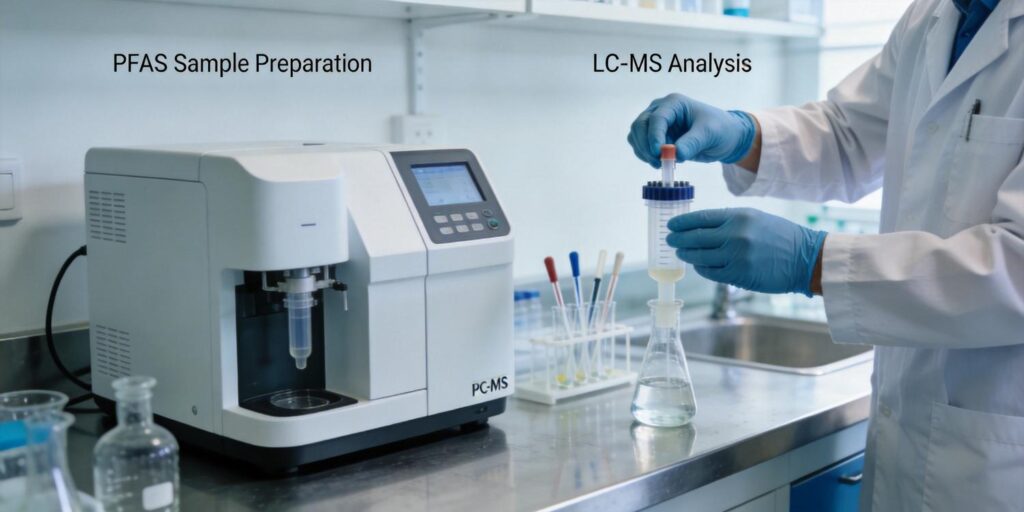
Liquid chromatography coupled with tandem mass spectrometry (LC-MS/MS) represents the analytical method of choice for PCP contaminant detection due to its superior sensitivity, selectivity, and ability to handle complex matrices. The analysis typically employs:
Chromatographic Conditions
Reverse-phase C18 column (100 × 2.1 mm, 1.7μm particle size) with gradient elution using water and methanol (both containing 0.1% formic acid). The gradient typically starts at 10% methanol, increasing to 95% over 15 minutes, followed by column re-equilibration.
Mass Spectrometric Detection
Electrospray ionization (ESI) in positive or negative mode depending on target compounds. Multiple reaction monitoring (MRM) transitions are optimized for each analyte, with two transitions per compound for confirmation. Typical instrument parameters include capillary voltage of 3.5 kV, source temperature of 150°C, and desolvation temperature of 500°C.
Quality Assurance
Method validation includes determination of method detection limits (typically 0.1-10 ng/L), precision (RSD 0.995). Matrix-matched calibration standards and procedural blanks are essential for accurate quantification in saline matrices.
Environmental Monitoring Significance
The development of robust SPE-LC-MS/MS methods for PCP contaminants in coastal waters addresses several critical environmental monitoring needs:
Ecological Risk Assessment
Accurate quantification of PCP contaminants enables proper assessment of their potential impacts on marine ecosystems. Many UV filters and fragrances exhibit endocrine-disrupting properties at environmentally relevant concentrations, potentially affecting reproduction and development in aquatic organisms.
Wastewater Treatment Evaluation
Monitoring PCP levels in coastal receiving waters provides indirect assessment of wastewater treatment efficiency. Spatial and temporal trends can identify areas requiring improved treatment technologies or highlight seasonal variations in contaminant loading.
Regulatory Framework Development
Reliable analytical data supports the establishment of environmental quality standards and regulatory limits for PCP contaminants. Several jurisdictions are considering or have implemented restrictions on specific UV filters in response to coral bleaching concerns.
Source Apportionment
Compound-specific profiles can help identify dominant contamination sources (e.g., residential vs. recreational inputs) and guide targeted mitigation strategies.
Long-term Monitoring
Establishing baseline concentrations and monitoring trends over time provides valuable data for assessing the effectiveness of pollution prevention measures and regulatory interventions.
The combination of optimized SPE using advanced sorbents like Oasis HLB with sensitive LC-MS/MS detection represents a powerful approach for addressing the analytical challenges posed by PCP contaminants in coastal environments. This methodology not only provides the sensitivity required for trace-level detection but also the robustness needed for routine monitoring programs in complex saline matrices.
For laboratories implementing these methods, careful attention to sorbent selection, sample preparation protocols, and quality assurance measures ensures reliable data generation that can inform environmental management decisions and protect coastal ecosystems from emerging contaminant threats.