Plasma Cleaning Process Overview
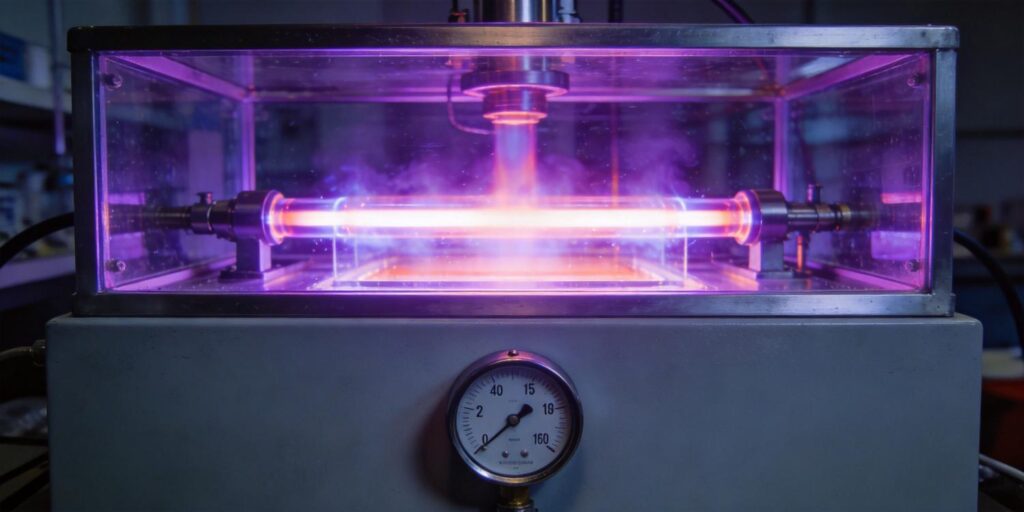
Plasma cleaning is a highly effective, dry process used to remove organic contaminants, oxides, and particulates from surfaces prior to bonding, coating, or assembly. In semiconductor fabrication, medical-device manufacturing, optics, and aerospace applications, plasma cleaning ensures superior adhesion and cleanliness without the use of hazardous solvents. The typical cycle begins with chamber evacuation to a stable base pressure, followed by controlled introduction of process gas (commonly oxygen, argon, or forming gas). Once pressure stabilizes in the 0.05–1 Torr range, RF or DC power ignites a low-temperature glow-discharge plasma that bombards the workpiece with ions and reactive species, breaking down contaminants into volatile by-products that are pumped away.
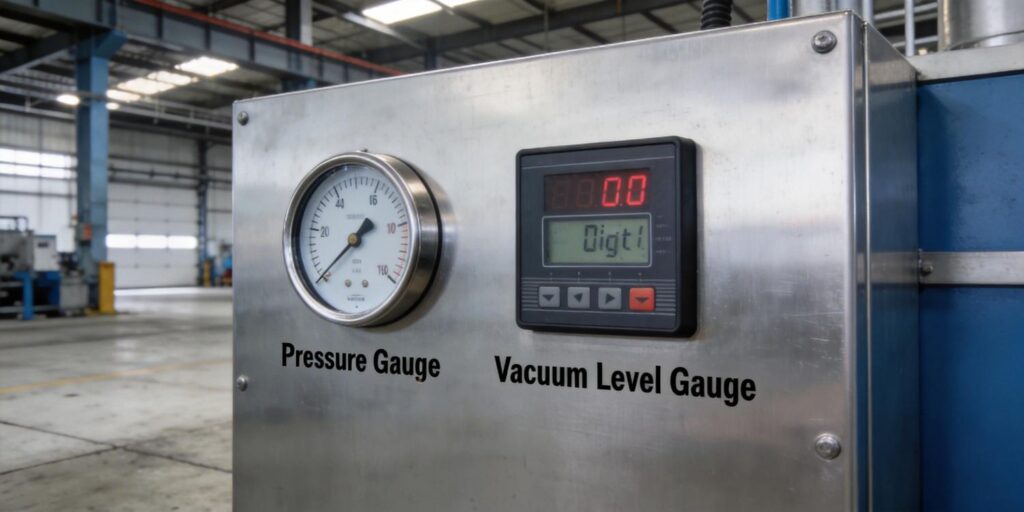
Process repeatability depends on precise vacuum control at every stage. Even minor pressure excursions can cause non-uniform plasma density, arcing, or re-deposition of contaminants. Poseidon Scientific’s VG-SP205 Pirani Vacuum Transmitter and VG-SM225 Cold Cathode Vacuum Gauge are engineered to provide the layered monitoring required for reliable plasma cleaning. The Pirani handles the dynamic mid-range pressures where gas flow and plasma ignition occur, while the cold cathode verifies the critical base-pressure condition before gas introduction—delivering the accuracy, speed, and serviceability that plasma-system OEMs and end users demand.
Required Pressure Range
Plasma cleaning operates across two distinct vacuum regimes. Initial evacuation must reach a stable base pressure below 10⁻³ Torr to remove residual air and moisture. Process gas is then introduced to raise chamber pressure to the operational window of 0.05–1 Torr, where the mean free path supports a stable, uniform glow discharge. Pressures below 0.01 Torr produce insufficient ionization; pressures above 2 Torr risk arcing and poor uniformity.
The VG-SP205 Pirani Vacuum Transmitter is optimized for exactly this mid-range window. Its platinum-filament thermal-conductivity design delivers fast response (<50 ms) and high linearity from 10 Torr down to 10⁻³ Torr, with best performance in the 1–0.01 Torr band where plasma is ignited and maintained. Once the process gas flow is established, the gauge provides the continuous feedback needed for closed-loop pressure control. For final base-pressure verification before gas admission, the VG-SM225 Cold Cathode Vacuum Gauge takes over in the 10⁻³ to 10⁻⁷ Torr range, confirming that outgassing has stabilized and the chamber is ready for plasma ignition.
Gas Flow Stability
Stable gas flow is essential for repeatable plasma chemistry and etch rate. Mass-flow controllers regulate inlet gas, but chamber pressure must remain constant despite variations in pumping speed or outgassing. Small fluctuations (±10 %) can shift plasma density, leading to non-uniform cleaning or substrate damage.
The VG-SP205 Pirani Vacuum Transmitter excels here because its heat-transfer principle responds almost instantaneously to pressure changes caused by flow variations. Engineers route the 0–10 V analog output directly to the mass-flow controller or PLC for real-time PID adjustment, maintaining pressure within ±0.01 Torr of setpoint. The customizable RS232 digital output allows simultaneous high-resolution logging, enabling trend analysis of flow stability over long production runs. This closed-loop capability reduces process variability and extends the service life of expensive components such as RF generators and matching networks.
Pirani Monitoring Before Plasma Ignition
Before RF or DC power is applied, the chamber must be confirmed free of excessive residual gas or moisture that could cause arcing or inconsistent plasma ignition. The VG-SP205 Pirani Vacuum Transmitter provides continuous monitoring during pump-down and gas introduction, delivering repeatable readings across the critical 10 Torr to 10⁻³ Torr transition. Its temperature-compensated circuitry maintains accuracy between 15 °C and 50 °C—typical of cleanroom and production-floor environments—while the maintenance-free platinum filament tolerates the occasional vapor load introduced during part loading.
Built-in rate-of-change alarms on the Pirani channel can detect unexpected pressure spikes from outgassing or minor leaks, automatically pausing the cycle before plasma ignition. This early warning capability prevents costly substrate damage and reduces scrap rates. Because the Pirani requires no high-voltage startup and operates continuously, it serves as the primary gauge for the entire pre-ignition phase, simplifying control logic and minimizing sensor wear.
Cold Cathode for Process Verification
Once process pressure is established and plasma is ignited, many advanced plasma-cleaning recipes require periodic verification that the base vacuum condition remains intact between cycles. The VG-SM225 Cold Cathode Vacuum Gauge provides this confirmation with stable Penning-discharge readings from 10⁻³ Torr down to 10⁻⁷ Torr. Its positive-magnetron design with ~100 gauss field and automatic voltage sequencing (–2500 V startup to –2000 V operation) ensures reliable operation even after repeated plasma exposure.
During process verification pauses, the cold cathode quickly confirms that outgassing has not increased and that the chamber has returned to the required base pressure before the next gas-flow step. The modular sensor head can be cleaned on-site if minor sputtered material accumulates, eliminating the need for full-gauge replacement. This field-serviceable architecture keeps maintenance costs low while preserving measurement integrity throughout thousands of plasma cycles.
Preventing Contamination
Plasma environments generate energetic ions and UV radiation that can sputter material onto gauge surfaces. To protect sensors, Poseidon recommends mounting both gauges out of direct line-of-sight of the plasma zone—typically on a side port or behind a simple baffle—while preserving adequate conductance. Short isolation tubing or KF flanges with Kalrez O-rings further reduce direct vapor exposure during part loading or cleaning-gas introduction.
The VG-SP205 Pirani’s chemically stable platinum filament resists oxidation and contamination far better than tungsten alternatives, while the VG-SM225’s detachable sensor head allows quick on-site electrode polishing with 500-mesh abrasive paper. These design features ensure long-term stability even in aggressive oxygen-plasma environments, minimizing drift and extending calibration intervals.
Maintenance Schedule
Routine maintenance keeps plasma-cleaning systems running at peak performance. The VG-SP205 Pirani requires virtually no routine service—its maintenance-free architecture and 3–5 year typical lifespan in clean service make it ideal for 24/7 production. Annual verification against a reference gauge at three pressure points (atmosphere, 1 Torr, 10⁻² Torr) is sufficient to confirm calibration.
The VG-SM225 Cold Cathode follows an environment-dependent schedule. In typical plasma-cleaning service, electrode inspection and cleaning every 12–18 months (or after 5,000 operating hours) restores full performance. The modular head design allows technicians to perform this task in minutes without breaking the chamber vacuum seal. Poseidon provides illustrated quick-start cards and status-code references with every unit, enabling service teams to maintain both gauges with minimal training and downtime.
Conclusion: Reliable Vacuum Monitoring for Consistent Plasma Cleaning
Plasma cleaning systems demand accurate, responsive vacuum measurement across the full cycle—from base-pressure verification to stable mid-range process control. Poseidon Scientific’s VG-SP205 Pirani Vacuum Transmitter delivers fast, linear monitoring before and during plasma ignition, while the VG-SM225 Cold Cathode Vacuum Gauge provides dependable high-vacuum confirmation and process verification. Together they ensure gas-flow stability, prevent contamination, and support the tight process windows required for repeatable, high-yield cleaning results.
Engineers and procurement teams benefit from gauges engineered specifically for real-world plasma environments: compact footprints, field-serviceable designs, temperature compensation, and fully customizable RS232 protocols that integrate seamlessly with existing controllers. By selecting the right combination, manufacturers reduce scrap, improve throughput, and lower total cost of ownership compared with legacy instrumentation.
Ready to optimize vacuum monitoring in your plasma cleaning systems? Contact Poseidon Scientific today for a no-obligation application review, custom interlock configuration, or sample units. Our team—led by the engineers who designed the VG-SP205 and VG-SM225—will deliver a tailored monitoring package that fits your chamber layout, gas chemistry, and control architecture.
Explore the full specifications of the VG-SP205 Pirani Vacuum Transmitter for mid-range monitoring or the VG-SM225 Cold Cathode Vacuum Gauge for high-vacuum verification and take the next step toward more consistent, contamination-free plasma cleaning performance.