Common Food Preservatives: Benzoates and Sorbates
Food preservatives are essential additives that prevent spoilage and extend shelf life, with benzoates and sorbates being among the most widely used organic acid preservatives. Sodium benzoate (E211) and potassium sorbate (E202) are particularly common in beverages, sauces, dressings, and processed foods due to their effectiveness against yeasts, molds, and bacteria.
These preservatives function through their acidic forms—benzoic acid (pKa 4.2) and sorbic acid (pKa 4.76)—which can penetrate microbial cell membranes in their undissociated forms under acidic conditions. Their widespread use necessitates accurate analytical methods to ensure compliance with regulatory limits and to monitor potential health concerns.
Matrix Interference Challenges: Sugars and Acids
Food matrices present significant analytical challenges due to complex interference from sugars, organic acids, pigments, and other matrix components. As noted in the literature, “the matrix, though still likely to contain plant sugars, acids and colorants, does not contain the co-formulated excipients and therefore does not present many of the problems associated with them” (Simpson & Wynne, 2000).
Sugars like glucose, fructose, and sucrose can cause matrix effects in chromatographic analysis and may interfere with preservative detection. Organic acids naturally present in foods—such as citric, malic, and tartaric acids—share similar chemical properties with preservatives, complicating selective extraction. Additionally, food colorants, caramel, and other additives can interfere with both UV detection and mass spectrometry analysis.
SPE Sorbent Selection for Organic Acid Preservatives
Selecting the appropriate SPE sorbent is critical for successful preservative analysis. The choice depends on the preservative’s chemical properties, matrix composition, and analytical requirements.
Reversed-Phase Sorbents (C18, C8, HLB)
For hydrophobic preservatives like parabens (methyl- and propyl-p-hydroxybenzoate), reversed-phase sorbents are effective. Research demonstrates that “using a C-18 sorbent and dissolving the cream sample in aqueous medium (20% v/v methanol), the hydrophobic parabens were completely retained” (Bonazzi et al., 1995). Hydrophilic-lipophilic balance (HLB) sorbents offer broader retention capabilities for both polar and non-polar compounds.
Ion-Exchange Sorbents (MAX, WAX, WCX, MCX)
For ionic preservatives like benzoates and sorbates, mixed-mode ion-exchange sorbents provide superior selectivity. Strong anion exchange (SAX) sorbents effectively retain acidic preservatives in their ionized forms. As documented, “ion-exchange methodology also proved to be suitable for the clean-up of cream samples containing hydrophobic, acidic drugs such as Ketoprofen (pKa=5.9) and Ibuprofen (pKa=5.2)” (Bonazzi et al., 1995).
The Waters Oasis strategy recommends specific sorbents based on analyte pKa: for weak acids (pKa 2-8), use Oasis MAX; for strong acids (pKa 10), use Oasis WCX.
Copolymeric Sorbents
For complex food matrices, copolymeric sorbents combining reversed-phase and ion-exchange mechanisms offer enhanced cleanup. These sorbents “work by providing separation of the acid/neutral drugs using reversed phase C8 functionality; the benzene sulfonic acid mechanism works on basic drugs by cation exchange of the amine functionalities” (Telepchak et al., 2004).
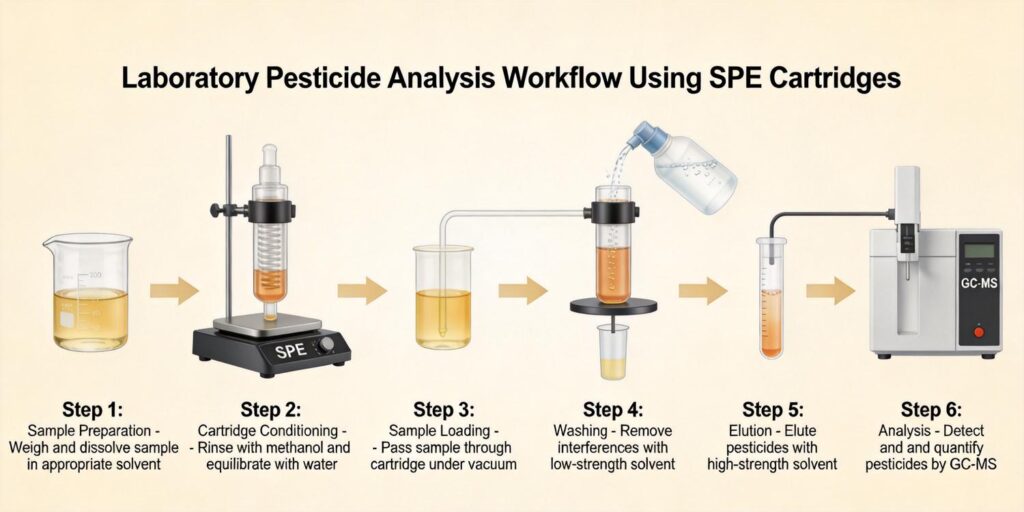
Example Extraction and Cleanup Workflow
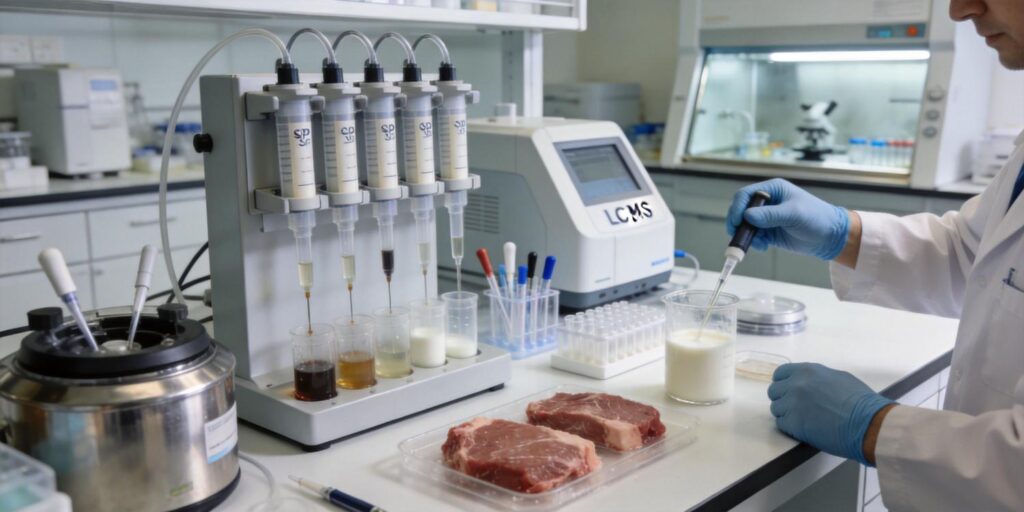
A comprehensive SPE workflow for food preservative analysis typically follows these optimized steps:
1. Sample Preparation
Homogenize 5-10g of food sample with appropriate extraction solvent (typically acidified methanol-water or acetonitrile-water). For beverages, simple dilution or pH adjustment may suffice. Centrifuge or filter to remove particulates.
2. SPE Cartridge Conditioning
Condition the selected sorbent (e.g., Oasis MAX for benzoates/sorbates) with 3-5mL methanol followed by 3-5mL water or appropriate buffer. Maintain sorbent wetness throughout the process.
3. Sample Loading
Load the prepared sample at controlled flow rates (1-3 mL/min). For acidic preservatives, adjust sample pH to 2-3 units above their pKa to ensure ionization and optimal retention on anion-exchange sorbents.
4. Washing Steps
Wash with 3-5mL of 5% methanol in water to remove sugars and polar interferences. Follow with 2-3mL of appropriate buffer to eliminate matrix components while retaining target analytes.
5. Elution
Elute preservatives with 3-5mL of acidified organic solvent (e.g., 2% formic acid in methanol for anion-exchange sorbents). Collect eluate in minimal volume for concentration if necessary.
6. Post-Processing
Evaporate eluate to dryness under gentle nitrogen stream and reconstitute in mobile phase compatible with subsequent HPLC or LC-MS analysis.
HPLC and LC-MS Analysis of Preservatives
Following SPE cleanup, chromatographic analysis provides the specificity and sensitivity required for preservative quantification.
HPLC-UV Analysis
Reverse-phase HPLC with UV detection at 230-254nm is commonly employed for preservative analysis. Typical conditions include:
- Column: C18 (150 × 4.6mm, 5μm)
- Mobile phase: Gradient of acidified water and acetonitrile
- Flow rate: 1.0mL/min
- Injection volume: 10-20μL
- Detection: UV at 230nm for benzoates, 254nm for sorbates
LC-MS/MS Analysis
For enhanced sensitivity and specificity, especially in complex matrices, LC-MS/MS is preferred:
- Ionization: Electrospray ionization (ESI) in negative mode
- MRM transitions: m/z 121→77 for benzoate, m/z 111→67 for sorbate
- Column: HILIC or polar-embedded C18 for improved retention
- Mobile phase: Ammonium acetate/acetonitrile or formic acid/methanol systems
The SPE cleanup significantly reduces matrix effects, improving both HPLC and LC-MS performance. As noted in SPE optimization literature, “ionic bonds are strong enough to allow the analyte to remain bound while interferences are washed away with high percentages (up to 100%) of polar or nonpolar organic solvents” (Telepchak et al., 2004).
Regulatory Testing Applications
SPE-based methods are essential for regulatory compliance testing across global food safety frameworks.
Maximum Residue Limits (MRLs)
Regulatory bodies including FDA, EFSA, and Codex Alimentarius establish MRLs for preservatives in various food categories. SPE methods enable laboratories to achieve the required detection limits (typically 1-10mg/kg) with adequate precision and accuracy.
Method Validation Requirements
Validated SPE-HPLC/LC-MS methods must demonstrate:
- Recovery: 70-120% across relevant concentration ranges
- Precision: RSD <15% for repeatability and reproducibility
- Linearity: R² >0.995 over calibration range
- Limit of detection: Typically 0.1-1mg/kg depending on matrix
- Selectivity: No interference from matrix components
International Standards
Standardized methods incorporating SPE include:
- AOAC Official Methods for preservatives in various foods
- ISO methods for food additive analysis
- FDA Bacteriological Analytical Manual (BAM) procedures
- EU Reference Laboratories (EURL) validated methods
Quality Control Applications
Beyond regulatory testing, SPE methods support quality control in food manufacturing for:
- Batch-to-batch consistency monitoring
- Supplier qualification and raw material testing
- Shelf-life studies and stability testing
- Troubleshooting production issues
The integration of efficient SPE cleanup with modern analytical instrumentation provides food laboratories with robust, reliable methods for preservative analysis. As SPE technology continues to evolve with innovations like water-wettable sorbents and simplified protocols, these methods will remain essential tools for ensuring food safety and quality in an increasingly regulated global marketplace.
For laboratories seeking optimized SPE solutions for food preservative analysis, HLB SPE cartridges offer excellent reversed-phase performance, while MAX SPE cartridges provide superior anion-exchange capabilities for acidic preservatives like benzoates and sorbates. High-throughput laboratories may benefit from 96-well SPE plates for increased productivity in routine testing applications.