Overview of PFAS Contamination Concerns
Per- and polyfluoroalkyl substances (PFAS) represent a growing environmental crisis that has captured global regulatory attention. These synthetic chemicals, characterized by their strong carbon-fluorine bonds, exhibit exceptional persistence in the environment and bioaccumulation potential. PFAS contamination in water sources stems from decades of industrial use in firefighting foams, non-stick coatings, water-repellent fabrics, and food packaging materials. The environmental persistence of these compounds is particularly concerning, with some PFAS having half-lives measured in years or even decades in environmental matrices.
Recent studies have documented PFAS contamination in groundwater, surface water, and even drinking water supplies worldwide. The health implications are significant, with epidemiological evidence linking PFAS exposure to various adverse effects including thyroid disease, elevated cholesterol, immune system suppression, and certain cancers. Regulatory agencies have responded with increasingly stringent guidelines, with some jurisdictions establishing advisory levels in the low parts-per-trillion (ppt) range, necessitating advanced analytical approaches for reliable detection and quantification.
Challenges of Ultra-Trace PFAS Detection
The analytical challenges associated with PFAS detection are formidable, primarily due to their ultra-trace concentration requirements and ubiquitous presence in laboratory environments. As noted in environmental analytical literature, “the trace enrichment aspect of SPE lends itself very well to the extraction of liquids, especially clean samples such as drinking water or groundwater” (Simpson, 2000). However, PFAS present unique complications:
Low Regulatory Limits
Current regulatory guidelines for PFAS often fall in the 1-70 ppt range, requiring exceptional sensitivity from analytical instrumentation. This necessitates effective pre-concentration methods that can handle large sample volumes while maintaining analyte integrity.
Background Contamination
PFAS are ubiquitous in laboratory environments, present in common materials like PTFE tubing, certain plastics, and even some laboratory clothing. This creates significant challenges for achieving reliable blank values and method detection limits.
Matrix Effects
Environmental water samples contain various interfering compounds including humic acids, fulvic acids, and other dissolved organic matter that can compete with PFAS for binding sites during extraction and potentially suppress ionization during mass spectrometric analysis.
SPE Sorbents Used for PFAS Extraction
Selecting appropriate solid-phase extraction sorbents is critical for successful PFAS analysis. The choice depends on the specific PFAS compounds targeted and the sample matrix characteristics.
Weak Anion Exchange (WAX) Sorbents
WAX sorbents have emerged as the gold standard for comprehensive PFAS analysis. These sorbents contain quaternary amine functional groups that provide strong anion exchange capabilities, particularly effective for capturing anionic PFAS compounds. The retention mechanism involves both hydrophobic interactions and ionic bonding, allowing for selective extraction of PFAS from complex matrices. Research demonstrates that “polymeric sorbents with high specific surface areas” show excellent performance for polar contaminants (Guenu & Hennion, 1996).
Mixed-Mode Anion Exchange Sorbents
Mixed-mode sorbents combine reversed-phase and anion exchange functionalities, offering versatile retention mechanisms. These are particularly useful for capturing both anionic and neutral PFAS compounds in a single extraction step. The dual retention mechanism provides enhanced selectivity and cleaner extracts compared to single-mode sorbents.
Carbon-Based Sorbents
Graphitized carbon black and activated carbon sorbents offer strong retention for highly fluorinated compounds through strong hydrophobic interactions. However, they may require more aggressive elution conditions and can exhibit irreversible adsorption for some PFAS compounds.
Polymeric Sorbents
Hydrophilic-lipophilic balanced (HLB) polymers provide excellent retention for a wide range of PFAS through multiple interaction mechanisms including hydrogen bonding, dipole-dipole interactions, and hydrophobic effects. These sorbents are particularly effective for capturing shorter-chain PFAS that may be poorly retained by traditional C18 phases.
Large-Volume Water Enrichment Procedures
Effective PFAS analysis requires processing substantial water volumes to achieve necessary pre-concentration factors. Standard procedures typically involve 250-1000 mL samples, though larger volumes may be required for ultra-trace analysis.
Sample Preservation and Preparation
Immediate preservation with ammonium acetate buffer (pH 4-5) is essential to maintain PFAS stability and prevent adsorption to container walls. Filtration through 0.45 μm glass fiber filters removes particulate matter that could clog SPE cartridges, though care must be taken to avoid PFAS contamination from filter materials.
SPE Cartridge Conditioning
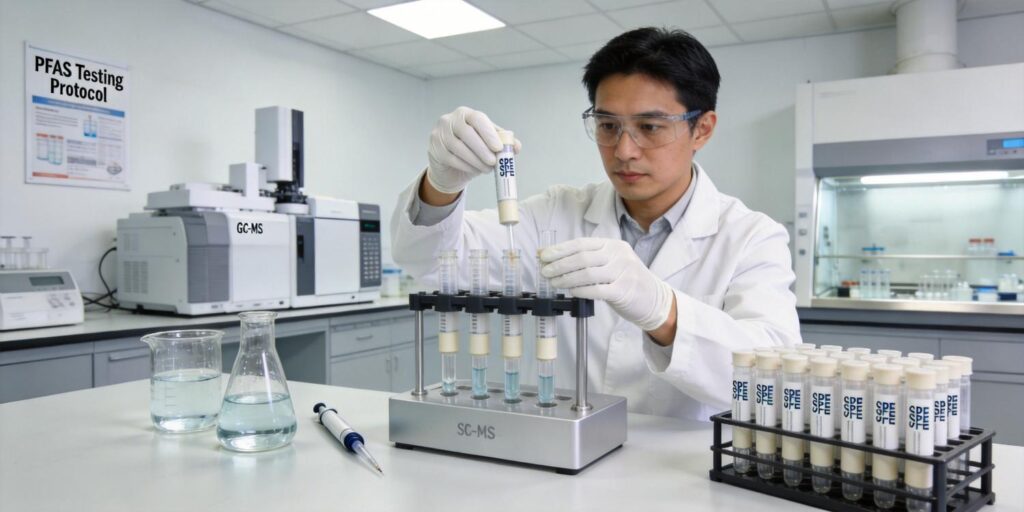
Proper conditioning is critical for reproducible PFAS recovery. A typical protocol involves sequential conditioning with methanol (or acetonitrile) followed by pH-adjusted water or buffer. As noted in SPE methodology, “preconditioning prepares the cartridge to accept the sample” (Agilent SPE Guide). For WAX cartridges, conditioning with methanol containing 0.1% ammonium hydroxide followed by pH 4 buffer has proven effective.
Sample Loading and Flow Control
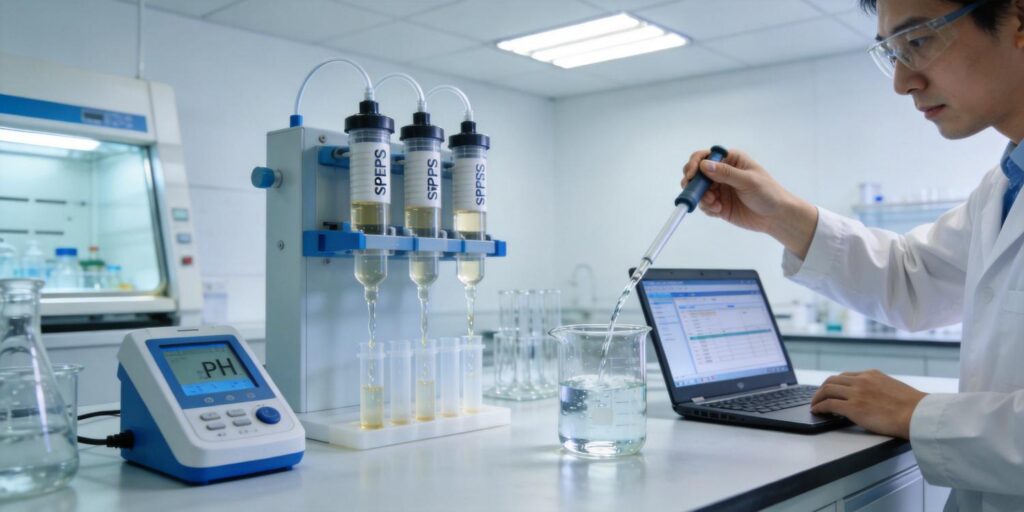
Maintaining consistent flow rates during sample loading is crucial for quantitative recovery. Flow rates of 5-10 mL/min are typically recommended for optimal analyte retention. Automated SPE systems provide superior reproducibility for large-volume samples compared to manual methods.
Wash and Elution Optimization
Post-loading washes with pH 4 buffer containing 25% methanol effectively remove interfering compounds while retaining PFAS. Elution typically employs methanol containing 0.1% ammonium hydroxide, with studies showing that “elution solvent strength must be carefully optimized” to ensure complete PFAS recovery while minimizing co-extraction of interferences.
Avoiding Background Contamination During SPE
Background contamination represents one of the most significant challenges in PFAS analysis, requiring rigorous procedural controls.
Laboratory Material Selection
Avoid all fluoropolymer materials including PTFE, FEP, and PFA in sample handling and processing. Use polypropylene or high-density polyethylene containers, glass fiber filters, and stainless steel or PEEK tubing. Even seemingly innocuous materials like certain brands of laboratory tape can contain fluorinated compounds.
Reagent and Solvent Purity
All solvents and reagents must be PFAS-free or demonstrated to contain PFAS at levels below method detection limits. Methanol and acetonitrile should be HPLC-grade from reputable suppliers with PFAS testing certificates. Water should be purified through systems with activated carbon and reverse osmosis stages.
Procedural Blanks
Include procedural blanks with every batch of samples, processed identically to environmental samples. These blanks should demonstrate PFAS levels below reporting limits. Elevated blank values necessitate investigation and potential replacement of contaminated materials or reagents.
Laboratory Environment Controls
Designate PFAS-free work areas with restricted access. Implement dedicated glassware, pipettes, and equipment for PFAS analysis. Regular surface wipes and air monitoring can help identify contamination sources before they affect analytical results.
LC-MS/MS Analytical Considerations
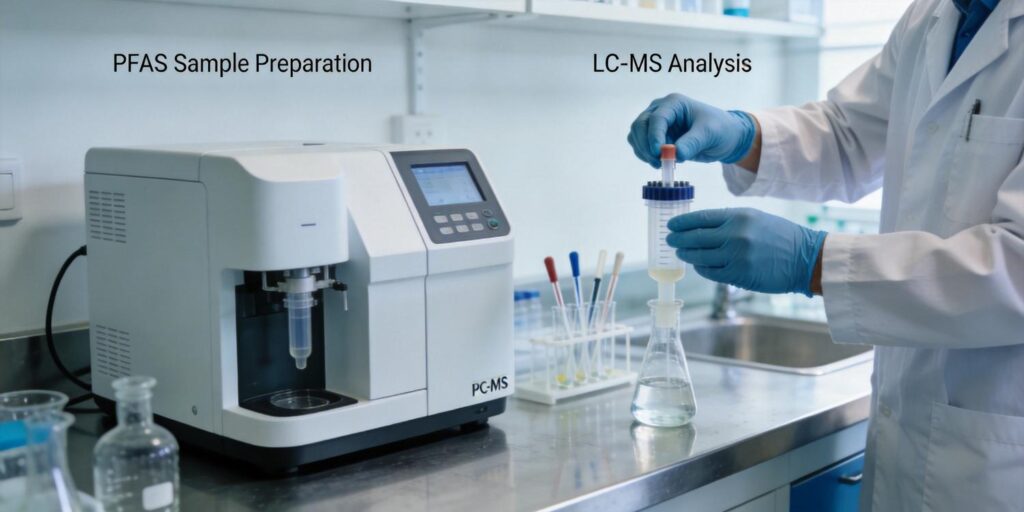
Liquid chromatography coupled with tandem mass spectrometry (LC-MS/MS) represents the analytical method of choice for PFAS determination, offering the necessary sensitivity and selectivity for ultra-trace analysis.
Chromatographic Separation
Reverse-phase chromatography using C18 or phenyl-hexyl columns provides adequate separation for most PFAS compounds. Mobile phase optimization typically involves methanol or acetonitrile with ammonium acetate or formate buffers. Gradient elution programs must be carefully optimized to separate isomeric PFAS compounds and minimize matrix effects.
Mass Spectrometric Detection
Electrospray ionization in negative ion mode provides optimal sensitivity for anionic PFAS. Multiple reaction monitoring (MRM) transitions should be carefully selected for each target compound, with at least two transitions monitored for confirmatory analysis. Instrument parameters must be optimized to minimize in-source fragmentation while maintaining adequate sensitivity.
Matrix Effects and Compensation
Ion suppression represents a significant challenge in PFAS analysis, particularly for complex environmental matrices. Isotopically labeled internal standards for each target PFAS provide the most effective compensation for matrix effects and recovery variations. Standard addition methods or matrix-matched calibration may be necessary for particularly challenging matrices.
Quality Assurance Protocols
Comprehensive quality control measures including laboratory control samples, matrix spikes, duplicate analyses, and continuing calibration verification are essential for reliable PFAS quantification. Method detection limits should be established following established protocols, with particular attention to blank contamination levels.
The integration of optimized SPE procedures with sensitive LC-MS/MS analysis enables reliable determination of PFAS at environmentally relevant concentrations. As environmental regulations continue to evolve toward lower detection limits, ongoing method refinement and rigorous quality control will remain essential for protecting water resources from these persistent contaminants.