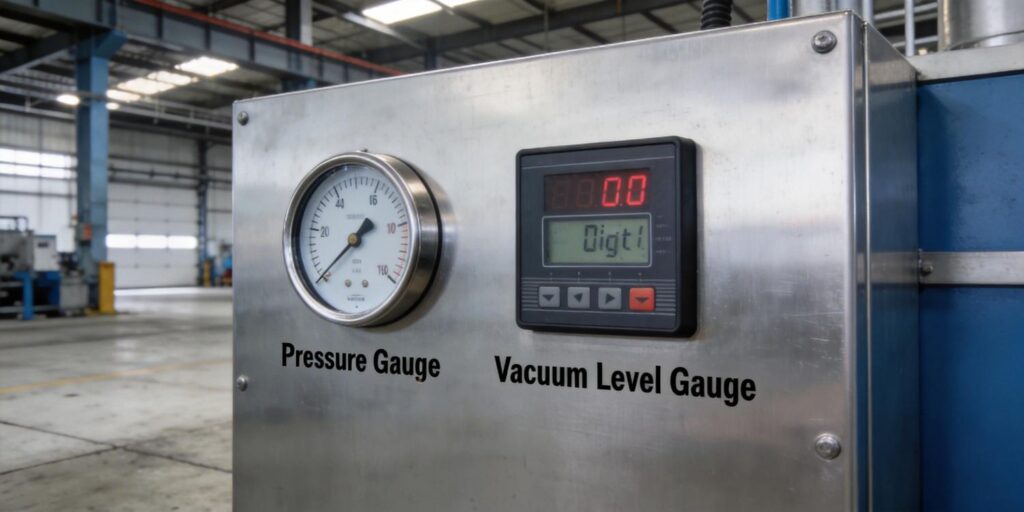
Lithium-ion battery manufacturing operates at the intersection of precision chemistry and high-volume production. Every step—from slurry coating to electrode drying and final cell assembly—demands controlled environments where even trace moisture or solvent residues can compromise cell capacity, cycle life, and safety. Vacuum technology is indispensable in these processes, yet accurate pressure measurement presents unique challenges. At Poseidon Scientific, we designed the VG-SP205 Pirani Vacuum Transmitter and VG-SM225 Cold Cathode Vacuum Gauge to address exactly these demands. Their complementary ranges, contamination-resistant materials, and field-serviceable design make them ideal for battery production lines.
This article explores the vacuum measurement challenges specific to lithium battery production. Drawing on established process requirements and real-world engineering data, we examine vacuum applications in electrode coating and drying, the need for pressure stability, solvent-vapor contamination risks, practical protection strategies, monitoring during thermal treatment, and the benefits of a recommended dual-gauge setup. Engineers and procurement teams will find actionable insights to optimize yield while controlling costs.
Vacuum Use in Electrode Coating and Drying
Electrode production begins with coating a metal foil (copper for anodes, aluminum for cathodes) with a slurry containing active materials, binders such as PVDF or CMC, and solvents—most commonly N-methyl-2-pyrrolidone (NMP) for cathodes or water for anodes. After coating, the electrodes must be dried to remove residual solvent and moisture before calendering and cell assembly.
Vacuum drying ovens or tunnel dryers are standard. The process typically proceeds in stages: initial convective heating under atmospheric or low-vacuum conditions, followed by deep vacuum to accelerate solvent evaporation at reduced temperatures (80–120 °C for NMP-based systems, 60–90 °C for aqueous). Typical vacuum levels range from 10–50 Pa (approximately 0.075–0.375 Torr) during active solvent removal to final pressures below 10 mbar (7.5 Torr) or even 0.01 mbar in multi-cycle purging protocols. These conditions lower the boiling point of NMP, enabling efficient removal without thermal degradation of the binder or active-material migration.
In high-throughput lines, electrode coils or punched sheets are processed in large vacuum chambers. Precise pressure control during the transition from atmospheric to fine vacuum prevents defects such as pinholes, cracking, or uneven binder distribution—issues that directly impact electrode adhesion and electrochemical performance.
Required Pressure Stability
Pressure stability is non-negotiable. Rapid pressure drops can cause violent boiling of residual solvent, leading to binder migration toward the electrode surface and reduced adhesion to the current collector. Conversely, insufficient vacuum prolongs drying times, lowering line throughput and increasing energy consumption.
Industry benchmarks call for pressure control within ±5 Pa during the critical solvent-removal phase. In vacuum post-drying of electrode coils, typical cycles alternate between 10 mbar and 30 mbar hold points with multiple argon or nitrogen purges to sweep away evolved moisture and solvent vapors. Final target pressures often reach <0.01 mbar to achieve residual moisture below 300 ppm—essential for preventing lithium-salt hydrolysis and gas generation during cell formation.
Both the VG-SP205 Pirani and VG-SM225 Cold Cathode deliver the repeatability needed for closed-loop control. The Pirani’s fast response (milliseconds) suits dynamic drying phases, while the Cold Cathode’s linear ion-current response in the 10⁻⁴ to 10⁻⁶ Torr region supports final verification before electrode transfer to dry-room assembly.
Solvent Vapor Contamination Issues
NMP and other organic solvents present the primary threat to vacuum gauges. These vapors can condense on cold surfaces, polymerize under ion bombardment, or chemically attack gauge components. In Pirani gauges, solvent residues alter the filament’s heat-transfer characteristics, shifting the power-versus-pressure calibration curve. In cold-cathode gauges, carbonization on electrodes raises ignition voltage and can reduce indicated pressure by an order of magnitude.
Moisture co-evolved with solvents exacerbates the problem. Hygroscopic electrode materials release water that, combined with NMP vapors, forms conductive films or promotes corrosion. Without mitigation, gauge drift can exceed 30 % within weeks of continuous exposure—unacceptable in a process where pressure errors directly translate to defective electrodes or safety risks during electrolyte filling.
Our platinum-filament Pirani design offers inherent resistance to chemical attack compared with tungsten alternatives, yet prolonged exposure still requires periodic verification. Cold-cathode sensors, with their stainless-steel electrodes and removable head, show predictable degradation that is both visible (dark deposits) and correctable on-site.
Gauge Protection Strategies
Effective protection combines hardware design, operational protocols, and maintenance routines. Poseidon’s gauges incorporate several built-in advantages:
- Material selection: Platinum filaments in the VG-SP205 provide superior chemical stability and a large temperature-resistance coefficient for accurate compensation across 15–50 °C.
- Removable sensor head: The VG-SM225 Cold Cathode sensor detaches without breaking the vacuum seal, allowing cleaning with 500-mesh sandpaper to restore metal luster and ignition performance in under 10 minutes.
- High-pressure interlock: Firmware automatically disables the Cold Cathode high voltage above 1.5 × 10⁻³ Torr, preventing electrode contamination during initial roughing.
- Temperature compensation: Dual circuit-plus-algorithm compensation minimizes drift from oven heating cycles.
Additional field strategies include:
- Installing the gauge on a short KF25 side port with minimal conductance difference from the main chamber.
- Using a sintered-metal or mesh filter upstream of the gauge port to trap particulates and condense heavier solvent vapors.
- Scheduling automated purge cycles with dry nitrogen between batches to flush residual vapors.
- Implementing cross-check routines at the 10⁻³ Torr overlap zone between Pirani and Cold Cathode readings to flag contamination early.
These measures typically extend gauge service intervals to 1–2 years in solvent-heavy environments, versus 6–9 months for unprotected units.
Monitoring During Thermal Treatment
Thermal treatment—whether post-drying annealing or electrode calendaring preparation—often occurs in the same or adjacent vacuum ovens. Temperatures reach 80–120 °C while vacuum levels ramp from intermediate (100–400 mbar) to fine vacuum (<10 Pa). Here, the gauge must withstand thermal cycling without losing calibration.
The VG-SP205 excels in the higher-pressure regime typical of initial heating and solvent evolution, delivering stable output even as oven temperature fluctuates. Once pressure drops below 10⁻³ Torr, the VG-SM225 assumes primary monitoring, its Penning discharge unaffected by moderate temperature once ignition is achieved. Redundant analog 0–10 V outputs and customizable RS-232 protocols allow seamless integration into existing PLC or SCADA systems, providing real-time data for recipe optimization and batch traceability.
Engineers report that dual monitoring during thermal ramps reduces scrap rates by catching pressure excursions that would otherwise cause binder creep or active-material cracking.
Recommended Dual Gauge Setup
A single-gauge solution cannot span the full dynamic range of battery drying cycles—from atmosphere to 10⁻⁷ Torr final verification. Poseidon recommends a dual-gauge configuration leveraging the natural overlap at 10⁻³ Torr:
| Phase | Primary Gauge | Backup / Cross-Check | Key Benefit |
|---|---|---|---|
| Initial roughing & heating (760–10 Torr) | VG-SP205 Pirani | — | Fast response, high linearity |
| Solvent removal (10–0.01 Torr) | VG-SP205 Pirani | VG-SM225 (standby) | Overlap validation at transition |
| Final deep vacuum (<10⁻³ Torr) | VG-SM225 Cold Cathode | VG-SP205 (saturated) | Contamination-resistant ion-current measurement |
| Thermal treatment hold | VG-SM225 | VG-SP205 | Redundancy during temperature ramps |
This setup delivers continuous coverage with automatic handoff logic in the controller. The 0–10 V outputs are directly compatible with most PLCs; RS-232 customization (minimum 5–10 units) enables unified digital streams. Installation uses standard KF25 flanges—no adapters required. In a typical 10-chamber drying line, the dual configuration adds negligible cost while eliminating single-point failures and providing built-in calibration verification.
Field data from similar battery lines show 15–20 % improvement in drying uniformity and a corresponding reduction in cell formation defects when dual gauges are implemented.
Conclusion
Vacuum measurement in lithium battery production is far more than installing a gauge—it requires understanding solvent chemistry, pressure dynamics, and contamination pathways. The VG-SP205 Pirani and VG-SM225 Cold Cathode, engineered specifically for cost-sensitive, high-reliability applications, meet these demands with overlapping ranges, robust materials, and field-maintainable designs.
Procurement teams gain domestic sourcing, rapid customization, and total ownership costs 60–75 % below imported equivalents. Engineers receive repeatable data that directly supports higher yields and safer cells.
If your facility is scaling electrode drying, optimizing thermal treatment, or facing gauge drift in solvent-rich environments, Poseidon Scientific offers tailored consultation. Our applications team can review your chamber layout, recommend exact mounting and control logic, and provide loaner gauges for on-site validation—all at no obligation.
Contact us today for a battery-industry-specific vacuum audit. Whether you are retrofitting legacy lines or commissioning new gigafactories, the right gauge pair can turn vacuum measurement from a hidden risk into a competitive advantage.