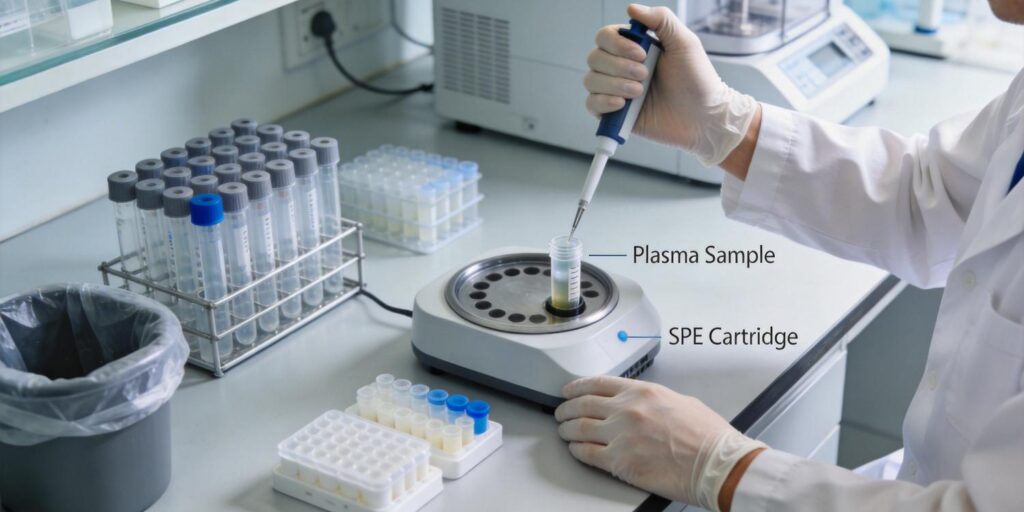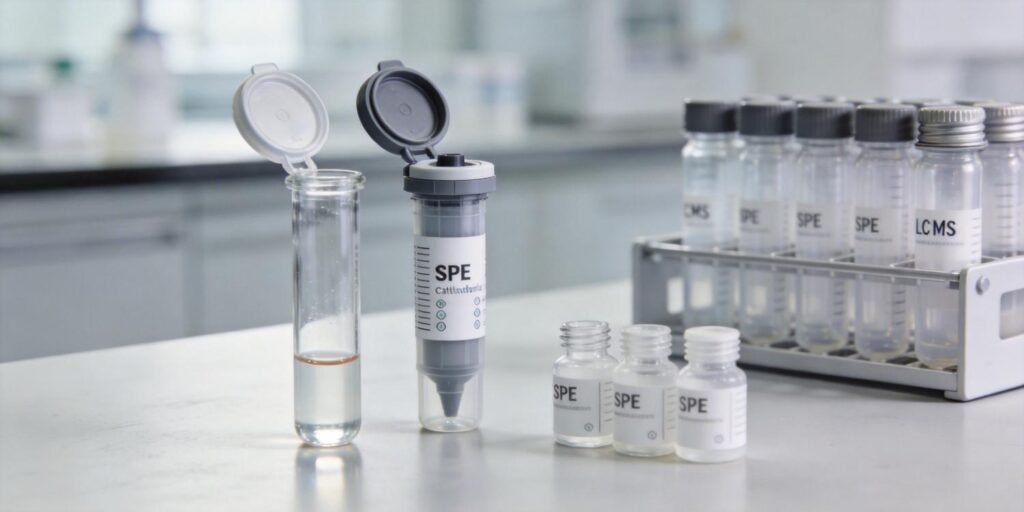
Matrix Complexity in Human Serum
Human serum presents one of the most challenging matrices for LC-MS analysis due to its complex composition. As noted in the literature, serum contains proteins, lipids, salts, and various endogenous compounds that can interfere with analytical measurements. The presence of proteins is particularly problematic, as they can bind to target analytes and reduce their availability for extraction. According to Simpson and Wynne (2000), “proteins may be precipitated if necessary. Protein binding of isolates may be a problem and should be considered if recoveries of isolate standards are high but recoveries from sample are low.”
The complexity extends beyond proteins to include phospholipids, fatty acids, and other macromolecules that can cause ion suppression in LC-MS systems. These matrix components can deposit in the transfer capillary/interface to the MS system, leading to rapid decline in signal intensity and quality of spectra. The Waters Oasis catalog emphasizes that “SPE has been shown to significantly increase gas (GC) and liquid chromatography (LC) column life while reducing the downtime on equipment like gas chromatography and liquid chromatography mass spectrometers (GCMS and LCMS) for source cleaning.”
Protein Precipitation vs SPE Cleanup Comparison
Protein precipitation has been a traditional approach for serum sample preparation, but it has significant limitations compared to solid-phase extraction. While precipitation with acetonitrile or other solvents can remove proteins, it often leaves behind other interfering compounds. According to forensic applications literature, “SPE recoveries should exceed 90% absolute recovery. If you don’t get that kind of recovery you are not adjusting other parameters (such as solubility, pH, and solvent strength) correctly.”
The comparison between liquid-liquid extraction (LLE) and SPE reveals clear advantages for SPE. As documented in the literature, “SPE vs. Liquid-Liquid Extraction offers improved throughput (parallel vs. serial processing), decreased organic solvent usage and waste generation, higher and more reproducible recoveries, cleaner extracts (contamination, solvent impurities), no emulsions, tunable selectivity (SPE phase choices, solvent mixtures), and ready automation.”
Research by Chen et al. (1992) demonstrated that for a range of acidic, basic, and neutral drugs extracted on a combination non-polar/cation exchange cartridge, recovery was generally highest when the sample was diluted in a buffer and subjected to physical denaturing (sonication) rather than chemical precipitation methods.
Selecting Mixed-Mode Sorbents for Serum Drugs
Mixed-mode sorbents offer superior performance for serum drug analysis by combining reversed-phase and ion-exchange functionality. According to Waters’ Oasis strategy, “Mixed-Mode Solid-Phase Extraction provides the cleanest extracts, best reduction of matrix effects, highest sensitivity, dual retention mechanism, and provides orthogonality and selectivity.”
The selection guide for mixed-mode sorbents follows these principles:
For Basic Compounds (pKa 2-10)
Use Mixed-mode Cation Exchange (MCX) sorbents that contain sulfonic acid groups. These are particularly effective for retaining basic drugs through both hydrophobic interactions and cation exchange mechanisms.
For Acidic Compounds (pKa 2-8)
Use Mixed-mode Anion Exchange (MAX) sorbents containing quaternary amine groups. These provide dual retention for acidic compounds through reversed-phase and anion exchange interactions.
For Strong Acids (pKa <1)
Use Mixed-mode Weak Anion Exchange (WAX) sorbents designed specifically for strong acids.
For Strong Bases (pKa >10)
Use Mixed-mode Weak Cation Exchange (WCX) sorbents optimized for strong bases and quaternary amines.
The literature emphasizes that “the water-wettable nature of Oasis allows direct loading of aqueous samples without sacrificing recovery,” which is particularly important for serum samples that require minimal pretreatment.
Example Protocol for SPE Cleanup After Precipitation
A comprehensive SPE protocol for serum samples typically involves these optimized steps:
Step 1: Sample Pretreatment
1. Add 200 μL of serum sample to a microcentrifuge tube
2. Add 400 μL of cold acetonitrile (1:2 ratio) for protein precipitation
3. Vortex for 30 seconds and let stand for 10-15 minutes
4. Centrifuge at 10,000 × g for 10 minutes
5. Transfer supernatant to a clean tube
Step 2: SPE Cartridge Preparation
1. Condition mixed-mode MCX cartridge (30 mg, 1 cc) with 1 mL methanol
2. Equilibrate with 1 mL water or appropriate buffer (pH adjusted for target analytes)
3. Load diluted supernatant (dilute with buffer to reduce organic content to <10%)
4. Apply sample at controlled flow rate of 1-2 mL/min
Step 3: Washing and Elution
1. Wash with 1 mL of 2% formic acid in water to remove interferences
2. Wash with 1 mL of methanol to remove neutral compounds
3. Dry cartridge under vacuum for 5 minutes
4. Elute with 1 mL of 5% ammonium hydroxide in methanol
5. Collect eluent in clean collection tube
Step 4: Sample Reconstitution
1. Evaporate eluent to dryness under gentle nitrogen stream at 40°C
2. Reconstitute in 100 μL of mobile phase compatible solvent
3. Vortex and centrifuge before LC-MS analysis
As noted in troubleshooting guides, “If manipulation of the matrix is not desirable, then there are options to alter the column characteristics. The first is to try a larger particle/pore size. Most standard SPE products offer a 40-60 μm particle size with a 60 Å pore diameter. Special phases are available that offer an average 150-μm particle with a 200 Å pore size.”
Effects on LC-MS Ion Suppression and Peak Shape
Proper SPE cleanup significantly improves LC-MS performance by reducing matrix effects. The Waters Oasis PRiME HLB technology demonstrates that “one method provides high recoveries for a diverse, wide range of analytes” while “reduces matrix effects with more than 95% of common matrix interferences removed.”
Matrix effects in LC-MS analysis manifest as:
Ion Suppression
Co-eluting matrix components compete with analytes for ionization, reducing signal intensity. Mixed-mode SPE effectively removes phospholipids and other ion-suppressing compounds that protein precipitation alone cannot eliminate.
Ion Enhancement
Some matrix components can enhance ionization of certain analytes, leading to inaccurate quantification. Selective SPE cleanup minimizes this variability.
Peak Shape Degradation
Matrix components can cause peak tailing, broadening, or splitting. Clean extracts from SPE result in sharper, more symmetrical peaks with better resolution.
Research shows that “LC-MS demanded, however, that the proteins and ionic species be removed – within limits the presence of other small organic molecules was not a problem because the MS detector could ‘select them out’ of the effluent from the chromatographic column.”
Troubleshooting Carryover and Recovery Issues
Low Recovery Problems
1. Incomplete protein binding disruption: Ensure proper pretreatment with appropriate solvents or physical methods
2. Incorrect pH adjustment: Verify sample pH is optimized for analyte retention on mixed-mode sorbents
3. Excessive organic content: Dilute samples to maintain <10% organic solvent during loading
4. Flow rate too high: Reduce flow rate to 1-2 mL/min for better interaction with sorbent
Carryover Issues
1. Incomplete elution: Use stronger elution solvents or increase elution volume
2. Strong secondary interactions: Add modifiers to elution solvent to disrupt hydrogen bonding or ionic interactions
3. Cartridge overloading: Reduce sample load or use higher capacity cartridges
Matrix Effects Persistence
1. Insufficient washing: Optimize wash solvents to remove specific interferences
2. Wrong sorbent selection: Consider alternative mixed-mode chemistries for specific analyte classes
3. Sample complexity: Implement additional cleanup steps or consider two-dimensional SPE approaches
The literature provides specific guidance: “Filtration is another common means to remedy sample matrix problems. A particularly useful tool is silanized glass wool. After column conditioning, a small pinch of glass wool is pushed into the SPE cartridge using forceps or an applicator stick; the wool should rest loosely, just on top of the column frit.”
For persistent recovery issues, consider that “the presence of cellular material in this case complicates an interpretation of the role protein binding may have played in reducing drug recovery from the untreated sample.” Systematic method development following established SPE principles – characterizing the analyte, understanding the matrix, and selecting appropriate sorbents and conditions – will yield optimal results for serum LC-MS analysis.
For more information about SPE products and applications, visit our HLB SPE Cartridges, MAX SPE Cartridges, MCX SPE Cartridges, WAX SPE Cartridges, WCX SPE Cartridges, and 96-Well SPE Plates product pages.