Regulatory Monitoring of Veterinary Antibiotics
Global food safety agencies maintain stringent regulatory frameworks for monitoring veterinary antibiotic residues in meat products. Organizations like the FDA, EFSA, and Codex Alimentarius establish maximum residue limits (MRLs) for various antibiotic classes to ensure consumer protection. These regulations mandate routine surveillance programs that require analytical laboratories to detect antibiotic residues at parts-per-billion (ppb) levels in complex meat matrices.
Compliance monitoring involves both targeted screening for specific antibiotics and broad-spectrum surveillance for multiple drug classes. Regulatory methods must demonstrate adequate sensitivity, specificity, and reproducibility to withstand legal scrutiny. The analytical challenge lies in detecting trace-level residues while eliminating matrix interferences that could lead to false positives or negatives.
Challenges of Meat Tissue Matrices
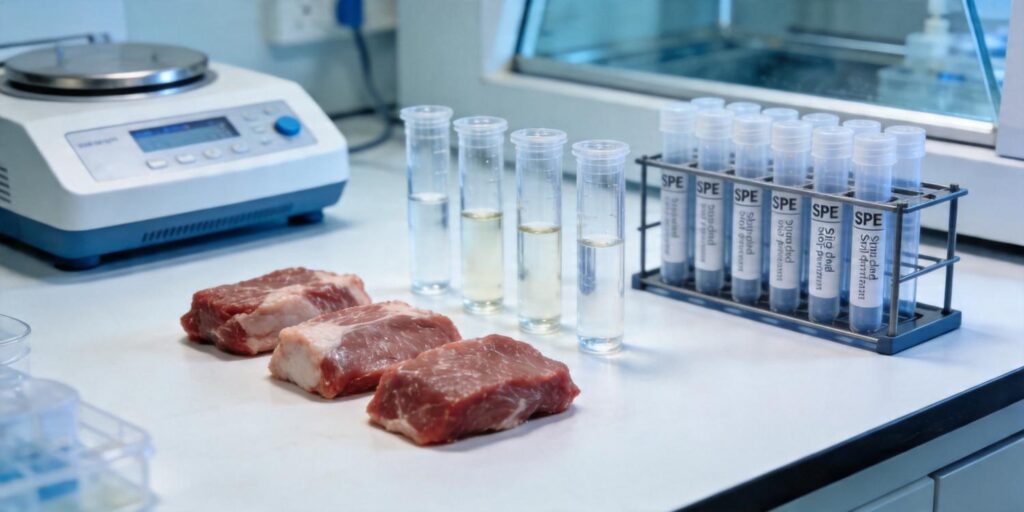
Meat tissue presents one of the most complex analytical matrices for veterinary drug residue analysis. The high protein and lipid content, along with endogenous compounds like cholesterol, fatty acids, and various metabolites, create significant interference challenges. Traditional solvent extraction methods often yield emulsified extracts requiring extensive cleanup before analysis.
Research by Horie et al. (1991) demonstrated that fish tissue homogenization in metaphosphoric acid/methanol (3:2 v/v) effectively deproteinizes samples, making them suitable for SPE processing. The high lipid content in meat tissues can cause cartridge clogging and reduce sorbent efficiency if not properly addressed during sample preparation.
Matrix Solid Phase Dispersion (MSPD) has emerged as a valuable alternative to traditional SPE for solid tissue samples, as documented by Barker and Long (1992). This technique combines sample homogenization with extraction in a single step, proving particularly effective for antibiotic residue analysis in muscle and liver tissues.
SPE Sorbent Selection for Antibiotic Classes
Sulfonamides
Sulfonamides, being amphoteric compounds with both acidic and basic functional groups, require careful pH control during extraction. Mixed-mode sorbents combining reversed-phase and ion-exchange mechanisms provide optimal recovery. Long et al. (1990a) developed a multiresidue method for sulfonamides in pork tissue using C18-based SPE with pH optimization, achieving recoveries exceeding 85% for multiple sulfonamide compounds.
Tetracyclines
Tetracyclines present unique challenges due to their metal-chelating properties and pH-dependent stability. Research by Long et al. (1990c) demonstrated successful MSPD isolation of oxytetracycline, tetracycline, and chlortetracycline from milk using C18 sorbents with EDTA-containing buffers to prevent metal complexation. For meat tissues, similar approaches with pH adjustment to 4.0-4.5 optimize tetracycline retention on reversed-phase sorbents.
Benzimidazoles
Benzimidazole anthelmintics, being basic compounds, benefit from mixed-mode sorbents containing both hydrophobic and cation-exchange functionalities. Long et al. (1990e) reported successful determination of five benzimidazole anthelmintics in pork muscle tissue using MSPD with C18 sorbents, followed by liquid chromatographic analysis with photodiode array detection.
Macrolides and Fluoroquinolones
These antibiotic classes typically require hydrophilic-lipophilic balanced (HLB) sorbents or mixed-mode cartridges. The diverse chemical properties within these groups necessitate method optimization for pH, solvent composition, and washing conditions to achieve comprehensive multiresidue recovery.
Example Extraction and SPE Purification Workflow
Sample Preparation
Begin with 5g of homogenized meat tissue. Add 10mL of metaphosphoric acid/methanol (3:2 v/v) and homogenize thoroughly. Centrifuge at 4000×g for 10 minutes and collect the supernatant. Evaporate to near dryness under nitrogen at 40°C and reconstitute in 5mL of appropriate buffer (typically phosphate buffer pH 6.0 for sulfonamides or McIlvaine buffer pH 4.0 for tetracyclines).
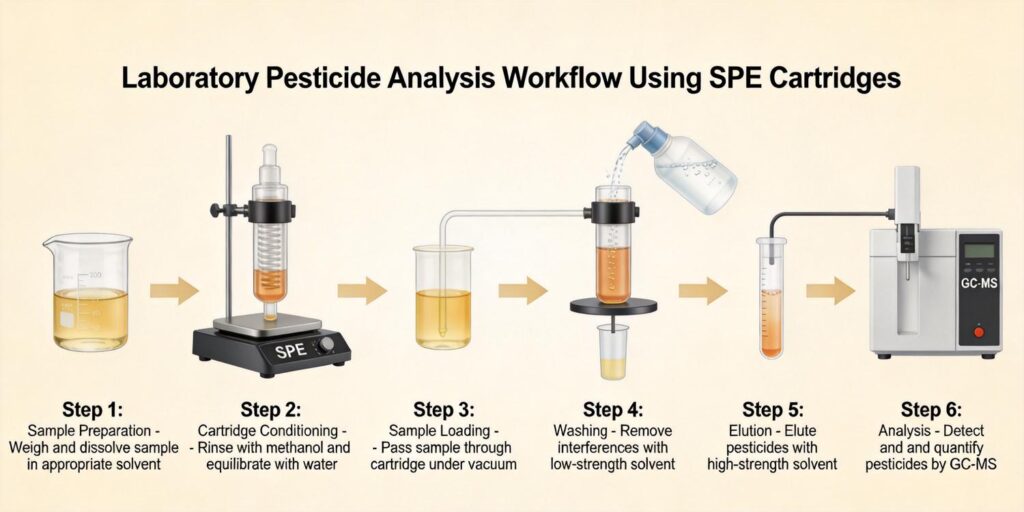
SPE Procedure
- Conditioning: Pass 5mL methanol followed by 5mL deionized water through the SPE cartridge (500mg C18 or mixed-mode sorbent).
- Loading: Apply the sample extract at 1-2mL/min flow rate.
- Washing: Use 5mL of water followed by 5mL of 5% methanol in water to remove polar interferences.
- Drying: Apply vacuum for 5 minutes to remove residual water.
- Elution: Elute with 5mL of methanol containing 2% formic acid for acidic antibiotics or methanol/ammonia for basic compounds.
Post-SPE Treatment
Evaporate eluate to dryness under gentle nitrogen stream at 40°C. Reconstitute in 1mL of mobile phase compatible with subsequent LC-MS/MS analysis. Filter through 0.22μm membrane before injection.
LC-MS/MS Detection Methods
Modern veterinary antibiotic residue analysis relies heavily on liquid chromatography coupled with tandem mass spectrometry (LC-MS/MS). This technique provides the sensitivity and specificity required for regulatory compliance at ppb levels. Electrospray ionization (ESI) in positive or negative mode, depending on the antibiotic class, offers optimal ionization efficiency.
Chromatographic separation typically employs C18 or phenyl-hexyl columns with gradient elution using water/methanol or water/acetonitrile mobile phases containing 0.1% formic acid or ammonium acetate buffers. Multiple reaction monitoring (MRM) transitions provide confirmatory data, with at least two transitions per compound recommended for unequivocal identification.
Recent advances in high-resolution mass spectrometry (HRMS) enable retrospective data analysis and non-targeted screening, expanding surveillance capabilities beyond predefined antibiotic lists. These techniques are particularly valuable for detecting emerging antibiotic residues or unexpected metabolites.
Food Safety Validation Requirements
Method Validation Parameters
Regulatory methods for veterinary antibiotic detection must undergo comprehensive validation according to guidelines from organizations like AOAC International, FDA, and EU Reference Laboratories. Essential validation parameters include:
- Specificity: Demonstration of no interference from matrix components at target analyte retention times
- Linearity: Correlation coefficient (r²) ≥0.99 over the calibration range
- Accuracy: Recovery rates of 70-120% at regulatory levels
- Precision: Relative standard deviation (RSD) ≤20% for repeatability and intermediate precision
- Limit of Detection (LOD): Typically 0.5-1.0× the MRL
- Limit of Quantification (LOQ): Typically 1.0-2.0× the MRL
- Matrix Effects: Evaluation and compensation for ionization suppression/enhancement
Quality Control Measures
Routine analysis requires implementation of robust quality control protocols. Each batch should include method blanks, fortified samples at MRL levels, and certified reference materials when available. Continuous monitoring of recovery rates and precision ensures method performance remains within acceptable limits.
Proficiency testing through interlaboratory comparisons provides essential external validation of analytical competence. Regular method verification against updated regulatory requirements maintains compliance with evolving food safety standards.
Documentation and Traceability
Complete documentation of sample handling, extraction procedures, instrument conditions, and data analysis is essential for regulatory compliance. Chain of custody documentation ensures sample integrity throughout the analytical process. Electronic data management systems facilitate data traceability and audit readiness.
The integration of optimized SPE cleanup methods with sensitive LC-MS/MS detection provides laboratories with robust tools for ensuring meat product safety. As regulatory requirements evolve and new antibiotic classes emerge, continued method development and validation remain essential for protecting public health while supporting sustainable animal production practices.