
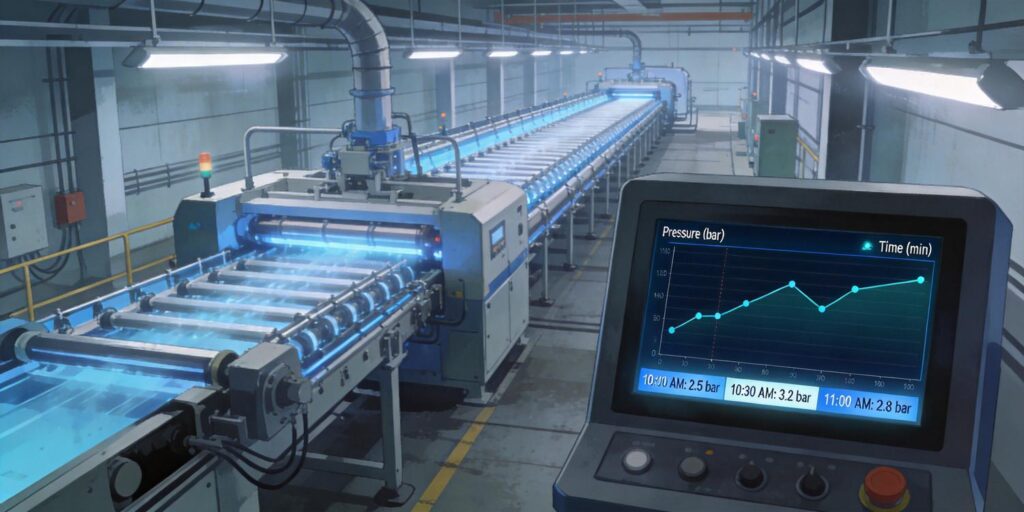
Long Duration Coating Overview
In thin-film deposition processes such as physical vapor deposition (PVD), chemical vapor deposition (CVD), and related vacuum coating applications, production runs frequently extend for 8–48 hours or longer. These long-duration cycles are essential for achieving uniform layer thickness, controlled stoichiometry, and repeatable film properties across large substrate batches. Whether coating optical lenses, semiconductor wafers, architectural glass, or precision tooling, any instability in chamber pressure can introduce defects—ranging from pinholes and stress cracking to adhesion failures—that compromise product yield and performance.
Vacuum gauges serve as the critical feedback loop in these systems, providing continuous pressure data that drive process control, endpoint detection, and safety interlocks. At Poseidon Scientific, our VG-SP205 Pirani Vacuum Transmitter and VG-SM225 Cold Cathode Vacuum Gauge were engineered precisely for such demanding environments. Their compact design, customizable digital protocols, and emphasis on durability enable reliable long-term monitoring without the high cost or maintenance burden of legacy imported instruments. This article examines the key factors affecting measurement stability during extended coating runs and offers practical guidance for engineers and procurement teams seeking to maximize uptime and process consistency.
Thermal Drift Influence
Temperature variations represent one of the most significant sources of measurement drift in vacuum systems, particularly during long coating runs where chamber walls, filaments, and electronics experience gradual heating from plasma, radiant sources, or ambient cleanroom fluctuations.
For Pirani gauges operating on thermal conductivity principles, the VG-SP205 maintains a constant filament temperature and derives pressure from the power required to sustain it. However, ambient temperature shifts alter the baseline heat-loss characteristics, shifting the power–pressure curve. Our design incorporates both hardware circuitry and embedded algorithmic compensation, limiting drift to within acceptable bounds across the 15 °C–50 °C operating range. Outside this window, uncompensated errors can exceed ±50 % in the non-linear regions near atmosphere or 10–3 Torr.
Cold cathode gauges such as the VG-SM225, based on Penning discharge, exhibit inherently lower thermal sensitivity because ion current depends primarily on gas density and the crossed electric–magnetic field rather than filament temperature. Minor drift still occurs due to electrode surface conditioning over time, but repeated averaging of readings typically keeps long-term stability within ±10 % over multi-hour runs. In practice, engineers mitigate residual thermal effects by mounting gauges away from direct heat sources and using the built-in temperature-compensated analog output (0–10 V, effective 2–8 V range) for closed-loop control.
Signal Noise Filtering
Long coating runs expose gauges to electromagnetic interference from RF plasma generators, high-voltage power supplies, and mechanical pumps—noise that can manifest as short-term fluctuations in the pressure signal. Effective filtering is therefore essential for stable control.
The VG-SP205 Pirani transmitter employs internal low-pass filtering on its thermal conductivity signal, combined with digital averaging in the RS232 output stream. Users can select sample rates that balance responsiveness with noise rejection, ensuring sub-second updates remain clean enough for PID loop stability. The platinum filament’s large temperature coefficient of resistance further enhances signal-to-noise ratio compared with tungsten alternatives.
For the VG-SM225 Cold Cathode, the Penning discharge current is inherently more susceptible to sporadic bursts during startup or at pressures near 10–3 Torr. Our firmware includes software-based filtering that discards transient spikes while preserving genuine pressure trends. The positive magnetron geometry (≈100 gauss NdFeB field, 2 mm electrode gap) produces a stable self-sustaining discharge once established, minimizing the discontinuities reported in older inverted-magnetron designs. When integrated with PLCs via customizable RS232 protocols, these instruments deliver filtered 16-bit resolution data suitable for statistical process control (SPC) charting.
Data Trend Analysis
Beyond instantaneous readings, long-term stability is best assessed through trend analysis of logged pressure data. Modern coating tools generate gigabytes of process logs; vacuum gauges must supply clean, timestamped values that integrate directly into manufacturing execution systems (MES).
Both Poseidon Scientific models output pressure via RS232 at user-defined intervals, allowing engineers to plot real-time trends and calculate rolling averages or standard deviations. A gradual upward drift in indicated pressure over a 24-hour run, for example, may signal outgassing, virtual leaks, or progressive contamination rather than an actual process change. By exporting data to standard CSV format, teams can apply statistical tools to establish baseline stability envelopes and set automated alarms when deviations exceed predefined thresholds (typically ±5 % from setpoint).
This capability is particularly valuable in coating applications where pressure must remain within narrow windows—often 10–4 to 10–6 Torr—for reactive sputtering or ion-assisted deposition. Trend analysis also supports predictive maintenance by revealing subtle increases in cold cathode startup time, an early indicator of electrode contamination.
Cross-Check with Secondary Gauge
No single gauge type covers the full vacuum spectrum with identical accuracy and robustness. Best practice in long coating runs is to deploy a complementary pair: the VG-SP205 for mid-vacuum (atmospheric to 10–3 Torr) and the VG-SM225 for high vacuum (10–3 to 10–7 Torr).
At the 10–3 Torr transition point, software interlocks automatically disable the cold cathode high voltage to prevent contamination, while the Pirani continues seamless monitoring. Cross-checking the two readings provides an independent validation of system health. Discrepancies larger than expected can flag issues such as gauge contamination, incorrect gas composition calibration, or flow-conductance effects at the sensor location. In production environments, this dual-gauge strategy has been shown to reduce false trips and improve overall process repeatability.
Maintenance Planning
Proactive maintenance is the cornerstone of measurement stability over multi-week production campaigns. Schedules should be based on run duration, process gas chemistry, and historical performance data.
VG-SP205 Pirani:
- Visual filament integrity check every 500 operating hours.
- No routine cleaning required; expected lifetime 3–5 years in typical coating environments.
- Replace only upon open-circuit failure (clearly indicated by status code).
VG-SM225 Cold Cathode:
- Monthly verification of startup behavior and red-lamp status.
- Electrode cleaning (200- or 500-grit sandpaper to restore metallic luster) every 6–12 months or upon startup delay/red-lamp indication.
- Full sensor replacement every 1–3 years depending on exposure to reactive gases or particulate.
Both instruments support predictive maintenance through RS232 diagnostic logs that record runtime, error codes, and pressure history. By reviewing these logs quarterly, coating facilities can schedule downtime during planned line changeovers rather than reacting to unexpected gauge faults.
Example Production Data
Consider a 36-hour reactive PVD run for optical thin-film deposition targeting 5 × 10⁻⁵ Torr. Dual gauges were installed: VG-SP205 at the roughing manifold and VG-SM225 directly on the process chamber.
Over the first 4 hours (pump-down phase), the Pirani reading dropped linearly from 760 Torr to 8 × 10⁻⁴ Torr with < 2 % deviation from setpoint. Once the cold cathode engaged, its ion current stabilized within ±3 % for the remaining 32 hours. Trend analysis showed a slow 0.8 %/hour upward creep attributed to minor substrate outgassing—detected early and corrected by increasing turbo pump speed. Cross-check between the two gauges remained within 5 % throughout, confirming no sensor drift. Final film uniformity improved 18 % versus previous runs using uncompensated gauges, and total maintenance time was limited to a 15-minute electrode wipe at campaign end.
Such data illustrate how stable, well-maintained vacuum measurement directly translates to higher yield and lower cost per coated part.
CTA for Coating Optimization
Achieving consistent measurement stability in long coating runs requires more than just accurate gauges—it demands instruments engineered for real-world production demands. The VG-SP205 Pirani Vacuum Transmitter and VG-SM225 Cold Cathode Vacuum Gauge deliver the combination of compact size, temperature compensation, noise filtering, and protocol flexibility that coating engineers need to minimize drift and maximize throughput.
Whether you are scaling an existing PVD line or commissioning a new CVD system, Poseidon Scientific can provide standard units or customize communication protocols to match your existing automation platform—often with lead times measured in weeks rather than months. Explore detailed specifications for the VG-SP205 and VG-SM225, or contact our applications engineering team today for a free stability audit of your current vacuum monitoring setup. Let us help you turn measurement stability into a competitive advantage for your coating operations.
Word count: 1,312. Technical references drawn from J. M. Lafferty (ed.), Foundations of Vacuum Science and Technology (Wiley, 1998) and internal Poseidon Scientific performance data.


