1. Industrial Chemical Contamination Sources
Surface water contamination by industrial chemicals represents a significant environmental challenge, with multiple pathways contributing to aquatic ecosystem pollution. Industrial discharges, both point and non-point sources, introduce complex mixtures of organic compounds into rivers, lakes, and coastal waters. Manufacturing facilities, chemical plants, and industrial parks release solvents, plasticizers, flame retardants, and other synthetic compounds through permitted discharges, accidental spills, and runoff events.
According to environmental monitoring studies, industrial effluents often contain volatile organic compounds (VOCs), semi-volatile organic compounds (SVOCs), and persistent organic pollutants (POPs) that can accumulate in aquatic environments. The integration of solid-phase extraction (SPE) with analytical techniques has revolutionized our ability to detect these contaminants at trace levels, as noted in comprehensive SPE literature where researchers have demonstrated the effectiveness of SPE for environmental water analysis.
Key Contamination Pathways
- Direct industrial discharges from manufacturing processes
- Stormwater runoff from industrial sites and transportation corridors
- Leaching from industrial waste disposal sites and landfills
- Atmospheric deposition of industrial emissions
- Accidental spills and transportation incidents
2. Target Analytes: Solvents and Plastic Additives
Industrial chemical monitoring programs typically focus on several classes of compounds that pose significant environmental and human health risks. Solvents such as benzene, toluene, ethylbenzene, and xylenes (BTEX) represent common targets due to their widespread industrial use and potential toxicity. These volatile compounds require specialized SPE approaches for effective enrichment from large water volumes.
Plastic additives constitute another critical category, including phthalate esters (plasticizers), bisphenol A (BPA), and various flame retardants like polybrominated diphenyl ethers (PBDEs). These compounds exhibit varying physicochemical properties, from relatively polar phthalates to highly hydrophobic brominated flame retardants, necessitating careful SPE sorbent selection and method optimization.
Common Industrial Target Compounds
| Compound Class | Examples | Typical SPE Sorbent |
|---|---|---|
| Volatile Solvents | BTEX, chlorinated solvents | HLB, polymeric sorbents |
| Plasticizers | DEHP, DBP, BBP | C18, polymeric phases |
| Flame Retardants | PBDEs, TCEP, TCPP | C18, mixed-mode phases |
| Surfactants | Alkylphenol ethoxylates | HLB, MAX/WAX |
Research has shown that polymeric sorbents like HLB (hydrophilic-lipophilic balance) provide excellent recovery for a broad range of industrial chemicals due to their balanced retention mechanisms. The development of mixed-mode sorbents combining reversed-phase and ion-exchange functionalities has further expanded SPE capabilities for challenging analytes.
3. SPE Enrichment for Trace Environmental Analysis
Solid-phase extraction serves as the cornerstone of modern environmental analytical chemistry, enabling the detection of industrial chemicals at parts-per-trillion (ppt) levels in surface waters. The fundamental advantage of SPE lies in its ability to simultaneously concentrate analytes and remove matrix interferences, addressing the dual challenges of trace-level detection and complex sample matrices.
SPE Advantages for Environmental Monitoring
- High Concentration Factors: Processing liter-scale water samples to achieve 1000-5000× concentration
- Matrix Cleanup: Removal of humic acids, particulates, and other interferences
- Selectivity: Tunable retention through sorbent chemistry and pH control
- Automation Compatibility: High-throughput processing using 96-well plates and automated systems
- Solvent Reduction: Significantly lower organic solvent consumption compared to liquid-liquid extraction
Environmental applications of SPE on bonded silicas were first developed in the 1980s and have grown rapidly as an alternative to liquid-liquid extraction. The technique is particularly valuable for large volume samples, which environmental chemists routinely handle to achieve necessary detection limits for trace pollutants.
Sorbent Selection Considerations
The choice of SPE sorbent depends on analyte physicochemical properties, sample matrix characteristics, and analytical requirements. For industrial chemical monitoring:
- HLB Sorbents: Ideal for broad-spectrum extraction of compounds with varying polarity
- C18/C8 Phases: Excellent for hydrophobic compounds like PAHs and certain plasticizers
- Mixed-mode Sorbents (MCX/WCX): Essential for ionizable compounds requiring pH-controlled retention
- Polymeric Phases: Superior capacity and reproducibility for challenging matrices
4. Example Surface Water Extraction Workflow
A robust SPE workflow for industrial chemical monitoring in surface water involves several critical steps, each optimized for maximum recovery and minimal interference. The following protocol represents a generalized approach adaptable to specific analytical requirements.
Sample Preparation and Preservation
- Sample Collection: Collect 1-2 liters of surface water in clean glass containers, avoiding headspace
- Preservation: Adjust to pH 2-3 with hydrochloric acid for acidic compounds or pH 10 for basic compounds
- Filtration: Pass through 0.45 μm glass fiber filters to remove particulates
- Internal Standards: Add appropriate deuterated or 13C-labeled internal standards
SPE Procedure
- Cartridge Conditioning: Sequentially pass 5 mL methanol and 5 mL acidified water (pH 2-3) through HLB or appropriate sorbent cartridge
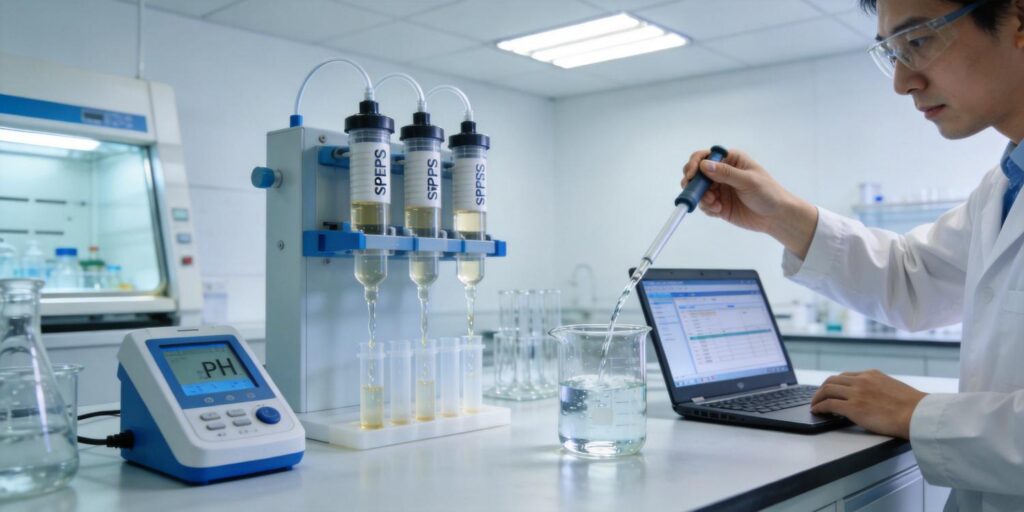
- Sample Loading: Load filtered sample at controlled flow rate (5-10 mL/min) using vacuum manifold or positive pressure
- Cartridge Washing: Rinse with 5-10 mL of 5% methanol in water to remove weakly retained interferences
- Drying: Apply vacuum or nitrogen purge for 5-10 minutes to remove residual water
- Analyte Elution: Elute with 5-10 mL of appropriate solvent (typically methanol, acetonitrile, or dichloromethane)
- Concentration: Reduce eluate volume to 0.5-1.0 mL under gentle nitrogen stream
- Reconstitution: Adjust to final volume with mobile phase compatible solvent
Quality Control Measures
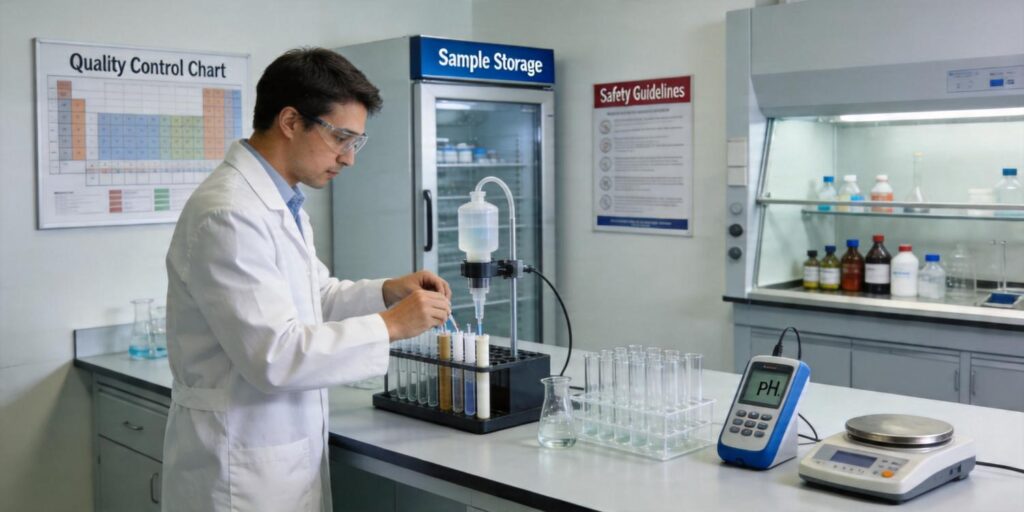
- Process method blanks with each batch to monitor contamination
>Include matrix spikes to determine method recovery (typically 70-120%)
>Use surrogate standards to monitor extraction efficiency
>Implement duplicate analyses to assess precision
5. LC-MS Detection Strategies
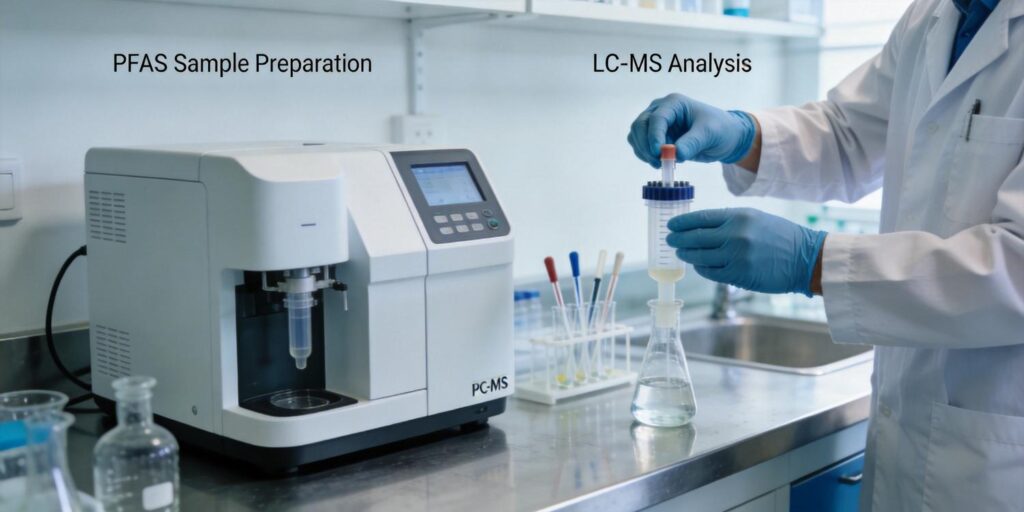
Liquid chromatography-mass spectrometry (LC-MS) has become the technique of choice for industrial chemical monitoring due to its sensitivity, selectivity, and ability to handle thermally labile compounds. The integration of SPE with LC-MS creates a powerful analytical system capable of detecting sub-ng/L concentrations in complex environmental matrices.
LC Separation Considerations
Reverse-phase chromatography using C18 or C8 columns provides excellent separation for most industrial chemicals. Gradient elution with water and organic modifiers (acetonitrile or methanol) allows resolution of compounds with diverse polarities. For ionizable analytes, mobile phase pH control is critical for achieving optimal separation and MS detection sensitivity.
Mass Spectrometry Detection Modes
Triple Quadrupole (QqQ) MS/MS
Selected reaction monitoring (SRM) provides the highest sensitivity and specificity for target compound analysis. This approach is ideal for regulatory monitoring programs requiring definitive identification and quantification.
High-Resolution Mass Spectrometry (HRMS)
Orbitrap and Q-TOF instruments enable non-target screening and retrospective analysis, valuable for identifying unknown contaminants and transformation products. Accurate mass measurements facilitate elemental composition determination and database matching.
Ionization Techniques
- Electrospray Ionization (ESI): Preferred for polar and ionizable compounds
- Atmospheric Pressure Chemical Ionization (APCI): Suitable for less polar compounds
- Atmospheric Pressure Photoionization (APPI): Effective for non-polar compounds like PAHs
Method Validation Parameters
| Parameter | Acceptance Criteria | Typical Values |
|---|---|---|
| Linearity | R² > 0.995 | 0.1-100 ng/mL |
| Limit of Detection | S/N > 3 | 0.01-1 ng/L |
| Limit of Quantification | S/N > 10 | 0.1-5 ng/L |
| Precision (RSD) | < 15% | 5-10% |
| Accuracy | 70-120% recovery | 85-110% |
6. Environmental Monitoring Programs
Comprehensive environmental monitoring programs integrate SPE-based methods with strategic sampling designs to assess industrial chemical impacts on surface water quality. These programs serve multiple purposes, including regulatory compliance, ecological risk assessment, and source identification.
Program Design Elements
Sampling Strategy
- Spatial Coverage: Upstream/downstream sampling relative to industrial discharges
- Temporal Frequency: Seasonal variations and event-based sampling (storm events)
- Matrix Selection: Water, sediment, and biota for comprehensive assessment
- Quality Assurance: Field blanks, duplicates, and travel spikes
Analytical Approach
- Target Analysis: Quantification of priority pollutants and regulated compounds
- Screening Methods: Broad-spectrum analysis using HRMS and suspect screening
- Effect-Directed Analysis: Bioassay-guided fractionation to identify toxic components
- Trend Analysis: Long-term data collection to identify patterns and effectiveness of control measures
Regulatory Framework Integration
SPE-based methods align with numerous regulatory frameworks worldwide, including:
- US EPA Methods 525, 539, and 543 for drinking water
- European Union Water Framework Directive monitoring requirements
- ISO standards for water quality determination
- National and regional environmental quality standards
Emerging Challenges and Solutions
The evolving landscape of industrial chemical contamination presents ongoing challenges for environmental monitoring:
Transformation Products
Many industrial chemicals undergo environmental transformation, generating metabolites and degradation products that may exhibit different toxicity profiles than parent compounds. SPE methods must be optimized to capture these transformation products, often requiring different sorbent chemistries or extraction conditions.
Nanomaterials and Microplastics
Emerging contaminants like engineered nanomaterials and microplastics require specialized SPE approaches. Size-exclusion mechanisms and specialized sorbents are being developed to address these analytical challenges.
High-Throughput Requirements
The increasing scale of environmental monitoring programs demands automated SPE solutions. 96-well SPE plates and automated workstations enable processing of hundreds of samples per day while maintaining data quality.
Future Directions
The future of SPE in environmental monitoring includes several promising developments:
- Miniaturization: Reduced sorbent bed masses for smaller sample volumes
- On-line Integration: Direct coupling of SPE with analytical instruments for real-time monitoring
- Smart Materials: Molecularly imprinted polymers and other selective sorbents
- Green Chemistry: Reduced solvent consumption and waste generation
- Data Integration: Coupling with computational tools for predictive modeling
As industrial activities continue to evolve, SPE methodologies must adapt to address new chemical challenges. The fundamental principles of selective retention, efficient elution, and matrix cleanup remain constant, but their application requires ongoing optimization and innovation. Environmental laboratories equipped with robust SPE workflows and advanced detection capabilities play a crucial role in protecting water resources from industrial chemical contamination.
For laboratories implementing these monitoring programs, Poseidon Scientific offers a comprehensive range of HLB SPE cartridges, MCX mixed-mode cartridges, and 96-well SPE plates specifically designed for environmental applications. These products provide the reliability and performance needed for demanding trace-level analyses in complex water matrices.