Vacuum Gauge

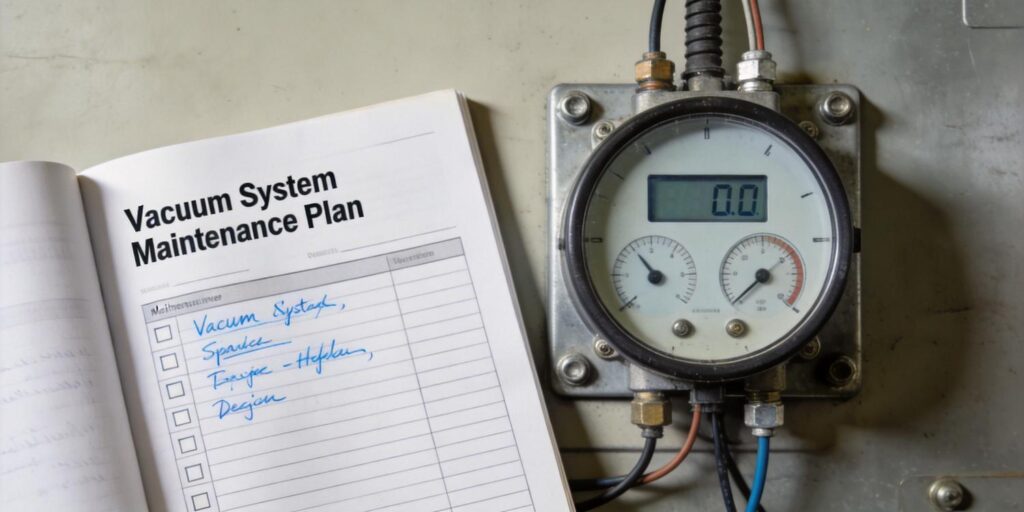
Vacuum gauge installed in industrial environment

How Environmental Conditions Affect Vacuum Gauge Performance

Introduction Environmental conditions play a decisive role in the long-term performance and reliability of vacuum gauges. Temperature fluctuations, stray magnetic fields, electrical noise, and even sensor orientation can introduce measurable errors, drift, or instability that compromise process control in semiconductor, PVD, vacuum furnace, and analytical systems. Understanding these influences allows engineers and procurement teams to […]

How Environmental Conditions Affect Vacuum Gauge Performance Read More »

Vacuum gauge installed in semiconductor cleanroom chamber

Vacuum Measurement in Semiconductor Manufacturing

Introduction Semiconductor manufacturing operates at the extreme edge of vacuum technology. Every wafer fabrication step—from deposition and etching to lithography and metrology—depends on precise control of residual gas pressure. A fluctuation of even 5 % at 5 × 10⁻⁷ Torr can introduce particles, shift etch profiles, or degrade film uniformity, directly impacting device yield and

Vacuum Measurement in Semiconductor Manufacturing Read More »

RS232 cable connected to vacuum transmitter in laboratory

Integrating RS232 Vacuum Transmitters into Data Logging Systems

Introduction Modern vacuum systems generate massive amounts of pressure data that must be captured, logged, and analyzed for process optimization, traceability, and predictive maintenance. RS232 remains one of the most reliable, low-cost, and universally supported interfaces for vacuum transmitters, especially in laboratory and light-industrial environments. The Poseidon Scientific VG-SP205 Pirani Vacuum Transmitter delivers native RS232

Integrating RS232 Vacuum Transmitters into Data Logging Systems Read More »

Digital vacuum readout with engineering calculations

Vacuum Gauge Accuracy vs Repeatability: What Engineers Must Know

Introduction In vacuum system design and process control, engineers often focus on a single number: “gauge accuracy.” Yet the real performance that determines yield, repeatability, and long-term stability is frequently repeatability. Understanding the difference between accuracy and repeatability—and knowing when each matters most—can save thousands in calibration costs, reduce scrap, and prevent process drift in

Vacuum Gauge Accuracy vs Repeatability: What Engineers Must Know Read More »

Vacuum pump with Pirani transmitter monitoring pressure

How Vacuum Gauges Protect Your Vacuum Pumps

Introduction Vacuum pumps are the heart of any vacuum system, yet they are surprisingly vulnerable to damage from improper pressure conditions. Overpressure during roughing, sudden gas bursts, or running a turbo-molecular pump against atmosphere can cause overheating, bearing wear, or catastrophic failure—leading to expensive repairs, unplanned downtime, and lost production. Modern vacuum gauges eliminate these

How Vacuum Gauges Protect Your Vacuum Pumps Read More »

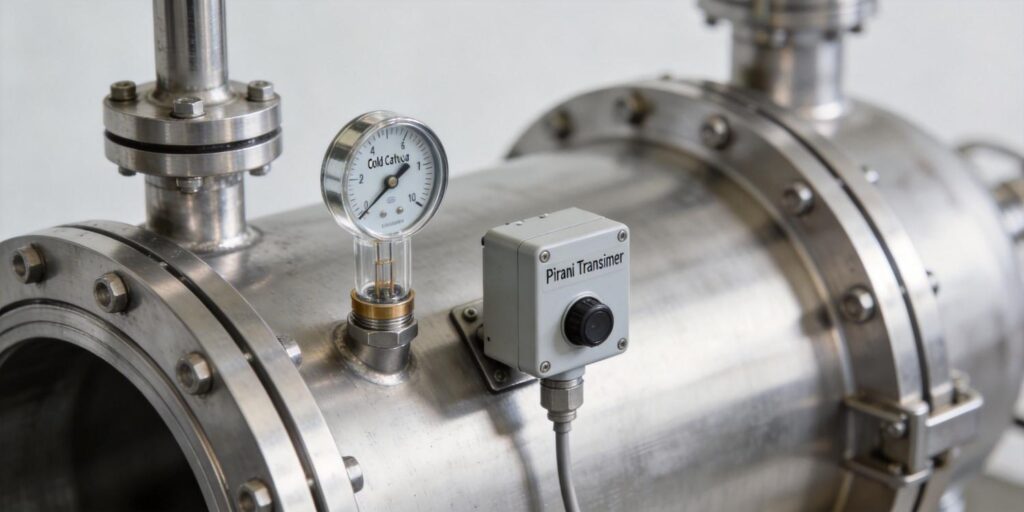
Cold cathode vacuum gauge installed on high vacuum chamber

High Vacuum Measurement Explained: From 10-3 to 10-7 Torr

Defining the High Vacuum Region High vacuum is the pressure regime where gas behavior transitions fully into molecular flow and surface effects dominate. In practical industrial and laboratory terms, high vacuum spans from 10−3 Torr (≈0.133 Pa) down to 10−7 Torr (and below). At these pressures the mean free path of molecules exceeds the dimensions

High Vacuum Measurement Explained: From 10-3 to 10-7 Torr Read More »

Engineer reviewing vacuum system design before selecting gauge

How to Request the Right Vacuum Gauge for Your Application

Introduction Selecting the right vacuum gauge for your specific application is one of the highest-ROI decisions you can make in vacuum system design. The correct instrument delivers stable, repeatable pressure data that improves yield, reduces scrap, shortens pump-down times, and minimizes maintenance. The wrong choice leads to range gaps, signal noise, calibration drift, or safety

How to Request the Right Vacuum Gauge for Your Application Read More »

Vacuum gauge with graphical logarithmic scale overlay

Understanding Logarithmic Output in High Vacuum Measurement

Introduction High-vacuum measurement spans many orders of magnitude—from 10−7 Torr in ultra-clean chambers to 10−3 Torr during process gas introduction. A linear voltage output would compress most of the useful range into a few millivolts at the low-pressure end, making precise control impossible. The Poseidon Scientific VG-SM225 Cold Cathode Vacuum Gauge therefore uses a logarithmic

Understanding Logarithmic Output in High Vacuum Measurement Read More »

Vacuum gauge installed on PVD coating chamber

Selecting Vacuum Gauges for PVD and Coating Equipment

Introduction Physical vapor deposition (PVD) and thin-film coating systems demand precise pressure control across a wide range—from atmosphere during venting and load-lock cycling to high vacuum during sputtering or evaporation. A gauge that cannot deliver stable, repeatable readings in both regimes will cause thickness variations, poor adhesion, or arcing that scrapes entire batches. Engineers and

Selecting Vacuum Gauges for PVD and Coating Equipment Read More »

Electrical wiring of vacuum gauge inside control cabinet

Vacuum Gauge Signal Noise: Causes and Solutions

Introduction Signal noise in vacuum gauge outputs can turn accurate pressure data into unreliable process variables. In automated systems, even 50 mV of ripple on a 0–10 V analog line or corrupted packets on an RS232 link can appear as pressure spikes of several decades, triggering false interlocks, extending pump-down times, or causing batch scrap.

Vacuum Gauge Signal Noise: Causes and Solutions Read More »

Shopping Cart
Poseidon Scientific
Privacy Overview

This website uses cookies so that we can provide you with the best user experience possible. Cookie information is stored in your browser and performs functions such as recognising you when you return to our website and helping our team to understand which sections of the website you find most interesting and useful.