Hormone Residue Monitoring in Dairy Production
Veterinary hormone monitoring in dairy production represents a critical food safety challenge that demands sophisticated analytical approaches. The detection of steroid hormones, corticosteroids, and other veterinary drug residues in milk requires methodologies that can achieve detection limits in the parts-per-billion (ppb) or even parts-per-trillion (ppt) range to comply with international food safety regulations. As noted in veterinary analytical literature, “The requirement for analytical results that can be defended under both scientific and legal scrutiny demands the use of a technique that provides unequivocal results” (Wynne, 2000).
Modern dairy operations utilize various veterinary treatments including corticosteroids for inflammation, anabolic steroids for growth promotion, and other therapeutic agents. The European Union, United States FDA, and other regulatory bodies have established maximum residue limits (MRLs) for these compounds, necessitating robust analytical methods that can reliably detect violations. The complexity of milk as a matrix presents unique challenges that must be addressed through optimized sample preparation techniques.
Matrix Challenges: Fats, Proteins, and Phospholipids
Milk represents one of the most challenging biological matrices for analytical chemists due to its complex composition. The primary interferences include:
Lipid Components
Milk contains approximately 3-4% fat, primarily triglycerides, phospholipids, and cholesterol. These lipophilic compounds can co-extract with steroid hormones, leading to matrix effects in LC-MS/MS analysis and potential ion suppression. As research indicates, “The extraction of bases from plasma samples is subject to far greater interference from co-extracting fatty acids and neutral compounds” (Wynne, 2000), a challenge that extends to milk analysis.
Protein Content
Casein and whey proteins (approximately 3.5% total) can bind to analytes, reducing extraction efficiency. These proteins must be effectively precipitated or denatured to release bound hormones while avoiding analyte degradation.
Phospholipids
Milk phospholipids, particularly phosphatidylcholine and sphingomyelin, present significant challenges in mass spectrometry analysis due to their tendency to cause ion suppression and contaminate LC systems.
Carbohydrates and Minerals
Lactose (approximately 4.8%) and various minerals can interfere with extraction efficiency and chromatographic separation if not properly addressed during sample preparation.
SPE Sorbents Suitable for Steroid Hormones
Selecting appropriate solid-phase extraction sorbents is crucial for successful hormone residue analysis in milk. Different sorbent chemistries offer specific advantages for steroid hormone extraction:
Reversed-Phase Sorbents (C18, C8)
Traditional reversed-phase sorbents provide excellent retention for moderately polar to non-polar steroid hormones. Research demonstrates that “Most methods for the separation of anabolic steroids therefore employ a C18 phase SPE cartridge for desalting and crude extraction” (Wynne, 2000). These sorbents effectively retain compounds like testosterone, progesterone, and estradiol while allowing removal of polar interferences.
Mixed-Mode Sorbents (MCX, MAX, WCX)
Mixed-mode sorbents combining reversed-phase and ion-exchange mechanisms offer superior selectivity for steroid hormones with ionizable functional groups. The Poseidon Scientific MCX cartridges (mixed-mode cation exchange) and MAX cartridges (mixed-mode anion exchange) provide enhanced cleanup by retaining both hydrophobic and ionic interferences.
Hydrophilic-Lipophilic Balance (HLB) Sorbents
HLB sorbents, such as those in Poseidon Scientific’s HLB cartridges, offer balanced retention for a wide range of steroid hormones regardless of their ionization state. These sorbents maintain retention even under 100% aqueous conditions, making them ideal for milk samples.
Specialized Sorbents for Specific Applications
For corticosteroids with specific functional groups, specialized sorbents may be employed. Research indicates that “An alternative SPE method using a silica cartridge allows the more selective retention of the corticosteroids, which are eluted by varying the ratio of dichloromethane (a wash solvent) and ethyl acetate” (Wynne, 2000).
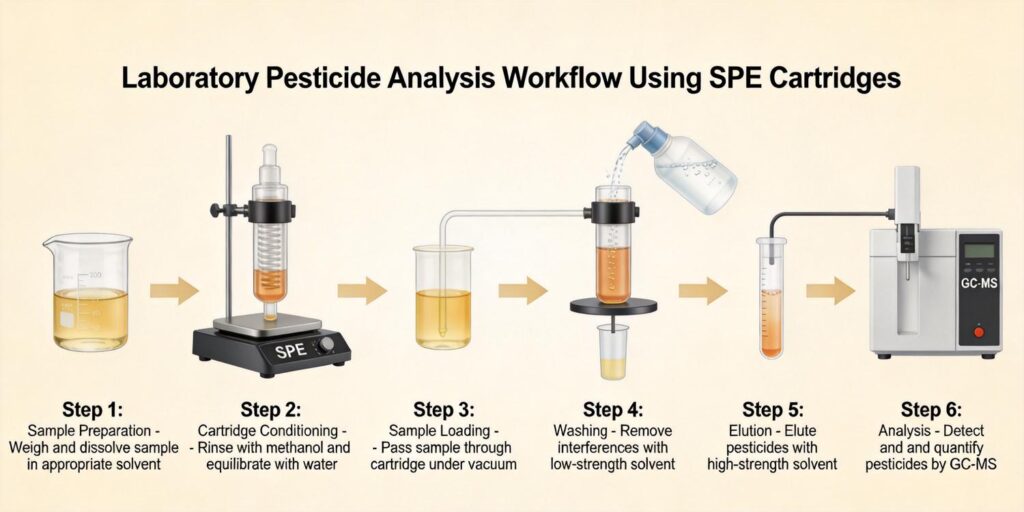
Combined Protein Precipitation + SPE Cleanup Workflow
A comprehensive sample preparation workflow for veterinary hormone analysis in milk typically involves sequential cleanup steps:
Step 1: Protein Precipitation
Initial protein removal is achieved using organic solvents (acetonitrile, methanol) or acidification. Acetonitrile precipitation (1:2 sample:solvent ratio) effectively denatures milk proteins while maintaining hormone stability. Centrifugation at 4,000-10,000 × g for 10-15 minutes separates the protein pellet from the supernatant containing hormones.
Step 2: Lipid Removal
Following protein precipitation, additional lipid removal may be necessary. Options include:
- Freezing at -20°C followed by filtration to remove solidified lipids
- Hexane or other non-polar solvent extraction
- Dispersive solid-phase extraction with primary secondary amine (PSA) or C18 sorbents
Step 3: Solid-Phase Extraction
The optimized SPE protocol for milk hormone analysis includes:
- Conditioning: 3-5 mL methanol followed by 3-5 mL water or buffer
- Loading: Acidified or basified sample supernatant (pH optimized for target hormones)
- Washing: 3-5 mL water followed by 3-5 mL 5-10% methanol in water
- Drying: Vacuum or positive pressure drying for 5-10 minutes
- Elution: 3-6 mL appropriate solvent (methanol, acetonitrile, ethyl acetate with modifiers)
Step 4: Concentration and Reconstitution
Eluates are evaporated under nitrogen at 40-50°C and reconstituted in mobile phase compatible with LC-MS/MS analysis.
LC-MS/MS Detection Limits Before and After SPE
The impact of SPE cleanup on analytical sensitivity is dramatic, particularly for complex matrices like milk:
Without SPE Cleanup
Direct injection of milk extracts typically results in:
- Detection limits: 5-50 ng/mL (ppb) for most steroid hormones
- Severe matrix effects (ion suppression >80%)
- Rapid column and source contamination
- Poor chromatographic peak shape and resolution
With Optimized SPE Cleanup
Proper SPE implementation achieves:
- Detection limits: 0.1-1 ng/mL (ppb) for most steroid hormones
- Sub-ng/mL (ppt) detection for some compounds
- Matrix effects reduced to <20%
- Improved signal-to-noise ratios (5-10× enhancement)
- Extended column and instrument lifetime
Research supports these improvements, noting that “SPE methodology does, however, offer distinct advantages in analyte recovery over more traditional methods” (Wynne, 2000). The use of mixed-mode sorbents particularly enhances sensitivity by removing both hydrophobic and ionic interferences that contribute to matrix effects.
Validation Considerations for Food Safety Labs
Method validation for veterinary hormone analysis in milk must address specific regulatory requirements and practical considerations:
Selectivity and Specificity
Validation must demonstrate that the method can distinguish target hormones from endogenous compounds and potential interferences. This includes testing against structurally similar compounds and matrix components. As noted in analytical literature, “Many dietary components or their metabolites are structurally similar to target analytes” (Wynne, 2000), making selectivity validation particularly important.
Accuracy and Precision
Recovery studies should span the analytical range with appropriate quality controls. Precision (repeatability and intermediate precision) should meet regulatory guidelines (typically <15% RSD for precision, 80-120% for accuracy).
Linearity and Range
Calibration curves should demonstrate linearity across the analytical range (typically 0.1-50 ng/mL) with correlation coefficients (r²) >0.99. The working range should cover the MRL and required reporting limits.
Limit of Detection (LOD) and Quantification (LOQ)
LOD and LOQ should be established using signal-to-noise ratios (typically 3:1 for LOD, 10:1 for LOQ) and verified through analysis of fortified samples. LOQ should be at or below the regulatory MRL.
Matrix Effects
Comprehensive matrix effect evaluation using post-extraction addition and post-column infusion experiments is essential. Compensation strategies may include:
- Matrix-matched calibration
- Stable isotope-labeled internal standards
- Standard addition methods
Robustness and Ruggedness
Testing method performance under varying conditions (different analysts, instruments, days, SPE lot numbers) ensures reliability. The Poseidon Scientific 96-well SPE plates offer excellent reproducibility for high-throughput applications.
Stability Studies
Evaluating analyte stability during sample storage, preparation, and analysis is crucial. This includes freeze-thaw stability, short-term and long-term storage stability, and processed sample stability.
Quality Control Procedures
Implementation of appropriate QC measures including:
- Method blanks and solvent blanks
- Fortified quality control samples at low, medium, and high concentrations
- Continuing calibration verification
- Proficiency testing participation
The integration of optimized SPE methodologies with sensitive LC-MS/MS detection represents the current gold standard for veterinary hormone analysis in milk. By addressing matrix challenges through strategic sorbent selection and comprehensive validation, food safety laboratories can achieve the sensitivity, specificity, and reliability required for regulatory compliance and consumer protection.